Table of Contents


At Haverford, heated topics shouldn’t chill speech
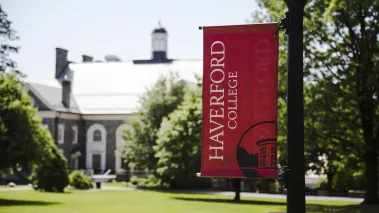
(AP Photo/Matt Rourke)
Haverford College in Haverford, Pennsylvania, on May 22, 2019.
In just one week, Haverford College faced two very different challenges involving free expression. The first involved religion professor Guangtian Ha, who was arrested on allegations of cyberstalking and threatening a Jewish colleague. If substantiated, the allegations against Ha could involve expression that falls outside constitutional protection. The First Amendment protects a great deal of expression that is offensive, hateful, or deeply upsetting. But it doesn’t cover everything. True threats, for example, fall outside its protection, as do certain other types of expression such as incitement or defamation.
The second involved a student-organized “Art Campaign in Solidarity with Palestine,” scheduled for Oct. 7, the anniversary of the 2023 Hamas-led attack on Israel. Citing safety concerns, President Wendy Raymond canceled the event. This drew criticism from the Council on American-Islamic Relations, a civil rights nonprofit, and prompted FIRE to reach out to school officials and raise concerns with Haverford about the cancellation. While colleges have a duty to ensure campus safety, that responsibility must not be used by administrators as a blank check to cancel controversial events. Rather, objective evidence should lead administrators’ assessment of whether there is a credible, specific threat of violence or a serious disruption. And before taking such drastic measures, other more reasonable routes — such as separating protesters and attendees — should be considered.
The good, the bad, and the vague in the new college accreditation rule
The Education Department’s final accreditation rule boosts campus speech protections in some places and invites trouble in others.
Why is this so important? Canceling an event without first taking those mitigating steps risks creating a heckler’s veto, where those opposed to a speaker’s event effectively gain the power to silence it — and those willing to engage in violent opposition gain the most power. Colleges must resist creating that incentive. Otherwise, students may lose the chance to take part in the open, varied discussions college communities should foster.
Ultimately, the Haverford YDSA art campaign event was rescheduled for Oct. 21, giving students another opportunity to engage with the art. While that outcome is welcome, students had every right to object to an event held on Oct. 7, criticize its organizers, or make their own case for why it should not take place that day. The organizers, in turn, had a right to express their views on the day of their choice. Nobody is required to attend every event, endorse every message, or pretend not to be offended. But neither should students expect administrators to curate campus life until nothing uncomfortable remains.
Administrators need not figure out how to balance campus safety and expressive freedom from scratch. Courts have spent decades distinguishing threats and other unprotected expression from speech that is merely offensive or upsetting. Without respect for those distinctions, drawing the line between an actual threat and an unpopular opinion depends on the listener’s reaction rather than the actual meaning of the expression — a recipe for both censorship and injustice.
President Raymond rightly affirmed that the art campaign was protected expression. More importantly, she recognized that events like this can create opportunities for students to find support, encounter different perspectives, and engage with one another rather than retreat into separate physical and ideological spaces. She was right to recognize what was lost when the event did not happen as planned: an opportunity for students to engage across differences, challenge one another’s assumptions, and perhaps even learn something from ideas they oppose.
Haverford College, like any other institution of higher education, cannot run on the assumption that everyone else needs to be managed.
Rescheduling the event is better than nothing, but it’s still not optimal. Haverford must establish clear expectations for how it will handle student expression in the future, especially when controversy or safety issues arise. Students must be able to trust that Haverford will protect free expression even when it becomes controversial.
Haverford’s experience is a reminder that a culture of free speech requires more than policies and formal protections. Private colleges generally are not directly bound by the First Amendment, but institutions (like Haverford) that commit themselves to free inquiry have a responsibility to make those commitments meaningful in practice. And students have a responsibility, too. Students help shape campus culture every time they choose whether to answer an argument, challenge an idea, or ask someone else to make the disagreement disappear.
Haverford College, like any other institution of higher education, cannot run on the assumption that everyone else needs to be managed. It depends on people who can hear an argument, respond, and trust others to do the same. The goal should not be to eliminate conflict from campus life, but rather to become the kind of community that can handle it.
Recent Articles
Get the latest free speech news and analysis from FIRE.

The good, the bad, and the vague in the new college accreditation rule

California’s new chatbot law has a free speech problem
When police treat free speech as suspicious activity