Table of Contents
When does speech become incitement?
Research & Learn
The Supreme Court draws a line between abstract advocacy of lawbreaking and incitement to imminent lawless action.
By David L. Hudson, Jr., associate professor of law at Belmont University (Last updated April 28, 2026)
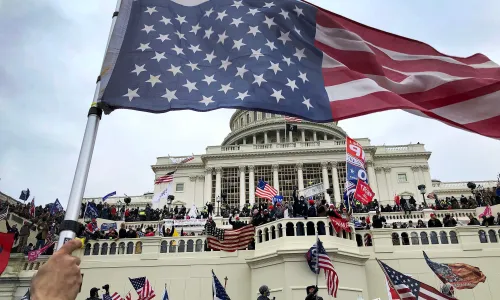
On Jan. 6, 2021, President Donald J. Trump delivered his “Save America” speech at the Ellipse in Washington, D.C., in which he spoke of a “stolen” election and urged his supporters to march on the Capitol. He also stated: “I know that everyone here will soon be marching over to the Capitol building to peacefully and patriotically make your voices heard.”
Shortly after Trump’s speech, an angry mob stormed the Capitol building in what many called an assault on democracy and the peaceful transfer of power. House Democrats led the charge on impeaching Trump for inciting an insurrection. Trump defenders responded that he merely engaged in heated political rhetoric, and special prosecutor Jack Smith ultimately did not charge Trump with incitement.
The debate over Trump’s language raised an important First Amendment issue: When does fiery language and charged political speech cross the line and become unprotected incitement to imminent lawless action?
Early incitement-type cases
At the start of the twentieth century, the Supreme Court of the United States failed to provide First Amendment protection for dissident political speech that challenged or criticized the established order. Congress passed the Espionage Act of 1917 and its amendment, the Sedition Act of 1918, in an effort to silence wartime dissenters. The Court upheld the convictions of defendants who did little more than disseminate pamphlets or newspapers opposed to the government’s stance and urging war-related industrial disruption.
Yet Justices Oliver Wendell Holmes and Louis Brandeis recognized the government should not be able to punish critical speech unless it presented a “clear and present danger” to security and order.
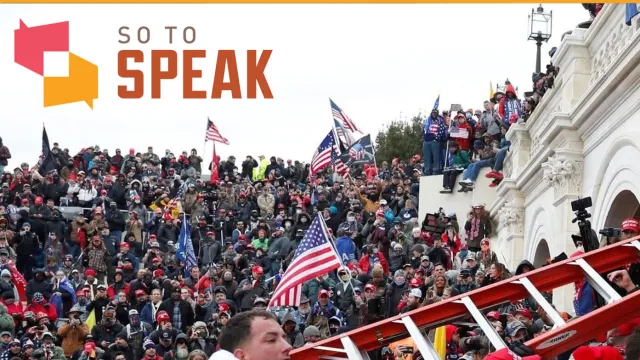
So to Speak podcast: ‘Incitement’ with David L. Hudson Jr.
In the wake of former President Donald Trump’s impeachment trial over his alleged "incitement" of the Jan. 6 violence at the U.S. Capitol, this obscure legal doctrine has captured headlines.
Justice Holmes wrote in his classic dissent in Abrams v. United States (1919) that it is “only the present danger of immediate evil or an intent to bring it about that warrants” punishing speech. Jacob Abrams and several other Russian immigrants had disseminated leaflets critical of the U.S. government’s militaristic policies and its position on Russia. The leaflets urged a general strike of workers at munition factories. The majority in Abrams wrote that the “language of these circulars was obviously intended to provoke and to encourage resistance to the United States in war.”
Justice Brandeis later authored a concurring opinion in Whitney v. California (1927), in which the Court affirmed Charlotte Anita Whitney’s criminal syndicalism conviction for little more than organizing activities with the Communist Labor Party. Brandeis, unlike the majority, was sensitive to the difference between advocacy and incitement, writing: “the wide difference between advocacy and incitement, between preparation and attempt, between assembling and conspiracy, must be borne in mind.”
The Brandenburg test
Holmes and Brandeis pushed the Supreme Court in a more speech-protective direction, but it wasn’t until Brandenburg v. Ohio (1969) that the Court crystallized its approach into the modern incitement test. KKK leader Clarence Brandenburg gave a speech at a rally that featured about a dozen Klansmen — some of whom carried guns — standing around a burning wooden cross. Brandenburg made disparaging remarks about blacks and Jews, including antisemitic and racist slurs, and stated: “if our President, our Congress, our Supreme Court, continues to suppress the white, Caucasian race, it is possible that there might have to be some revengeance taken.”
County officials charged Brandenburg under Ohio’s criminal syndicalism law, a 1920s relic, like California’s law prosecutors used to convict Whitney. But the Court unanimously reversed Brandenburg’s conviction, holding:
[T]he constitutional guarantees of free speech and free press do not permit a State to forbid or proscribe advocacy of the use of force or of law violation except where such advocacy is directed to inciting or producing imminent lawless action and is likely to incite or produce such action.
The Court emphasized that the Ohio law punished “mere advocacy” rather than actual incitement to lawless conduct. It further held the “contrary teachings of Whitney v. California cannot be supported and that decision is therefore overruled.”
In Hess v. Indiana (1973), the Court clarified that advocacy of illegal conduct at some indefinite or vague time in the future likewise does not constitute unlawful incitement. Reversing the conviction of Gregory Hess — an anti-war demonstrator who yelled, “We’ll take the fucking street later” as police dispersed a crowd of demonstrators — the Court explained that his statement was neither directed to any particular person or group nor likely to produce imminent lawless action.
Every idea is an incitement. It offers itself for belief and if believed is acted on unless some other belief outweighs it or some failure of energy stifles the movement at its birth.
The Court reached a similar result in NAACP v. Claiborne Hardware (1982), a case involving heated political rhetoric by civil rights activist Charles Evers. He was upset some African-Americans were not actively participating in an economic boycott of white businesses that engaged in discrimination, so in lengthy addresses he made impassioned pleas for black citizens to unify, to support and respect each other, and to realize the political and economic power available to them. The Court held his “emotionally charged rhetoric . . . did not transcend the bounds of protected speech set forth in Brandenburg,” noting the speech fell far outside Brandenburg’s imminence standard.
Limitations of the Brandenburg test
Incitement to imminent lawless action in many ways represents culmination of the early Holmes-Brandeis opinions that first provided greater protection for dissident political speech. The Brandenburg test is highly speech-protective, to overwhelmingly positive effect. However, perhaps for this very reason, courts sometimes avoid Brandenburg and analyze cases under other lines of First Amendment analysis, such as true threats or speech integral to criminal activity.
Take the example of Rice v. Paladin Press Enterprises, Inc. (1997), in which an assassin followed about 30 step-by-step instructions from the book How to Be a Hitman in killing three people. The victims’ families sued Paladin Press, the book’s publisher. A federal district court held the book was protected speech, because it did not meet the Brandenburg standard.
However, the U.S. Court of Appeals for the Fourth Circuit didn’t apply Brandenburg. Instead, it asked whether the book aided and abetted violent crime, as speech integral to criminal conduct (e.g., speech that perpetuates fraud), a separate category not protected by the First Amendment.
The Ninth Circuit similarly bypassed Brandenburg in Planned Parenthood v. American Coalition of Life Activists (2002) when it analyzed “the Nuremberg Files” website — which listed abortion providers’ names and addresses and crossed out their names as they were killed — under the true threats doctrine, yet another unprotected speech category, holding that “advocating violence is protected, threatening a person with violence is not.”
Under the incitement exception, only speech that is directed to and likely to immediately lead to unlawful action can be proscribed.
Incitement thus remains a narrow category of unprotected speech in First Amendment jurisprudence. In certain circumstances, when there is the requisite degree of intent and imminence, speech could fall within its ambit. But, the vast array of speech — even speech that advocates illegal conduct — does not come close to meeting the strict Brandenburg standard.
Consider again President Trump’s speech on Jan. 6, 2021. Some contend his speech led directly to the riotous actions at the Capitol. However, a reading of the entire transcript, including language about marchers being peaceful, could present difficulties in ultimately proving the speech met the Brandenburg standard.
After all, as Justice Holmes famously wrote in his dissent in Gitlow v. New York (1925): “Every idea is an incitement. It offers itself for belief and if believed is acted on unless some other belief outweighs it or some failure of energy stifles the movement at its birth.”
But, as Holmes continued, to realize free speech in a democracy, ideas must “be given their chance and have their way.”
So, whether one finds speech reprehensible — or particularly insightful — the First Amendment ensures that we, as citizens in a democracy, can hear it and judge it for ourselves, rather than allowing the government to punish the speech and make that judgment for us. Under the incitement exception, only speech that is directed to and likely to immediately lead to unlawful action can be proscribed.
Keep Reading

Fighting words overview
Issue Pages
Rhetorical hyperbole: A powerful defense in defamation and true threat cases
Issue Pages
Time, place, and manner limits on speech
Issue Pages