Table of Contents
Victory! UNC Chapel Hill backs away from comedy probe, reaffirms commitment to free speech
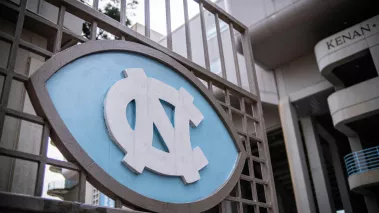
University of College / Shutterstock.com
After first signaling that satire might trigger administrative scrutiny in the wake of an April Fools’ controversy, the University of North Carolina at Chapel Hill has now clarified its position, retracted its public statement suggesting an investigation, and reaffirmed its commitment to free speech. That’s good news for UNC students, for its campus culture, and for anyone who wants colleges to handle controversy without punishing protected expression.
The episode began on April 1, when The Daily Tar Heel ran several satirical headlines such as “The Daily Woke Heel,” “Trump orders ALE in Chapel Hill to be replaced with ICE agents,” and “UNC brings back DEI — for whites.” On April 6, the student-run show Hill After Hours released a sketch satirizing an out-of-touch white student who goes slumming . . . by interacting with her fellow black and Latino students right on campus. Some students labeled the sketch racist, even though it satirized the protagonist, and both the paper and the show sparked outrage on campus and on social media. Soon, there was an open dialogue taking place, rife with strong opinions, about how the Chapel Hill community should respond to offensive satire.
But the campus conversation soon gave way to something more troubling. Later on April 6, UNC Chapel Hill issued a statement condemning both groups’ content and announcing an investigation into the comedy sketch. FIRE quickly wrote to UNC Chapel Hill, urging the university to retract its statement. In its response, UNC Chapel Hill told FIRE that no group was under investigation and that it did not intend to chill freedom of expression. FIRE then asked the school to ensure students knew that, by publicly retracting its statement and clarifying that no student or group is being investigated for satire.
And that’s what UNC Chapel Hill did. On April 16, the university updated its original statement with this language:
Carolina is committed to upholding the First Amendment rights of our students and student groups to engage in free expression. This is true even when we believe those instances of expression may be offensive to members of our campus community . . .
For the record, the University is not investigating any student or student group for the articles that appeared in the April 1, 2026 edition of The Daily Tar Heel or for the recent Hill After Hours video. Our April 6, 2026 statement was issued out of concern for members of our community, many of whom were clearly distressed. That statement was in no way intended to chill free speech on our campus, and we retract those portions of our message that may have suggested our students and student groups were engaged in unlawful conduct or conduct that could subject them to discipline.
The university even linked students to its free speech resource. FIRE gives credit where credit is due. And it’s definitely due to UNC Chapel Hill, which made a mistake and then, unlike most institutions, quickly corrected it once it was pointed out. Free speech doesn’t only apply to sanitized expressions. When speech is particularly biting, as satire often can be, those who engage in it can often face a fiery backlash — even if the point of the satire is completely missed. And while critics are free to answer that speech with their own thoughts, the state has no place taking any action designed to chill expression on a university campus.
So what should other schools do when such firestorms inevitably break out? They should take a deep breath and keep in mind their obligation to uphold the First Amendment rights of their students. Yes, even if some people don’t like it. And if they make the wrong call, they can fix it as soon as possible and learn from the experience. There’s no shame in that, or shouldn’t be, particularly at an educational institution. Here’s hoping that more schools follow UNC Chapel Hill’s example.
Recent Articles
Get the latest free speech news and analysis from FIRE.

Why you should talk to strangers w/ Fin Colleton and Kratima Divakar
Podcast
After a congressman challenged a student reporter’s right to record, here’s what journalists should know
Restoring Title IX kangaroo courts is no solution to the ‘Cornell 7’ sexual assault controversy