Table of Contents
New FIRE study finds narrowing range of political views among faculty donors

- A new analysis of faculty who donate to political candidates finds that the average donor is only slightly less left on the political spectrum than Bernie Sanders.
- The study finds politically active faculty are largely confined to a narrow band of liberal politics, with virtually no conservative counterbalance.
- The new findings align with past FIRE research in which faculty reported that conservatives are much less welcome within their departments.
PHILADELPHIA, May 28, 2026 — A new study commissioned by the Foundation for Individual Rights and Expression indicates that donations from faculty at top universities have become increasingly one-sided, with the range of opinion becoming concentrated on the left.
“Free speech is not just the right to speak, it is the condition that lets universities test ideas through real disagreement,” FIRE Vice President of Research Angela Erickson said. “Our findings suggest politically active faculty are clustered within a narrow ideological band, which raises serious concerns about whether students and scholars are getting the full benefit of the open inquiry universities promise.”
FIRE provided University of Rochester Professor David Primo with a list of more than 100,000 faculty members at 55 universities that was first compiled for use in the 2024 FIRE Faculty Survey Report. Primo then analyzed a dataset created by cross-referencing those names with a database of over 850 million state and federal campaign contributions compiled by a Stanford University professor. Faculty members who could be matched with donations were assigned a “CFscore,” a measure used by researchers to estimate a person’s political ideology based on who they donate to.
“Studying faculty campaign contributors provides a unique window into the views of politically active professors,” Primo said. “These data allow us to systematically measure viewpoint diversity at top universities and lay a foundation for strengthening discourse, teaching, and research on college campuses.”
By relying on contribution data rather than voter registration data, Primo was able to measure professors’ ideology instead of just their party affiliation. A Republican professor who gives exclusively to Maine Sen. Susan Collins (CFscore: 0.70) would score differently than a Republican professor giving exclusively to Texas Sen. Ted Cruz (CFscore: 1.52), for example.
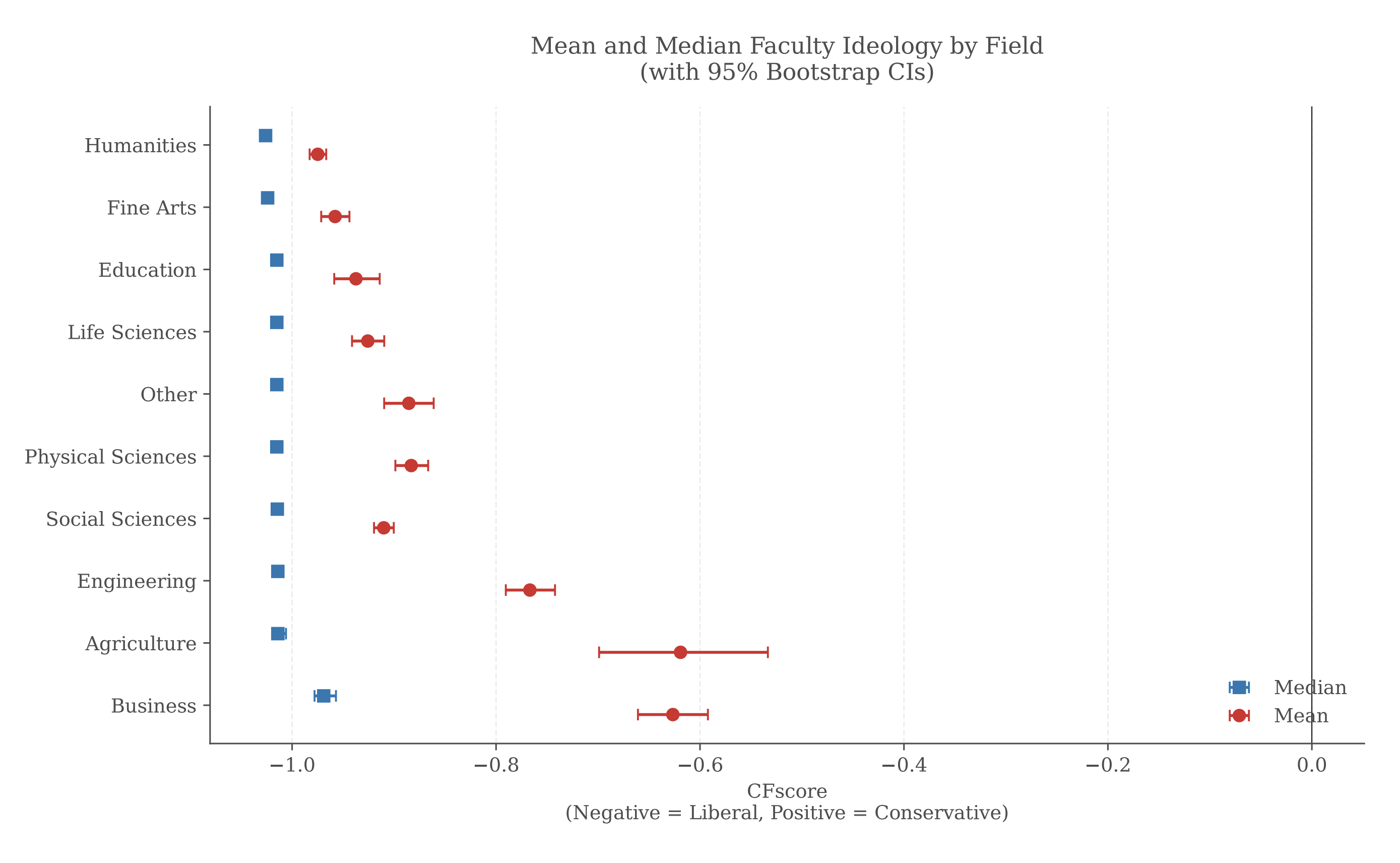
The average ideology score of faculty donors in the 55-school sample was -1.02. That’s only slightly less left-leaning than some of the most left-wing members of the U.S. Senate, such as Vermont Sen. Bernie Sanders and Massachusetts Sen. Elizabeth Warren, who are tied with CFscores of -1.14. Notably, there was no equivalent critical mass of donations on the Republican side.
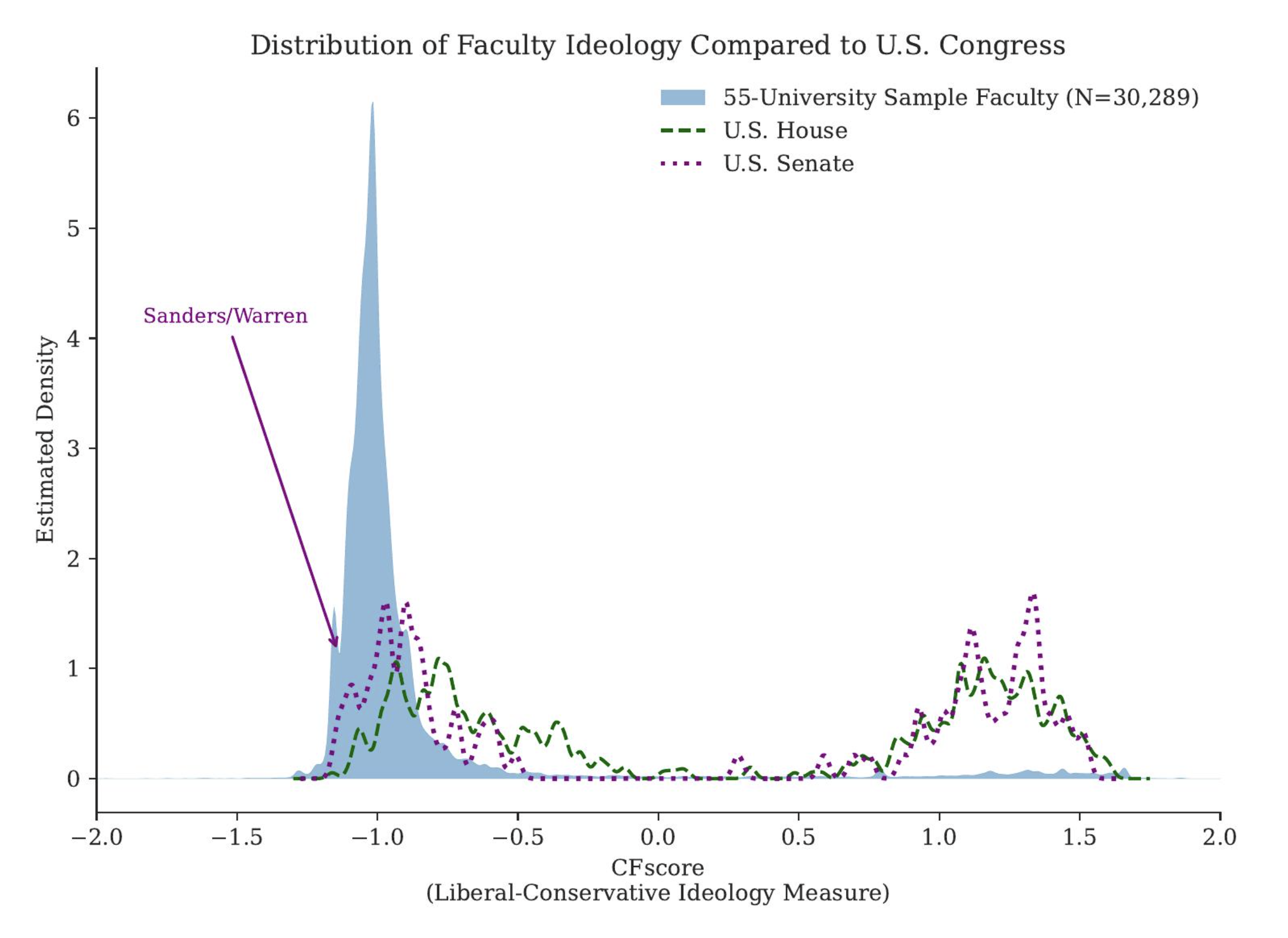
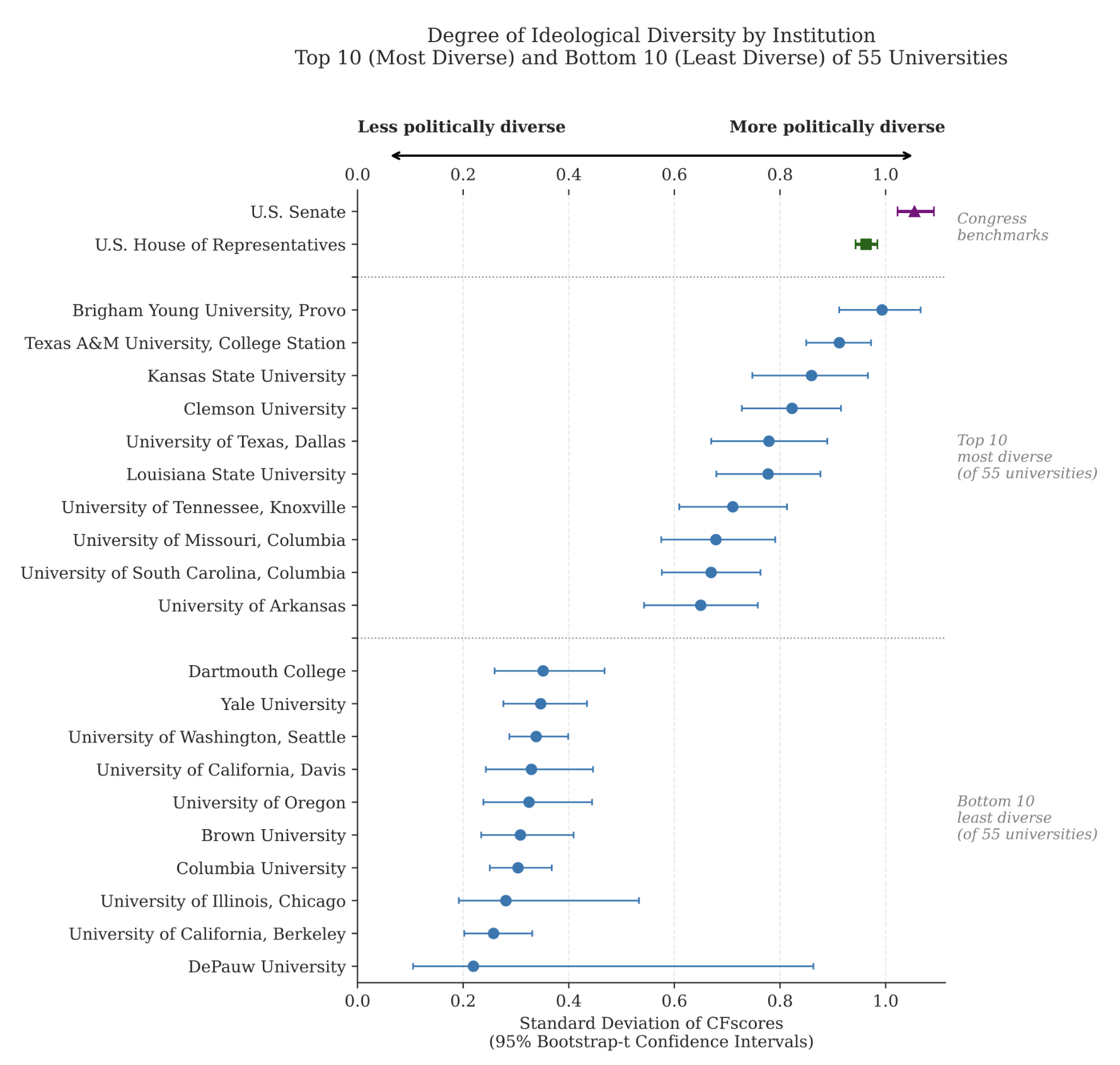
By comparing the standard deviation of the CFscore of donations, it's also possible to approximate which schools and disciplines might have greater intellectual diversity than others. The humanities and fine arts show the least political diversity, while business and agriculture show the highest — but even business and agriculture professors still lean heavily to the left in their donations.
Eight of the ten most politically diverse faculty bodies were at universities located in the U.S. South, a region where conservatives are more plentiful (the other two were Kansas State University and Brigham Young University). Meanwhile, four of the ten least intellectually diverse campuses were located on the West Coast, and four were Ivy League schools in the Northeast.
A high level of ideological conformity within the academy doesn’t necessarily mean dissenting voices are being silenced or frozen out. However, FIRE’s survey research suggests that many faculty experience it that way.
In the most recent FIRE Faculty Survey, only 20% of university faculty reported that they believed a conservative scholar would be a welcome fit within their department, while 71% said the same of a liberal scholar. And of the conservative faculty who do exist, nearly half (47%) reported they feel unable to voice their opinions due to potential backlash, compared with only a fifth of liberal faculty (19%).
Universities interested in taking meaningful action can consult FIRE’s recommendations on how to foster viewpoint diversity in their faculty ranks. Among the basic steps FIRE recommends are enforcing viewpoint-neutral standards, adopting institutional neutrality, and eliminating compelled speech that discourages open disagreement.
“The lack of viewpoint diversity in academia is a crisis, but the cure can’t be worse than the disease,” FIRE Campus Advocacy Chief of Staff Connor Murnane said. “Heavy-handed measures like ideological tests or hiring quotas for conservatives would just replace one form of forced conformity with another. Instead, universities should recommit to creating a culture that makes room for students and faculty to challenge ideas from the left, right, and center.”
The Foundation for Individual Rights and Expression (FIRE) is a nonpartisan, nonprofit organization dedicated to defending and sustaining the individual rights of all Americans to free speech and free thought — the most essential qualities of liberty. FIRE educates Americans about the importance of these inalienable rights, promotes a culture of respect for these rights, and provides the means to preserve them.
CONTACT:
Alex Griswold, Communications Campaign Manager, FIRE: 215-717-3473; media@fire.org
Recent Articles
Get the latest free speech news and analysis from FIRE.
After a congressman challenged a student reporter’s right to record, here’s what journalists should know
Restoring Title IX kangaroo courts is no solution to the ‘Cornell 7’ sexual assault controversy
A UK teen mocked a local politician. Then the police showed up.