Table of Contents
A Marine takes the stage for free speech
Shutterstock
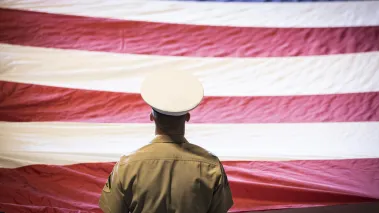
Greyson Hartsell spent four years as a mechanic stationed at Camp Pendleton in California, where he spent his days as a United States Marine doing engine, transmission, and drivetrain work on Humvees, LVSRs, and 7-ton trucks. He was talented, a hard worker, and rose through the ranks to corporal.
Once tasked with keeping equipment ready for the battlefield, he now unexpectedly finds himself on the front lines of a very different kind of battle, fighting for artistic freedom as part of a theater troupe at Cape Fear Community College in Wilmington, North Carolina.
Last month, Greyson and his fellow theater students were performing the ancient Greek play The Bacchae by Euripides. Riffing on how the women in the play became radicalized in their own time, the students included a variety of contemporary protest slogans, including “No Kings,” in the set design.
But mere hours before opening night, Greyson and the troupe found out that the school had suddenly decided that one slogan in particular — “No Kings” — had to go. Officials cited a supposed obligation of “political neutrality” (which wouldn’t apply to a student play even if the school had an institutional neutrality policy, which it doesn't) and claimed “overt references to current political messaging” would distract from the “enduring themes of the work.”
Greyson was in disbelief. The original purpose of the play itself was to use ancient stories as a way to make allegorical references to current political events, namely the Peloponnesian War. Administrators ignored that one of the “enduring themes of the work” was a warning against tyranny — exactly the kind of warning embodied by the slogan “No Kings,” which, as far as Greyson was concerned, wasn’t a partisan phrase.
“As an American,” he told a local radio station, “I feel like the ‘No Kings’ message is more of a . . . rite of passage, since that’s how America was founded, getting away from kings, from the king of England.”

How schools still abuse ‘institutional neutrality’ to silence speech
Universities are invoking “institutional neutrality” to muzzle students and faculty. But the fix is simple: restrain administrators, not speech.
Greyson wrote to his college’s president, Jim Morton, telling him that as a Marine who took an oath to defend the Constitution, he stands by the First Amendment and the right to free expression. “Even,” he added, “when that expression may be uncomfortable.”
Throughout his life, Greyson says theater has been a constant source of community — and he wasn’t about to let that community get bullied out of its voice. As a kid, Greyson moved from Charlotte, the bustling city on the border of North and South Carolina, to much-smaller Wilmington, on the shores of the Atlantic. It was three and a half hours away, but it might as well have been another country. He didn’t know anyone. He played football. He tried baseball. But nothing felt like it really clicked. “I wrestled for one year,” he says, laughing. “That didn’t last long.”
When some friends convinced him to try out for a theater production during his first year of high school, however, he quickly found his community. “I did sports but, I don’t know, acting was just… I was just better at it, I guess.”
Greyson found another community in the Corps. But after the Marine Corps, back in school at Cape Fear Community College, Greyson picked theater back up as well. He was initially reluctant to join the production of The Bacchae. “I am not a fan of Shakespeare and old Greek plays,” he says. “I think they’re kind of hard to follow if not done right.”
He says he was so turned off by the ancient story, in fact, that he decided not to act in the play at all, and to take on a tech role in the crew instead — a first for him. Yet he was stunned when he saw the production performed for the first time. “I saw the first dress rehearsal and I was blown away by how it all came together. I was not expecting that at all. I kind of regret not acting in it now.”
Greyson attributes The Bacchae’s success to the interpretation his peers integrated into the set design, where topical political slogans implied overlap with the themes of the play. “At first, I didn’t understand the art themes for the set that the girls had decided on, but after watching it and seeing it and understanding it, I was able to kind of see it all come together. They did a really good job connecting real-world issues with an old play like this.”
Greyson says The Bacchae intersects naturally with our time in history and the social movements the set design references. His peers agree, telling WHQR the messaging was an attempt to relate the play’s thematic elements to struggles over power, as seen in protest movements past and present. In the original, King Pentheus tries to suppress the ecstatic worship of Dionysus because he sees the god and his followers as threats to his authority. Dionysus responds by driving the women of the city mad. In the end, they rip Pentheus apart — his own mother tears off his head. The whole play is a warning against the blind arrogance of a tyrant. That’s why Greyson doesn’t think “No Kings” is a distraction from its enduring themes.
Besides, the students’ set design falls into a tradition of avant-garde restagings of old, historic plays. Shakespeare’s Macbeth, for example, has been famously reimagined to critical acclaim. One such adaptation transposed the play into the high-pressure environment of a Michelin-starred restaurant, where the “three witches” were memorably recast as three trash collectors.
That creative risk, Greyson says, was what made the production work. The decision to remove the “No Kings” slogan undercut the source of the production’s success, and the spirit of the original play. Plus, Greyson says, there is a principle at stake — this is a fundamental matter of free expression. “I may not necessarily believe and have the same ideology as most of my classmates,” he remarks, “but I’m still going to try to stop someone from walking in and telling them what they can and can’t say or do.”
Administrators’ demands initially did not stop at one phrase, Greyson says. School officials also expressed concern about slogans like “We the People” and “Silence = Violence.” But when students took to defending their design, a bargain emerged from administrators: If “No Kings” disappeared, the rest might be allowed to stay. With opening night at hand, they had little choice, and painted over the slogan.
It’s now late May, and the production has long since finished its run. Greyson doesn’t expect school administrators to reverse course ex post facto or suddenly discover their spines.
Greyson was unimpressed by the college’s explanation that this was all in the service of neutrality. To him, official “neutrality” stopped looking neutral the moment administrators ordered students to alter their expression.
“If it was really about the institution being neutral,” he said, “then they shouldn’t have said anything to stop us. They could obviously ask us and maybe suggest it slightly, but to tell us — that’s a different story. That’s them taking a side.”
“If I had been in the room,” he added, “I would have just told them to go kick rocks.”
Instead, he wrote the college president an email. Though the president never responded, another administrator did, brushing off Greyson’s concerns with vague references to political neutrality and maximizing interpretive space. Greyson says the exchange reminded him, in a small way, of the hierarchy he had known in the Marine Corps. He never pretends to have been a major or a colonel. He was a corporal, E-4, the first rank of a noncommissioned officer. “You get ignored a lot by higher-ups,” he says. “So this is kind of a drop in the bucket.”
Still, the principle mattered. Greyson did not see the students’ work as some reckless political stunt. He saw it as young artists trying to make an old text speak in the present. And he has little patience for the idea that protest only becomes respectable once history has distanced its impact. “If this was 1773,” he says, “they would say the Tea Party would have been a radical thing to do.”

A new FIRE documentary about U.S. Cavalry veteran Christian DeJohn and his fight for free speech at Temple University
When Christian DeJohn returned from deployment, Temple professors and administrators didn’t like his pro-military opinions and began a petty vendetta against him.
After the first article about the controversy circulated, Greyson’s former classmates and even his high school theater teacher reached out to say they were proud of him for standing up against art censorship. He also remembers hearing about one especially tough local theater critic — the kind of person whose praise does not come easily — calling The Bacchae one of the best productions Cape Fear Community College had put on in years.
In her Facebook post, Mirla Criste Thompson, the local critic who herself is a theater professor, wrote that she remained “as impressed as ever by the quality of Jack Landry’s student actors,” praising their “discipline, boldness of choice, vocal clarity, utter commitment and utter fearlessness.” She singled out the Greek chorus as “particularly engaging,” writing that its members moved and chanted “as a single whirlwind of body and voice.”
It’s now late May, and the production has long since finished its run. Greyson doesn’t expect school administrators to reverse course ex post facto or suddenly discover their spines. But he does hope his peers will take something from the episode. Not cynicism, but a clearer sense of their own agency. “I don’t expect them to really do anything differently,” he says of the administration. “I think they’re just going to remain the cowards they are. But I hope that the students take a slight lesson from this and start challenging people’s authority more often.”
The curtain may be drawn, but Euripides’ words still echo: “Do not mistake the rule of force for true power. Men are not shaped by force.”
Recent Articles
Get the latest free speech news and analysis from FIRE.

After a congressman challenged a student reporter’s right to record, here’s what journalists should know
Restoring Title IX kangaroo courts is no solution to the ‘Cornell 7’ sexual assault controversy
A UK teen mocked a local politician. Then the police showed up.