Table of Contents
FIRE backs JAWBONE Act to end backdoor censorship
Shutterstock
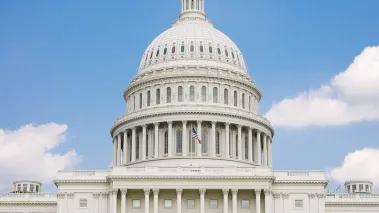
U.S. Capitol Building in Washington, D.C.
Whether leaning on social media platforms or threatening broadcasters, federal officials of both parties have made jawboning — using government power, or the threat of it, to indirectly censor protected speech — a growing stain on American life.
To fight back, Senators Ted Cruz and Ron Wyden have introduced a landmark bill to rein in jawboning against websites and social media platforms, AI systems, and broadcast airwaves. Supported by FIRE, the Justice Against Weaponized Bureaucratic Overreach to Networked Expression (JAWBONE) Act would mark major progress toward addressing indirect and unconstitutional government censorship of Americans’ speech.
What is jawboning?
Jawboning is when the government uses threats to force private actors into censoring speech the government cannot ban directly. It’s government censorship by coercion, and FIRE has long warned that jawboning is a serious threat to free expression, especially online. (Check out our full explainer on jawboning.)
Consider the recent Supreme Court ruling in NRA V. Vullo, a case involving a New York state insurance regulator opposed to the National Rifle Association who allegedly threatened its insurance company with fines unless they dropped the NRA as a customer. In other words, the NRA claimed the regulator was going after the NRA’s speech indirectly because they couldn’t target it directly. The Court unanimously said if that was the case, it was unconstitutional coercion.
Or consider FCC Chairman Brendan Carr’s threats of regulatory consequences for broadcasters to pressure them to drop Jimmy Kimmel Live! after Kimmel was condemned by President Trump. That’s jawboning, too.
Why do we need legislation?
The Supreme Court has held that coercing private parties to become government censors is a violation of the First Amendment since 1963’s Bantam Books v. Sullivan, so why do we need a new law when this is already unconstitutional? The reason is that a right is only effective if you have some way to enforce it, and people censored through jawboning often lack that ability, usually for one of three reasons.
1. You don’t always know you were jawboned.
Say you’re on Facebook, criticizing the IRS. A federal official sees your post and privately reaches out to Facebook, saying, “Delete this user or we’re going to start launching tax audits of Facebook executives.” Facebook deletes your account and never tells you why. Your First Amendment rights were violated, and you have no idea it even happened.
Even if someone at Facebook tips you off, you may not have enough evidence to file a lawsuit. This is exactly why FIRE drafted model legislation last year to require transparency when government officials talk to social media companies about moderating content. That way, everyone can see if there’s any pressure, threats, or backchannel dealing.
2. It’s hard to sue when the censorship is indirect.
The government doesn’t always directly threaten the speaker they’re trying to censor. Often, they’ll coerce a third party to do that work for them, such as in the targeting of an insurance company to punish the NRA. (And to be sure, these episodes also implicate the expressive rights of the third parties.)
Often, the third party is a social media company. Consider how the Biden administration turned the screws on social media companies to pressure them to take down certain content related to COVID, vaccines, and elections. Now we’re similarly seeing the Trump administration pressuring companies to delete lawful content about immigration.
But when the Biden administration’s jawboning faced a challenge in court, the Supreme Court said in Murthy v. Missouri (2024) that it wasn’t enough for victims to prove social media companies removed their speech after the government pressured the platforms to do so. The users also had to prove that the social media companies took down the content because of the government pressure.
Of course, this is hard to prove without the company’s help. When the Supreme Court was deciding Murthy, Google and Facebook had not spoken up about the Biden administration’s jawboning. Only after the political winds shifted did the companies put out statements acknowledging they’d been “pressed” or “pressured” to remove content. Even now, neither company has been willing to say the jawboning was the reason they took any content down.
This all boils down to two important points: First, the government can get away with attempted jawboning when the third party does not act. Even though the threat alone is a violation of the First Amendment, it’s very hard to challenge it unless the third party agrees to censor you. Second, when you do get censored, you’ll have a hard time making your case unless the third party — which has already caved to the government — is now willing to help you challenge the government’s actions by confirming that the government pressure was the only reason for the censorship.
3. You can’t sue for money when the feds violate your constitutional rights.
At the state level, you can sue and seek damages if a government official violates your constitutional rights. This is intended to incentivize government employees to respect Americans’ rights and to provide accountability when they fail to do so.
But you can almost never sue a federal employee for damages when they violate your constitutional rights, and certainly not for violating your First Amendment rights. You can sue to make them stop violating your rights, but you can’t sue to make them pay. And after they’re done violating your rights, making them stop ceases to be a viable remedy, so you get no day in court at all.
The upshot: When the feds violate your rights via jawboning, you often won’t know. If you do know, you’ll face an uphill battle in court. And even if you win, you can’t actually get any compensation, and rarely any accountability.
The JAWBONE Act
The JAWBONE Act is designed to chip away at each of these problems by doing two important things:
1. The bill lets people sue for money if the federal government jawbones their speech.
This is huge. If the JAWBONE Act becomes law, Americans will be able to sue federal officials for violating the First Amendment when they coerce social media companies, AI platforms, or broadcasters to change or take down protected speech. If the federal official did the jawboning “willfully and wantonly,” they’ll have to personally pay the damages. (Otherwise, the government will pay on their behalf.) That means federal employees will be personally incentivized to make sure they’re staying on the right side of the First Amendment when they reach out about speech on social media, AI platforms, TV, or radio.
The bill also provides for liability for when the government makes the illegal threat. This means they won’t escape accountability just because the company won’t help the plaintiff prove the threat was the reason the company suppressed the speech.
2. The bill requires the government to publicly report its communications with social media companies, AI companies, and broadcasters.
While it doesn’t go as far as FIRE’s model legislation, the JAWBONE Act raises the specter of public accountability for jawboning, which should deter officials from doing it. When jawboning does happen, the increased transparency will put more victims on notice that their rights were violated.
The bill also makes it easier for plaintiffs to obtain discovery, requiring the government to share more information about their jawboning. This will help victims prove their case in court.
Putting it all together
Let’s go back to our hypothetical: You’re posting criticisms of the IRS, and a federal official privately reaches out to Facebook and says, “Delete this user.” Facebook then deletes your account and never tells you why. Under the status quo, you never find out you were a victim of jawboning. You never file a lawsuit. The official faces zero consequences for violating your rights.
Under the JAWBONE Act, the government would have to report that communication publicly. Now the official is much more likely to be deterred from jawboning in the first place, because they will get found out. If they proceed anyway, the communication will have to be reported, so you’re going to know it happened. Now you can sue. If the public disclosure didn’t include enough information to prove your case in court, you can get discovery to dig up more evidence.
Since you can show your speech was jawboned, you can win even if Facebook won’t help you prove it. And you can get compensation. The government faces real consequences for violating your rights, and any federal employee who learns about the case thinks twice before doing the same to someone else.
This change would be a huge step forward in reining in First Amendment violations by federal officials, especially as the share of America’s discourse happening on digital platforms continues to grow. Jawboning has proven to be an enduring, bipartisan problem, and we know we cannot rely on platforms alone to protect our rights. The JAWBONE Act empowers Americans to take their rights into their own hands. FIRE applauds Sens. Cruz and Wyden for introducing this legislation, and we urge Congress to pass it.
Recent Articles
Get the latest free speech news and analysis from FIRE.

Venezuela is a cautionary tale w/ Jim Epstein and Germania Rodriguez Poleo
Podcast

FIRE sues Los Angeles City Council over policy banning certain words during public comment

It was never just going to be about keeping kids off social media