Table of Contents
Free speech study finds surprising similarities between 'very liberal' and 'very conservative' Americans
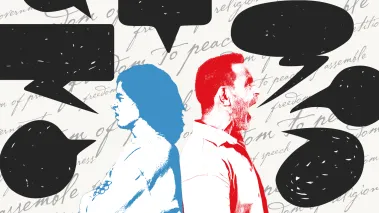
PHILADELPHIA, Aug. 11, 2026 — They may not agree on much, but Americans who identify as “very liberal” or “very conservative” have strikingly similar attitudes toward free speech, according to a new survey by the Foundation for Individual Rights and Expression.
The latest edition of the National Speech Index, a recurring survey that tracks Americans’ views on free speech, finds that the most partisan among us are much more comfortable discussing controversial topics without fear of reprimand than liberals, moderates, or conservatives:
- Fifty-five percent of very liberal and 52% of very conservative respondents said they feel “very comfortable” discussing abortion rights — but only one-quarter of liberal, moderate, and conservative respondents feel the same.
- Forty-six percent of very liberal and 48% of very conservative respondents feel “very comfortable” discussing race in America, against just one-fifth of liberals and one-quarter of moderates and conservatives.
- Forty-two percent of very liberal and 54% of very conservative respondents feel “very comfortable” discussing the war in Iran, versus 22% of liberals, 25% of moderates, and 28% of conservatives.
Regardless of ideology, only 23% of Americans feel very comfortable discussing the Israel-Palestinian conflict, 26% feel very comfortable discussing transgender treatment for minors, and 28% feel very comfortable discussing ICE operations, evidence of the dismal state of free speech in America today.

“Many Americans have come to expect that sharing views some consider controversial will get them fired, kicked off social media, or even hunted down by the government,” said FIRE Manager of Polling and Analytics Nathan Honeycutt. “Ideally, everyone should be comfortable expressing their opinions about key topics of debate, but most Americans don't appear to feel that way.”
The survey also found that Americans are strongly concerned that the government will regulate how they use AI to express themselves: 93% say it’s at least somewhat important for governments to protect their free speech when regulating the use of artificial intelligence to express ideas.
Americans are also concerned about the possibility of governments spying on their use of AI. Nearly four-fifths (79%) are at least somewhat concerned about government pressure on AI developers to weaken or remove safeguards for the purpose of domestic surveillance or autonomous weapon systems. About the same number (76%) are concerned about their use of AI being tracked or incorporated into a government database.

“Americans’ concerns are well founded,” said FIRE Legislative Counsel John Coleman. “Multiple states have already passed laws specifically limiting AI-generated expression about politicians and elections. Any regulation of AI must protect users’ right to read, learn, and create.”
The National Speech Index is a quarterly poll designed by FIRE and conducted by the Dartmouth Polarization Research Lab, to capture Americans’ views on freedom of speech and the First Amendment, and to track how Americans’ views change over time. The July 2026 National Speech Index sampled 1,000 Americans and was conducted from July 7, 2026 through July 20, 2026. The survey’s margin of error is +/- 3%.
The Foundation for Individual Rights and Expression (FIRE) is a nonpartisan, nonprofit organization dedicated to defending and sustaining the individual rights of all Americans to free speech and free thought — the most essential qualities of liberty. FIRE educates Americans about the importance of these inalienable rights, promotes a culture of respect for these rights, and provides the means to preserve them.
The Polarization Research Lab (PRL) is a nonpartisan collaboration between faculty at Dartmouth College, Stanford University and the University of Pennsylvania. Its mission is to monitor and understand the causes and consequences of partisan animosity, support for democratic norm violations, and support for partisan violence in the American Public. With open and transparent data, it provides an objective assessment of the health of American democracy.
CONTACT:
Jack Whitten, Communications Campaign Strategist, FIRE: 215-717-3473; media@thefire.org
Recent Articles
Get the latest free speech news and analysis from FIRE.

VICTORY: New Jersey drops complaint against school board member targeted for asking constituents about taxes

FIRE sues Los Angeles City Council over policy banning certain words during public comment

It was never just going to be about keeping kids off social media