Table of Contents
How Anthony Comstock became America’s most powerful censor
FIRE / Jackson Fleagle
This year, the United States celebrates its 250th anniversary. To commemorate the occasion, FIRE is proud to present the limited series “Figures of Speech,” looking at the heroes and villains of free speech in American history. We began with Joseph McCarthy, the senator who scared America silent. Then we looked at Thomas Paine, American history’s winter soldier. Now we turn to Anthony Comstock, the postal inspector who became the nation's censor-in-chief.
In the spring of 1873, the U.S. postal inspector, a prudish Christian named Anthony Comstock, arrived in Washington carrying a box of dildos. There were also dirty books, naughty pictures, French playing cards, abortion pamphlets, “intermediate tegumentary coverings” (condoms), and enough sexually explicit material to scandalize Congress into trying to legislate the Devil out of Americans.
Comstock called the collection his “Chamber of Horrors” and went around showing it to lawmakers like a traveling freak show. The performance worked. On March 3, President Ulysses S. Grant signed what became known as the Comstock Act, one of the most sweeping censorship laws in American history. The statute banned the mailing of “obscene, lewd, or lascivious” materials, along with contraceptives, abortion-related items, and even information about where such things could be found.
The law didn’t just criminalize objects. It criminalized the circulation of certain ideas. Then Congress did something truly astounding and effectively gave Comstock himself the authority to enforce the law. America had effectively created its censor-in-chief.
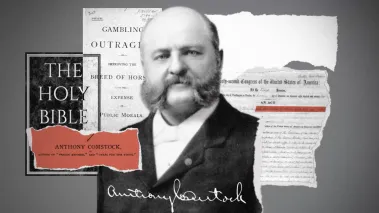
Comstock came of age in a world of New England restraint during one of the most turbulent periods in American history. Born in Connecticut in 1844, he fought for the Union in the Civil War and served without incident, although he complained about his fellow soldiers using profanity.
Comstock’s worldview was intensely religious. Amy Sohn — author of The Man Who Hated Women, a book about Comstock and civil liberties in the Gilded Age — notes that Comstock idolized his mother, a direct descendant of the Puritans who epitomized the “Victorian ideal.” He also masturbated obsessively and was tormented by guilt over it. “Today Satan has sorely tired me,” he wrote in his diary. “Yet by God’s grace did not yeild (sic).” Another entry notes, “This morning were severely tempted by Satan and after some time in my own weakness I failed.”
After the war, many people began insisting the country was cooked. About 700,000 lives had been lost, Lincoln was assassinated, and the economy was in ruins. But at the same time, the rural republic of Comstock’s childhood was becoming an industrial and increasingly urban nation. Railroads stitched together distant regions, and a trip that once took weeks by wagon or canal could suddenly take days by train. This allowed news and ideas to move across the country at unprecedented speed, helping form a truly national American identity. It also allowed cheap newspapers and dime novels to create a new mass media culture that circulated scandal on an unprecedented scale.
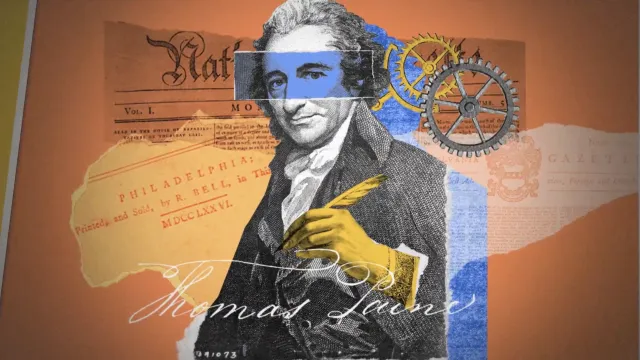
Thomas Paine: American history’s winter soldier
Two hundred fifty years after "Common Sense," Thomas Paine’s life reminds us that free speech and free thought are the lifeblood of a free society.
Americans had worried about the disruptive power of mass-distributed print before. Thomas Paine’s Common Sense helped ignite the Revolution by proving that cheaply printed pamphlets could move ordinary people nationwide. Now it seemed, to Comstock at least, the technology that spread democracy was also spreading sin.
As postwar Americans left farms for factory wages in places like New York, Chicago, and Philadelphia, those cities began to experience overcrowded tenements, labor unrest, and more crime. As fears about crime intensified, so did anxieties about the vices believed to cause them. At the same time, waves of immigrants — especially Irish and Germans — transformed American cities with customs unfamiliar to its Protestant Anglo-American majority. This fueled nativist movements and calls for moral reform. Comstock moved to New York in 1867, where he worked as a stock clerk and with the local Young Men’s Christian Association.
In 1872, Comstock worked to get feminists Victoria Woodhull and Tennessee Claflin arrested after their newspaper, Woodhull & Claflin’s Weekly, published allegations about a preacher having an affair. Woodhull, the daughter of a con man and a literal snake oil salesman, was a spiritualist and the first woman to run for president of the United States. Along with her sister Tennessee, she was also the first woman to open a Wall Street brokerage firm. But the obscenity law Comstock used to get them arrested did not apply to newspapers. The sisters were acquitted and the embarrassment convinced Comstock he needed a broader federal law.
The following year, backed by the YMCA, he founded the New York Society for the Suppression of Vice and traveled to Washington with his “Chamber of Horrors.” He persuaded lawmakers to pass the federal obscenity statute that became known simply as the Comstock Act. The law’s language was intentionally broad enough to criminalize almost anything Comstock deemed immoral. As the journalist Devin Leonard writes:
Within a year, Comstock seized more than twelve tons of offensive literature, and 200,000 salacious items . . . He kept his collection at the American Tract Society Building on Nassau Street in lower Manhattan, where it could do no harm. But even with the money and imprimatur of the YMCA, Comstock didn’t always succeed in putting smut merchants behind bars. It was the era of Boss Tweed, and the city was a lawless place. Pornographers bribed prosecutors to drop the charges against them. Corrupt state judges tossed out cases against booksellers and rubber goods dealers.
For the next four decades, Comstock stalked publishers, raided bookstores, and helped criminalize public discussion of sex in the United States. His censorship campaign devastated lives. He drove targets to prison, financial ruin, and even suicide — something Comstock actually bragged about. One case was Ida Craddock, a sex educator and writer who was prosecuted for distributing marital advice manuals through the mail. She advocated frank discussions of sexuality within marriage and opposed marital rape. After repeated arrests and looming imprisonment, Craddock killed herself in 1902, leaving a suicide note that condemned Comstock and the legal system that empowered him.
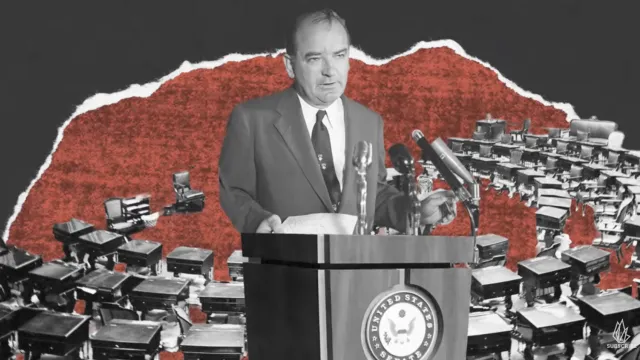
How McCarthy scared America silent
A paranoid senator, a terrified nation, and the birth of modern political censorship. This is the chilling story of how McCarthyism came to haunt America.
“His concept of immorality cast a wide net,” writes Robert Corn-Revere, who adds that Comstock even claimed that “evil reading” was more dangerous than smallpox or yellow fever, and “considered sex to be worse than deadly diseases. Why? Because he saw sex (and the lure of masturbation — and therefore eternal damnation) in everything.” Near the end of his life, Comstock claimed to have convicted enough people “to fill a passenger train of sixty-one coaches” and to have destroyed 160 tons of literature and 4 million pictures.
“Comstock once pursued a man for over a year, in a chase involving seven cities in three countries, because the offender sold Comstock a single condom,” write Greg Lukianoff, Adam Goldstein, and Ryne Weiss in their review of Corn-Revere’s book The Mind of the Censor and the Eye of the Beholder. The book, which begins with the story of Comstock, is a riveting if at times disturbing read. Here’s another detail they pull from its pages:
Comstock was physically attacked at various points in his career: once stabbed in the face by a publisher; attacked by a former prize fighter; and punched repeatedly during a court proceeding by an opposing attorney, with a contemporary newspaper reporting that the commissioner overseeing the hearing imposed no punishment, and in fact “said something under his breath about some things being deserved.
Eventually, Comstock became a joke. A syndicated news report from New York in 1913 would say Comstock “has made himself the laughing stock of the town so many times that his ‘raids’ have ceased to arouse any interest.” In 1915, he stepped down from his role as postal inspector and died three months later at the age of 71. Yet Comstock was more than a Victorian scold with unfortunate facial hair. Though he never held elected office, few people have exerted more influence over the limits of speech in America. If Senator Joseph McCarthy embodied the Cold War panic over political dissent, Comstock represented an earlier American panic over moral contamination.

Over time, the constitutional foundations of Comstock’s censorship regime eroded. In United States v. One Book Called “Ulysses”, federal courts rejected broad obscenity standards used to suppress literature. In Roth v. United States, the Supreme Court narrowed the obscenity doctrine substantially. Later decisions such as Griswold v. Connecticut dismantled laws restricting contraception and recognized constitutional protections for private intimate decisions. Legally and culturally, America moved in directions Comstock would have considered apocalyptic. Yet he never disappeared.
In June 2024, FIRE launched a campaign urging President Joe Biden to posthumously pardon DM Bennett, the freethinking publisher who was imprisoned under the Comstock Act in 1879 for mailing an anti-marriage tract. FIRE filed the petition on behalf of Roderick Bradford, publisher of The Truth Seeker, one of the oldest magazines in America and the paper Bennett founded in 1873. The intention was not only to correct a historical injustice, but to underscore the ongoing dangers posed by Comstock's legacy.
Every era produces its own comstockery. The targets change, but the underlying logic remains familiar. Speech is framed as harm, citizens as vulnerable, and suppression as protection. That’s why the story of Anthony Comstock belongs in any history of American free speech. His is not merely a story of Victorian morality but of the enduring temptation to use state power against ideas deemed socially dangerous.
Recent Articles
Get the latest free speech news and analysis from FIRE.
After a congressman challenged a student reporter’s right to record, here’s what journalists should know
Restoring Title IX kangaroo courts is no solution to the ‘Cornell 7’ sexual assault controversy

A UK teen mocked a local politician. Then the police showed up.