Table of Contents
Professors are inviting dialogue. That’s not the same as free speech.
Shutterstock.com
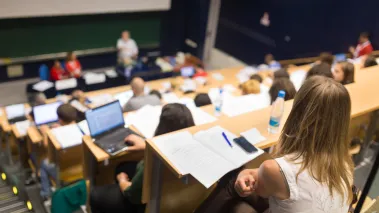
I regularly teach a freshman seminar at Sarah Lawrence College. And every semester, without fail, the same scene plays out. A student lingers after class, or appears at my office door, or sends a carefully worded late-night email, sharing a view they would never dream of voicing to their peers. Sometimes it’s a defense of Israel, or abortion rights, or gun control, or simply to confide that they are not extremely liberal. Sometimes it’s skepticism about a campus orthodoxy everyone seems to take for granted. Sometimes it’s something as basic as having a different opinion about an assigned text. They tell me these things because they’re not afraid of me. They’re afraid of the room.
I thought about those students when I read the new Gallup and Lumina Foundation report, “The College Reality Check: What Students Experience vs. What America Believes.” Its central message is reassuring: the critics of higher education are exaggerating. Between 64% and 74% of Democratic, Republican, and independent students say their professors encourage open dialogue. A mere 2% of all students, including just 3% of Republicans, feel they don’t belong on campus because of their political views. Nothing to see here, the report implies. Move along.
But before accepting that reassurance, it helps to know who’s offering it. The Lumina Foundation is one of the most influential funders in American higher education, with an endowment of roughly $1.4 billion and a mission organized explicitly around equity and increasing college access and graduation rates. Those are laudable goals. But they shape the questions a researcher thinks to ask and, just as importantly, the questions that never make it onto the survey. A foundation whose work depends on students trusting and enrolling in colleges is unlikely to commission a study asking whether the climate inside those colleges suppresses minority viewpoints. The report does ask whether professors create safe environments for students with minority views — and the answers are broadly positive. But those questions measure only faculty behavior. They cannot capture whether students themselves feel free to take the social and intellectual risks that genuine dissent requires.
Scrutinize what actually is there, and the problems multiply. And FIRE’s data makes clear just how deep they go.
The survey is measuring the wrong thing
The Gallup/Lumina findings on free expression rest almost entirely on a three-question battery asking students, “Thinking about the instructors you have had at [institution], how many have:”
- Encouraged students to share their views, even if it might make others in class uncomfortable?
- Created a safe environment for students who might be upset by what someone else says in class?
- Created a safe environment for students who express opinions that are not shared by most other students?
These questions measure only one slice of the phenomenon and then treat it as the whole. The third one is the most telling. About 71% of students say their professors have “created a safe environment for students who express opinions that are not shared by most other students” — that is, that they have cultivated an environment hospitable to minority views. But whether students truly feel able to express unpopular opinions depends on more than what faculty do. Peer dynamics and other factors the survey doesn’t measure also shape the perceived cost of dissent.
Faculty classroom practices may have genuinely improved. I see it in my own colleagues. Syllabi now routinely include language about open inquiry, civil dialogue, and “brave spaces.” Course policies invoke the importance of hearing multiple perspectives. Professors have learned the vocabulary of intellectual openness and built it into the architecture of their courses. Gallup is probably picking up something real: compared to a generation ago, more faculty are formally signaling their commitment to open dialogue.
But the signal is not the thing itself. Institutions and professors have mastered the language and posture of open inquiry without necessarily creating the conditions for it. A syllabus can promise a brave space while the actual classroom — with its particular mix of students, social pressures, and unspoken hierarchies — remains anything but. What Gallup is measuring, at best, is the invitation. What it cannot measure is whether the conditions exist for anyone to accept it.
Campus speech operates through at least two distinct mechanisms of suppression, and the Gallup survey captures only one. Faculty behavior matters, yes. But peer pressure — the ambient, unspoken social cost of holding minority views — is at least as powerful a silencer as anything a professor does or fails to do. A professor can formally invite dissent at the start of every class while students sit in a room where they have quietly, accurately calculated that speaking up will cost them friendships, social standing, or worse. That calculation isn’t hypothetical. I watch students make it at Sarah Lawrence every semester. They don’t stay silent because their professors failed to invite them. They stay silent because they know how to read the room. They know what their peers think. They know the campus climate. They know the stakes.
The Gallup questions ask whether professors have encouraged dialogue and created safe classroom environments, but they do not measure whether students themselves feel able to take the social and intellectual risks that genuine dissent requires. Even beyond the survey’s design, there is reason to question whether a professor’s stated openness to diverse views translates into a classroom climate in which students are comfortable expressing disagreement. Harvard President Alan Garber offered a candid admission about his own institution that cuts to the heart of the problem. In rare and unusually candid remarks on the Shalom Hartman Institute’s Identity/Crisis podcast in January 2026, Garber acknowledged that Harvard “went wrong” by allowing professors to inject their personal views into the classroom, arguing that faculty activism has chilled free speech and debate.
After all, he noted, “How many students would actually be willing to go toe-to-toe against a professor who’s expressed a firm view about a controversial issue?” The point is not that a professor who expresses a strong view thereby prohibits disagreement — of course the invitation to dissent can coexist with a professor’s own convictions. The point is that the invitation and the social reality of accepting it are two different things. Students are not irrational when they notice that a professor has strong views and calculate accordingly. A verbal invitation to disagree does not neutralize the status differential between professor and student, nor the social pressure students feel from peers who share the professor’s position. Garber’s observation is valuable precisely because it comes from inside the institution: even a well-intentioned professor with explicitly open-door rhetoric can, by virtue of authority alone, shape what students believe they can safely say.
The report’s own numbers expose a gap that isn’t adequately explained. The work simultaneously finds that 30% of students are reluctant to share their views and only 2% feel they don’t belong due to politics. But if political alienation is genuinely that rare, what explains the reluctance of the other 28%? The Gallup report waves this away by noting that 57% of American workers also self-censor about politics at work, but that comparison sidesteps the crucial question. The issue isn’t whether self-censorship exists everywhere. It’s whether it falls asymmetrically on students with heterodox views. On that question, the data is simply silent. It never asks.
There’s also a category error built into the report’s architecture because it treats belonging and free expression as proxies for the same thing. They aren’t. Belonging is about friendship, community, and social integration. Free expression is about intellectual risk. A student can feel warmly welcomed on campus, have close friends, love her dorm, and thrive socially all while being entirely unwilling to voice a dissenting view in a seminar. Conflating these two phenomena produces numbers that look reassuring while measuring the wrong thing entirely.
The sample itself compounds the problem. The survey was conducted using Dynata’s non-probability web panel and included students ranging in age from 18 to 59, not the traditional 18-to-22-year-olds living in the social and intellectual environment of a residential campus. Older, returning, and commuter students — who have more social capital, more economic independence, and far less exposure to residential peer pressure — dilute the results in ways that make the climate look more hospitable than it is for the students most affected. Also, the survey can only reach students who stayed. Those who transferred, dropped out, or self-selected away from certain institutions because of the climate they anticipated are simply invisible. Their absence makes the campus look more welcoming than it is.
What FIRE’s data actually shows
The ideological context the Gallup report never provides is this: on most American college campuses, conservative students are a small minority. According to FIRE’s 2024 College Free Speech Rankings, drawn from 55,102 verified students, 48% of college students identify as politically left-of-center while only 19% identify as right-of-center. On predominantly liberal campuses, the average liberal-to-conservative student ratio is 5-to-1. That baseline is not a footnote. It’s the context in which every other number must be read.
When the Gallup report finds that Republican and Democratic students report similar rates of professor openness, this is not evidence that the playing field is level. It could just be that the few conservative students who choose to attend heavily liberal institutions have already self-selected for tolerance before they arrive. They knew the ratio. They enrolled anyway. Their reported comfort is baked in before the first survey question is asked.
FIRE’s 2026 College Free Speech Rankings, a substantially larger and more methodologically rigorous sample than the Gallup study (drawn from over 68,000 verified enrolled students at 257 colleges and universities), measures something the Gallup study does not. The 2025 rankings found that 34% of very conservative students self-censor often, compared to just 15% of very liberal students, while the 2024 rankings found that more than one in three conservative students report feeling pressure to avoid discussing controversial topics, compared to just 19% of liberal students.
These are not marginal numbers. They describe a campus culture in which the social cost of speaking falls very unevenly on conservatives. And crucially, FIRE asks about actual student behavior — whether students self-censor, whether students feel pressure — rather than only about whether faculty members behave in ways that are hospitable to dissent. Gallup’s questions capture something real about faculty conduct. What they cannot capture is how students weigh the social costs of speaking up among peers — costs that exist regardless of what any professor does or doesn’t do in the classroom.
One data point from the 2026 rankings is worth dwelling on: for the first time in the survey’s six-year history, most students opposed allowing every hypothetical controversial speaker (three liberal and three conservative) onto campus. Not a single speaker cleared 50% support. Read that alongside the Gallup finding that roughly two-thirds of professors encourage students to share their views and you get a precise picture of the gap this report cannot see. The syllabus says one thing. The culture of the campus says another.
The feedback loop between faculty and student self-censorship makes things worse still. FIRE’s 2024 faculty survey, the largest ever conducted on this topic, found that 42% of faculty say they are likely to self-censor in classroom discussion or lectures, a rate four times higher than during the McCarthy era. When faculty narrow what they teach, students encounter a narrower range of ideas. When students never hear certain arguments taken seriously, they are even less likely to voice them. Faculty self-censorship and student self-censorship feed each other — producing exactly the kind of quiet, apparently civil classroom that the Gallup/Lumina survey may mistake for genuine openness.
The problem is structural, not individual
It would be a mistake to reduce all this to individual bad actors; an activist professor here, an intolerant student there. The pressure is institutional, ambient, and self-reinforcing. Garber’s admission is significant precisely because it comes from inside the system: faculty activism isn’t a rogue phenomenon. It has been permitted, rewarded, and in many cases celebrated as a form of engagement. The invitation to dialogue appears in the syllabus. The actual norms of the classroom tell a different story.
I know how structural this problem is from direct experience. In 2018, I published ideas in The New York Times, based on a nationally representative survey conducted with NORC at the University of Chicago, showing that student-facing college administrators are liberal over conservative by a ratio of 12-to-1. The response at Sarah Lawrence was instructive. My office was vandalized, students called for a tenure review, and my college president initially described my empirical findings as an attack on the campus community. But, of course, the data itself was never seriously disputed. The problem, apparently, was that I had published it at all. That reaction, that reflexive impulse to suppress rather than engage, is exactly what a survey about professorial gestures toward openness cannot detect.
When university presidents testified before Congress in late 2023 and retreated to context-dependent free speech principles when asked whether antisemitic speech violated their campus policies, the revealing issue was not whether the speech itself was protected — much of it was. The issue was the selective application of institutional frameworks. These same universities had deployed broad DEI-based harassment standards, mandatory training requirements, and speaker disinvitations against right-of-center expression for years. When the targets shifted to Jewish students, the institutions suddenly discovered the complexity of context. That inconsistency was not a rogue faculty member’s doing. It was a message from the institution itself. This is the kind of structural, atmospheric pressure — operating through DEI offices, orientation programming, speaker selection, and residential life — that shapes what students believe they can safely say.
FIRE’s 2026 rankings found that 166 of 257 schools surveyed received a failing grade for their campus speech climate. Only 11 earned a C or higher. A record one in three students now holds some level of acceptance for using violence to stop a campus speech. No question about whether professors formally invited participation is going to surface any of that.
Getting the diagnosis right
The Gallup/Lumina study could be meaningfully improved. Ask students directly whether they self-censor, as FIRE does, rather than asking only whether students believe their professors are creating environments hospitable to all views. Measure the asymmetry explicitly. Do students of different political identities report different levels of pressure in the same classroom? Survey recent dropouts and transfers alongside current students. Disaggregate by campus type and student age so that commuter and returning adults don’t smooth over the experience of traditional-age residential students, the population the report is ostensibly trying to measure. And stop treating belonging and free expression as interchangeable constructs, because the difference between them is precisely where the problem lives.
Getting this diagnosis right matters well beyond the seminar room. Public confidence in higher education has been in a decade-long decline, and institutions are searching for data that might reassure a skeptical public. But reassurance built on the wrong questions helps no one: not the institutions that need genuine accountability, not the students who deserve an honest account of the climate they actually inhabit, and not the public trying to decide whether higher education deserves their trust and their money.
Garber’s admission — that Harvard went wrong, that faculty activism chills speech, that students won’t go toe-to-toe with a professor who has already taken sides — is the most honest thing a university president has said about this problem in years. The Gallup report, for all its data, cannot see what Garber finally described: that the invitation to speak and the freedom to speak are not the same thing, and that on most campuses, one has been systematically undermining the other for a very long time.
Recent Articles
Get the latest free speech news and analysis from FIRE.

It was never just going to be about keeping kids off social media
Pepperdine banned a professor who taught about a black Jesus
The Biden-era Title IX rule was already dead. Now it’s off the books.