Table of Contents
Can students learn to disagree without becoming enemies?

FIRE
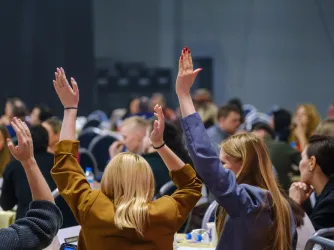
Students discuss and debate at FIRE's 2026 Free Speech Forum in Washington, D.C, from June 21 to 27.
Willa Mack is a rising sophomore at Princeton University. Isaac Apple is a rising junior at the University of Wisconsin-Madison.
In 1990, black blues musician Daryl Davis arranged to interview Roger Kelly, the Ku Klux Klan’s imperial wizard in Maryland, without telling him he was black. Kelly arrived at Davis’s hotel room with an armed bodyguard. The meeting was dangerous, but it sparked an unlikely friendship. Kelly eventually left the Klan, gave Davis his robe and hood, and even asked Davis to be his daughter’s godfather.
Davis now travels the country with a collection of Klan hoods and Nazi flags given to him by people who say their conversations with David helped them reject racism. On June 21, he shared that work with a rapt audience at FIRE’s third annual Free Speech Forum in Washington, D.C.
The Forum is a weeklong summer program where high school students learn about the First Amendment and how to defend — and advocate for — their free speech rights. Nearly 200 students traveled from across the country to American University’s campus, where they practiced debate, collaborated on free speech projects, and heard from First Amendment leaders.
During Davis’ keynote address, students eagerly asked about the expressive power of music and how they could emulate his courage and commitment to dialogue. The conversations continued after the lecture, through the opening night’s ice cream social, and throughout the week. Students repeatedly returned to the five principles Davis discussed: Everyone wants to be loved, respected, heard, treated fairly and truthfully, and everyone wants the same things for their family that you want for yours.
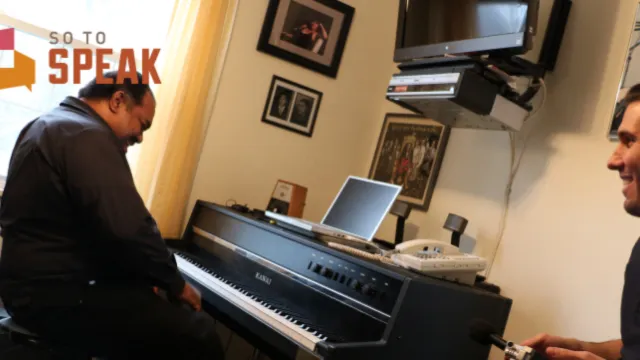
‘So to Speak’ podcast: How Daryl Davis, a black man, defeats the Ku Klux Klan with open dialogue
The next day, students heard from Lee Rowland, executive director of the National Coalition Against Censorship and former policy director at the New York Civil Liberties Union. Her quick-witted answers about free speech litigation energized students about the breadth of First Amendment law — and the many paths into civil liberties advocacy. Rowland urged students to be wary when the government reduces minors’ rights in the name of protecting children, pointing to age-verification laws being proposed and enacted in the United States and abroad.
Afterward, students unwound at Creative Expression Night. As they beaded keychains and colored banners, one student announced a new life goal: working at the NYCLU.
Students also worked together on projects to strengthen free speech culture at their own schools. They produced instructional zines and pamphlets, skits, games, videos, comic books, and plans for community action days.
Later in the week, they heard from Nadine Strossen, former president of the American Civil Liberties Union, who has spent her career defending even the most controversial speech. Strossen discussed how technology has transformed free expression and recalled leading the ACLU during Reno v. ACLU, the Supreme Court’s first major case addressing freedom of expression on the internet. The Court struck down provisions of the Communications Decency Act that broadly restricted online speech deemed “indecent” or “patently offensive” in an effort to shield minors.
As artificial intelligence rapidly develops, Strossen encouraged students to embrace new technology without abandoning books. Her own passion for free speech, she said, began when she read and reread every book available to her in the library as a child.
FIRE President and CEO Greg Lukianoff then traced the history of free speech from Socrates to the present day. Against a backdrop of colorful slides, he described free speech as a nonpartisan democratic principle — and an “eternally radical idea.”
His talk resonated with students. One said Lukianoff’s “unique perspective” encouraged them to see free speech not merely as a tool for individual speakers, but as a principle worthy of protection in its own right.
Sometimes the first step toward defeating an idea is having the courage to speak with the person who holds it.
The students also left campus for a trip to Capitol Hill, visiting the Folger Shakespeare Library, the Library of Congress, the Lincoln Memorial, and the U.S. Capitol. Back at American University, they performed in a talent show, sang karaoke, competed in trivia, and ended one evening with bowling and arcade games.
But the Forum’s most important moments did not always happen onstage. They happened when students confronted a person who sincerely believed something they considered deeply wrong — and chose to ask another question instead of walking away.
They practiced how to debate effectively, disagree respectfully, and search for truth amid conflict. Most of all, they learned that sometimes the first step toward defeating an idea is having the courage to speak with the person who holds it.
Recent Articles
Get the latest free speech news and analysis from FIRE.
Your speech, their rules: How foreign governments censor Americans

New Mexico's $25 billion verdict against Meta is fundamentally about speech
Silencing social media won't stop the unrest in France