Table of Contents


California college police officer threatens to arrest student over anti-police flyers
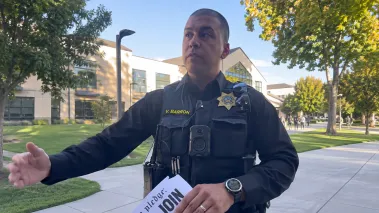
FIRE / Screenshot from video
A San Joaquin Delta College police officer holds an anti-police recruitment flyer during a confrontation with a student over her right to post it on campus.
On Sept. 10, San Joaquin Delta College hosted a Public Safety Career Fair, where one student offered a different message about police recruiting. She put up flyers saying, “TAKE THE PLEDGE: I WON’T JOIN THE STOCKTON PD,” along with the names and faces of people the flyers identified as having been killed by Stockton, California, police.
One professor tore down the flyers. So did a Delta College police officer, who then told the student to stop.
“This type of free speech,” a video shows the officer telling her, “is not allowed on this board.”
He added, “I will detain you to verify if you are a student,” saying that if she wasn’t a student, she faced arrest for trespassing, and if she was a student, she faced “student intervention,” which could mean probation, suspension, or dismissal.
Student journalists know their rights. Universities should too.
Student journalists know their First Amendment rights. Universities must do more to protect those rights, not stand in the way of their reporting.
When the student asked what policy required approval of the flyers, the officer just repeated that she needed approval without ever pointing to a rule, saying that explaining such things was not his job.
No such rule exists. But considering that Delta is a public college, the First Amendment applies to any rule it might have that would restrict posting flyers. The Supreme Court has rejected the idea that First Amendment protections “apply with less force on college campuses than in the community at large,” and the student’s flyers, which criticize police recruitment, constitute core political speech entitled to the highest First Amendment protection. A public college can impose reasonable time, place, and manner restrictions that are content-neutral, such as restricting posting flyers on walls likely to be damaged in the process. But when a police officer tells a student “this type of free speech” is not allowed based on what the flyer says, he appears to be imposing an impermissible restriction based on the flyer’s message.
This holds even if the message is one that some are likely to find offensive. Public colleges cannot shut off “the mere dissemination of ideas, no matter how offensive to good taste.” That means flyers that discourage certain career choices get the same protection as flyers that promote them. California law adds its own protection. California Education Code § 76120 says community college rules “shall not prohibit the right of students to exercise free expression,” including “the distribution of printed materials or petitions.”
Moreover, the U.S. Court of Appeals for the Ninth Circuit, which covers California, has applied these principles to flyers on the state’s community college campuses. In an unpublished opinion in 2023’s Flores v. Bennett, the court affirmed a preliminary injunction against a California community college’s ban on “inappropriate or offensive” flyers, concluding the policy was likely overbroad and vague.
Delta College seems to have come to this realization. On Sept. 18, President Lisa Aguilera Lawrenson said, “Freedom of expression is fundamental to what we do as a College” and that the police department “has already completed additional training for officers” after the incident.
But the explanation Delta gave The Collegian leaves questions open. A college spokesperson claimed one poster was on a tree, “which is not an approved location.” Yet on video, the officer specifically refers to a bulletin board. And even if one flyer were attached to a tree, that would justify removing only that copy of the flyer. It does not justify threatening to detain or discipline a student for putting flyers on a bulletin board.
The posting rule itself, Administrative Procedure 3760, asks for an author or agency name and a 30-day expiration date on postings. Nothing requires prior approval, the officer’s stated basis for stopping her. A rule requiring every flyer to name its author also burdens anonymous speech, which the Supreme Court has called “an honorable tradition of advocacy and of dissent.”
Delta can resolve this quickly. It should confirm the student faces no discipline for her flyers. It should tell everyone who staffs campus events — officers, faculty, and outside recruiters alike — that students may post on bulletin boards without prior approval, and that a flyer’s message cannot decide whether it stays up. And it should revise AP 3760 to clarify the rules and protect anonymous expression.
FIRE is ready to help Delta do that.
A career fair is supposed to show students their options. Students should be free to weigh those options — including the option of saying no to a career in policing — and to say so on a public college’s bulletin board. Delta should say that plainly.
FIRE defends the rights of students and faculty members — no matter their views — at public and private universities and colleges in the United States. If you are a student or a faculty member facing investigation or punishment for your speech, submit your case to FIRE today. If you’re a faculty member at a public college or university, call the Faculty Legal Defense Fund 24-hour hotline at 254-500-FLDF (3533). If you’re a college journalist facing censorship or a media law question, call the Student Press Freedom Initiative 24-hour hotline at 717-734-SPFI (7734).
Recent Articles
Get the latest free speech news and analysis from FIRE.

FIRE statement on President Trump's repeated threats against the media

Policing Halloween costumes won’t eliminate hate on campus

FIRE calls on 20 Washington cities to end censorship of social media comments