Table of Contents


Policing Halloween costumes won’t eliminate hate on campus
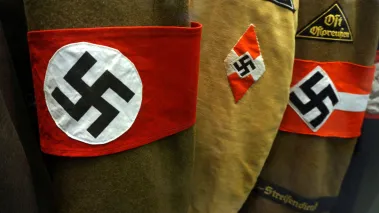
Berliner Verlag/Steinach/picture-alliance/dpa/AP Images
Nazi uniforms on display at the German Historical Museum in Berlin, November 2013.
When I was a student at Swarthmore College, I got emails every October “reminding” us not to wear offensive costumes for Halloween. This was, the emails assured us, in the interest of fostering a welcoming and inclusive environment for all. It would be great if something as simple as what students wore on Halloween could actually accomplish that. But not only did I feel infantilized reading an email telling me not to wear something offensive, I also recognized it as another way my alma mater was chilling expression, albeit with good intentions. Such emails do almost nothing to make the hate go away, but they do silence students who’ve done nothing wrong.
I imagine these sorts of emails were similar to the one that sparked controversy at Yale in 2015, when lecturer Erika Christakis gently questioned administrators’ efforts to discourage offensive Halloween costumes:
I wonder, and I am not trying to be provocative: Is there no room anymore for a child or young person to be a little bit obnoxious… a little bit inappropriate or provocative or, yes, offensive? American universities were once a safe space not only for maturation but also for a certain regressive, or even transgressive, experience; increasingly, it seems, they have become places of censure and prohibition.
This measured reflection led to outrage and protests. More than 740 students, alumni, and community members signed an open letter claiming that her email ignored minority voices and demanding that she and her husband, sociologist Nicholas Christakis, be immediately fired. In a viral video showing students confronting Nicholas, one student said, “We’re sitting here telling you that you’re being racist. You’re being offensive. You admitted that you hurt us. Why can’t you say sorry and move past this?”
“If I hurt you,” Christakis replied, “I’m sorry.”
The crowd broke into derisive laughter. Erika and Nicholas Christakis eventually stepped down from their college leadership positions. The message to everyone watching was hard to miss: Even gently questioning this “guidance” carries a price.
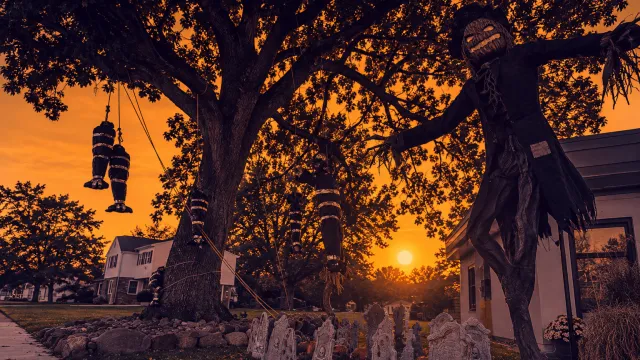
Government officials admit his Halloween decorations are legal. Why won't they leave him alone?
Bristol Borough officials admit a homeowner’s Halloween decorations are legal. They keep pressing him to take them down anyway. That’s jawboning.
Costumes are a form of expression, and warning students not to express themselves in certain ways sets a precedent that there are particular ideas or concepts that are off-limits, and that they had better not express at all. But you cannot claim (as does Swarthmore) to be a school that “is deeply committed to creating an environment that fosters diversity without in any way sacrificing its unwavering commitment to free inquiry, speech, expression, and exchange of ideas,” while also discouraging students from wearing Halloween costumes that someone might find offensive.
“Refrain from wearing offensive, hurtful costumes.”
Consider the thought process of a student reading that sentence: What exactly do those words mean? One of my friends may think it’s offensive if I wear a nun costume because she’s Catholic, but my other friend may find it funny. I don’t know whether my campus administration would punish me for wearing this, so I better play it safe and dress up as a mermaid. Or is that offensive because mermaids resemble Mami Wata, a water spirit revered in parts of West and Central Africa?
The problem is, discouraging or censoring expression doesn’t actually get rid of hate.
The phrasing of the email assumes something that simply isn’t true — that offensiveness and hurtfulness are objective, when in fact they are largely subjective. It hides the implicit question of to whom? And it does so in an environment when students are already self-censoring too much. Data from FIRE’s 2027 College Free Speech Rankings shows that 62% of students self-censor at least “occasionally” during classroom discussions, while 27% self-censor at least “a couple of times a week.” Schools should be encouraging more expression, not less.
Nor do these emails accomplish what they purport to do. In 2024, FIRE’s Campus Rights Advocacy team worked with a student at Portland State University after the university referred him to its Bias Team for dressing as a Nazi for a Halloween costume contest. But even if we assume the student was not making a joke, punishing him for wearing a Wehrmacht tunic and an armband would not eliminate whatever hateful beliefs he might have harbored. It might even convince him to view the costume as an act of defiance, and view its suppression by the university as a legitimate grievance (which, in our country, it is). As evidence repeatedly demonstrates, people change their minds through engagement, not censorship. In fact, censorship can often have the opposite effect. Plus, the chilling effect of these emails reaches well beyond extreme cases. It applies to students who hold any view they think others might find offensive.
As I sat in one of Swarthmore’s libraries reading one of its Halloween warning emails, I came to better understand how the chilling effect I was feeling represented the greater intolerance present on campus. There are certain costumes you are expected to know are off-limits; there are certain statements you are expected to know are off-limits. If you just happened not to know the unspoken rules, you were out of luck. And to entertain an idea for the sake of argument was to take a social risk. The message sent by these emails doesn’t stay confined to one night on Halloween. It affects what students feel is acceptable to say, year-round, in and out of the classroom.
Trying to blindfold students to “hate,” however defined, neither eliminates such attitudes nor helps them prepare to confront any hate or prejudice they may encounter after college. I’d like to know if I’m in a room full of misogynists, or if I’m moving to a neighborhood full of neo-Nazis. Being surrounded by people who secretly hate you until it’s too late to do anything about it doesn’t strike me as an improvement. So, this Halloween, campus administrators should remember that censorship does not create saints, and if there are actual neo-Nazis (or other hateful groups) on campus, students are safer knowing this rather than staying in the dark.
Recent Articles
Get the latest free speech news and analysis from FIRE.

FIRE calls on 20 Washington cities to end censorship of social media comments
Student journalists know their rights. Universities should too.
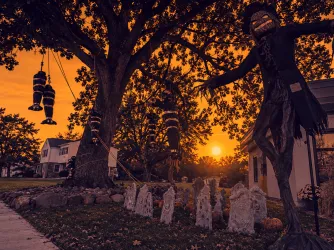
Government officials admit his Halloween decorations are legal. Why won't they leave him alone?