Table of Contents
This European country launched a task force to target ‘hate speech.’ Now a journalist who insulted politicians is going to prison.
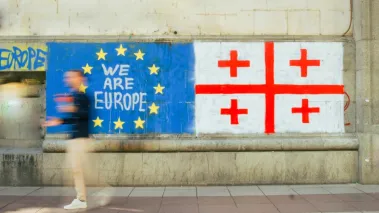
Shutterstock
TV news reporter in Tbilisi, Georgia.
Last month, Georgia’s Ministry of Internal Affairs (the country, not the American state) established the Division for Combating Hate Speech. The department’s role is to identify offenders and their identities, draft reports of the alleged offense, and pass them along for prosecution. State Minister for Coordination of Law Enforcement Bodies Mamuka Mdinaradze said the group is needed to address “any type of public communication that contains hate speech, incitement of enmity, violation of dignity, and other similar acts.”
Revisions to the criminal code pushed through by the ruling Georgian Dream party last year, which punish insults to public officials with fines and short prison terms, have given this new division a vast range of political speech to target. And the department has been busy indeed.
In just one month of hunting down alleged “hate speech,” staff forwarded 150 cases to courts for prosecution, even when the target of the speech hadn’t filed a complaint. In yet another victory for the department, presumably one of many more to come, a journalist who insulted politicians on social media was sentenced to prison last week.
Shiloh Hendrix’s conviction can’t be squared with the First Amendment
However much offense words cause, that does not justify the government imprisoning, fining, or otherwise punishing the speaker.
Vakho Sanaia, a journalist with Formula TV, wrote a Facebook post in June sarcastically encouraging others not to call Parliamentary Speaker Shalva Papuashvili and Member of Parliament Lado Bozhadze “dicks.” On July 10, the Tbilisi City Court fined Sanaia around $2,300 for the post. Sanaia responded to the ruling with two more comments: “I wrote a post, saying ‘don’t call Papuashvili and Bozhadze d*cks’ [sic] and they fined me ₾6,000. Well, go ahead and call them that, then,” and a joke that the decision meant the court was therefore declaring Papuashvili and Bozhadze “dicks.”
Sanaia soon learned the Division for Combating Hate Speech was pursuing an investigation of these two new posts, and last week he was sentenced to 14 days in prison on top of his original fine.
“After becoming aware of the previous court decision, he published a post that also contained insulting language,” a lawyer representing the Ministry of Internal Affairs said of the decision. “Accordingly, we considered this to be a disregard for the court’s decision and an indication of a willingness to continue engaging in unlawful conduct.”
There are many lessons to learn from Georgia’s continuing descent into censorship, but an especially important one is that this is simply an inherent risk of giving government officials a wider mandate to crack down on “hateful” expression: Authorities may very well take it as an opportunity to punish speech they deem hateful toward . . . authority.
Just remember last year, when President Donald Trump, responding to questions about then-Attorney General Pam Bondi’s threat to target “hate speech” for prosecution, suggested Bondi would “go after” journalists because they treat Trump “unfairly” and “hate” him. (“Hate speech,” of course, is quite famously protected under the First Amendment, and Bondi later attempted to walk back her statement.)
Sanaia’s arrest isn’t an outlier in Georgia, and it isn’t even the first time he has personally been charged under this law against insulting politicians. Nor, unfortunately, is his case an outlier globally. In Germany, for example, politicians receive heightened protection against insults under the country’s criminal code, and social media users regularly face prosecution and investigation for online jokes and insults about political figures. One man’s home was even raided after he — and I’m sensing a broader theme here — called a Hamburg minister a “penis.”
Even in the United States, where insulting political figures stands second only to baseball as a national pastime, this right is under attack.
In France, a woman was prosecuted for calling President Emmanuel Macron “filth” on Facebook, and in Italy a journalist was fined over tweets joking about Prime Minister Giorgia Meloni’s height. Around the world, it’s the same: A mocking tweet can land you in hot water, and maybe even behind bars.
Even in the United States, where insulting political figures stands second only to baseball as a national pastime, this right is under attack. That’s why FIRE sued leaders of the Department of Homeland Security and Immigration and Customs Enforcement this month after federal agents issued a “WARNING NOTICE” to a man simply for likening the head of ICE to a Nazi over email.
Authorities should not exempt themselves from criticism by the very people whose lives they affect, sometimes in profound ways. Restrictions on insults to public officials fundamentally invert the way free societies should function — and government “hate speech” bodies like the one Georgia just rolled out only deepen authorities’ power to narrow the boundaries of political speech.
Recent Articles
Get the latest free speech news and analysis from FIRE.
After a congressman challenged a student reporter’s right to record, here’s what journalists should know
Restoring Title IX kangaroo courts is no solution to the ‘Cornell 7’ sexual assault controversy
A UK teen mocked a local politician. Then the police showed up.