Table of Contents


When America knew what it was defending
Shutterstock
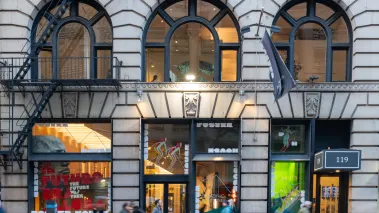
Poster House in New York City, 2025.
I recently took my son to Poster House in New York City, a wonderful little museum in Chelsea devoted to the history and power of posters. I actually collect vintage travel posters, so I have been visiting for quite some time. Usually, the museum is cheerful and a bit political, so I didn’t expect to leave in a state of awe after seeing a particular show.
We went to see an exhibition called Reading Under Fire: Arming Minds & Hearts During Wartime. This small show explored how books and reading became part of the American war effort during the First and Second World Wars.
I didn’t actually know much about this page of our history and deeply appreciated learning about the work our government and polity did to distribute books and share ideas widely. The posters were not just encouraging Americans to read. They were explicitly creedal and encouraged Americans to donate books, support our soldiers, and recognize the importance of reading as part of the war effort.
There was no hesitation in the poster messaging, either. I love looking at posters because they convey ideas quickly and graphically and can tell you quite a lot about the sentiments of the day. The government directly and forcefully said that books could sustain morale, educate soldiers, and remind Americans of the values they were fighting to preserve.
One poster immediately caught my attention. Created in 1943 by Barbara Marks, it shows an arm with a Nazi swastika on its sleeve, driving a blade through a Bible. Against a blood-red background, the words at the bottom declare: “THIS IS THE ENEMY.”
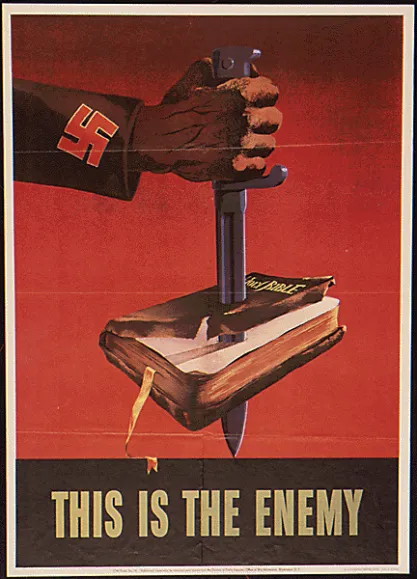
I stood there looking at that image for quite a while because I rarely see anything from our government that is so forceful and so clear. The image was simple and the idea extraordinarily clear: the Nazi regime was attacking religious liberty in Europe and threatening the moral foundations of American life. As opposed to what we see with many leaders today who hedge and hesitate in condemning illiberal behavior, our government back then was willing to say plainly which American values were under attack and what needed to be defended.
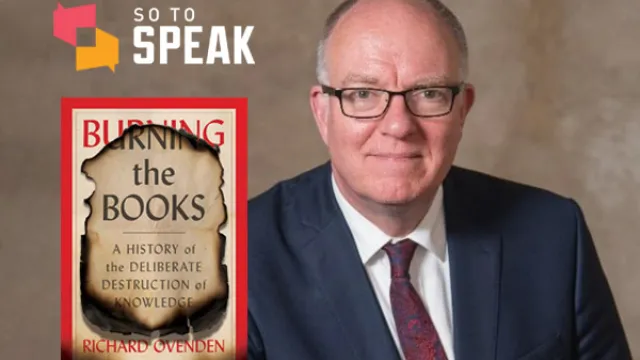
But another set of posters, just a little farther along, stayed with me even more. My son was standing in front of a poster from 1943 showing the Nazi book burnings. Across the top were the words “THE NAZIS BURNED THESE BOOKS,” followed by the reminder that free Americans could still read them. Above it was another poster showing a massive book towering over Nazi soldiers throwing books into a fire.
The words on that poster came from President Franklin Roosevelt: “Books cannot be killed by fire. People die, but books never die.” Roosevelt described books as part of humanity’s long struggle against tyranny. The poster ended with the words: “BOOKS ARE WEAPONS IN THE WAR OF IDEAS.”
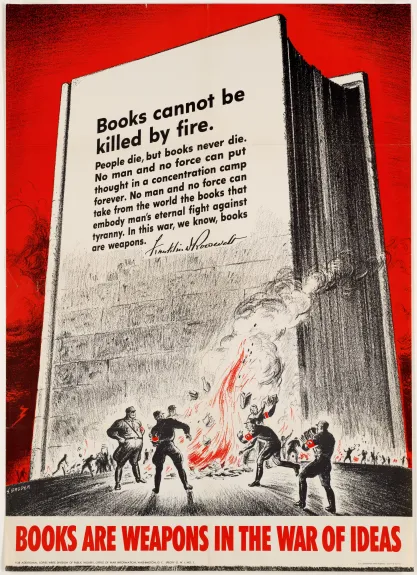
The museum explained that these posters were part of a broader effort to get books to American servicemen and remind the public of what distinguished a free society from a totalitarian one. The Council on Books in Wartime helped distribute more than 122 million pocket-sized paperbacks to American troops between 1943 and 1947. Soldiers carried these books overseas, including some of the very books that had been banned by the Nazis.
That contrast is awe-inspiring. The Nazis burned books while Americans printed them and sent them into war zones. The American response to an attempt to destroy ideas and dissent was to distribute more ideas. To me, this was Justice Louis Brandeis’s argument in his 1927 concurrence in Whitney v. California put into practice: “more speech, not enforced silence.”
Standing by these posters with my son, who was holding a little book of his own, I was extremely moved by what they were declaring about our American values.
I often take for granted that my son is growing up in a country where he can walk into a bookstore or library and choose almost anything he wants to read. It is far too easy to forget how much of human history has been spent trying to deny access to ideas. Since leaving the museum, I have continued to think about these 80-year-old posters. The nation could seriously benefit from the moral and civic clarity.
We spend an enormous amount of time arguing about free speech in America, especially on our college and university campuses. And too often, institutional leaders either stay silent or issue carefully worded statements that manage to say very little about how speech works in this country.
I have written about this inability to express and teach how speech works at my own school, Sarah Lawrence College. When protesters disrupted Ezra Klein’s visit in January of this year, President Cristle Collins Judd sat beside him without intervening. After the protesters left, Judd simply said, “Welcome to Sarah Lawrence College.” Judd condemned the intimidation in an email the next day, but the students needed to hear her say, right there in real time, that disagreement with the speaker did not give anyone the right to stop others from listening.
I think that too many forget that defending free expression does not require us to abandon judgment or pretend that every idea is equally worthy of respect. There is a difference between telling Americans what to think and reminding them why they are free to think for themselves. The posters reminded Americans that living in a free country meant having the right to read the very books the Nazis had burned and banned.
It is possible to defend someone’s right to express an offensive opinion while explaining why that opinion is wrong; I do this all the time as a teacher. We can also protect peaceful protest while making clear that rioting, violence, and the destruction of property are unacceptable. And colleges should not take positions on political controversies unrelated to their educational mission, but they still have a responsibility to teach and defend free inquiry. They must also insist that intimidation and coercion have no place in a community devoted to learning, and enforce their own stated rules and protocols.
That all being said, despite the powerful messaging on the wartime posters, America did not always live up to the freedoms it celebrated. The same Roosevelt administration that defended intellectual liberty and promoted reading also incarcerated Japanese Americans, a profound violation of civil rights. But there was real value in the principles being promoted, and our failures to honor them are reasons to take them more seriously.
As a professor and parent, I want my students and children to understand that free expression is far more than a rule about what they can say without being punished. Free speech is a value and a freedom that generations of Americans have fought to preserve, and each generation has to learn to value what it has inherited. I tried to help my son understand exactly that point during the show.
I left the museum with my son certain that we are not doing enough to explain and defend these freedoms. That is why FIRE and others exist, but I wish we didn’t need them. We need our leaders to make the case for a free society as plainly and confidently as those wartime posters did.
Recent Articles
Get the latest free speech news and analysis from FIRE.
At Haverford, heated topics shouldn't chill speech

The good, the bad, and the vague in the new college accreditation rule

California’s new chatbot law has a free speech problem