Table of Contents
The romance of fair use and fiction
David Volodzko using ChatGPT / FIRE
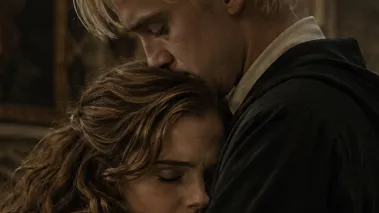
Hermione Granger and Draco Malfoy share a passionate embrace. Don't tell Ron.
Ally Duong studies at Rutgers Law School and is a documentation volunteer for the non-profit fan activist group Organization for Transformative Works and their virtual archive of fan works Archive of Our Own. Previously, she interned in the contracts department at Deep Vellum Publishing, formerly Dalkey Archive.
“Romantasy” is a genre marriage of romance and fantasy that has been selling books like wildfire. And this year, your local bookstore’s romantasy section is likely lined with covers featuring a curly-haired brunette heroine next to a suave, silver-haired hero–all because fans who saw what an author couldn’t see decided to write stories about a couple that never came to be.
Much of the latest wave traces back to the couple Draco Malfoy and Hermione Granger, two of the best-known characters in JK Rowling’s Harry Potter series. In Rowling’s books, Draco and Hermione remain enemies and never become romantically involved. But fans have spent countless hours imagining an alternate reality, producing more than 100,000 online stories about “Dramione” on Archive of Our Own alone.
Now some of those fan works are making the leap from online archives to traditional publishing. The attraction for publishers is obvious: a popular fanfic may arrive with a ready-made audience and social-media buzz. But that shift raises a serious legal question: What must an author change before an unauthorized derivative work becomes an independent — and lawfully marketable — novel?
Copyright protects expression, not every idea
Critics of the fanfiction-to-publishing pipeline call the practice unethical, legally questionable, or both. They argue that authors are profiting from characters, settings, and stories someone else created. But the necessary extra labor of reworking a story to transform it from internet fanfiction into a traditionally published book leaves little doubt that such books are legal to sell under a copyright law doctrine called “fair use.”
Copyright does not demand that each new book emerge from a cultural vacuum.
Copyright protects an author’s original expression, but it doesn’t protect abstract ideas, general themes, stock characters, or familiar plot devices. The fair use doctrine recognizes that people must be allowed to use copyrighted material in certain situations to allow free expression, satire, and parody to flourish. Fair use is decided on a case-by-case basis with courts weighing four factors:
- The purpose and character of the use, including whether it is commercial
- The nature of the copyrighted work
- The amount and substantiality of the copyrighted material used
- The effect on the potential market for or value of the copyrighted work
The key question is: How much is a copyrighted work transformed? In other words, is the original work used to express something different?
For traditionally published fanfiction, however, courts may never need to reach fair use. The threshold question is whether the rewritten book still copies protected expression at all. Copyright law requires only a “modicum of creativity” for a work to contain copyrightable expression. If only unprotected ideas, tropes, and conventions remain, there may be no infringement to excuse.
Filing off the serial numbers
Fanfiction culture has proved fertile ground for artistic expression. Copyright law nurtures that creativity by protecting an author’s particular expression rather than the underlying ideas. Humans have always retold familiar stories. Shakespeare borrowed plots. West Side Story reworked Romeo and Juliet. Countless romances owe something to Pride and Prejudice. Copyright does not demand that each new book emerge from a cultural vacuum. If it did, creativity would be stifled and expression severely limited on the grounds that practically no story is entirely original.
Fanfiction has also been quietly making its way onto bookstore shelves for years. Fifty Shades of Grey began as a Twilight fanfiction titled Master of the Universe. After the name and references were changed, only devoted “Twihards” were likely to see Edward Cullen and Bella Swan behind Christian Grey and Anastasia Steele.
Fan communities call that revision process “filing off the serial numbers.” The author reworks the original characters’ names, identifiable locations, invented terminology, and other features tied to the source material. The online version is often deleted before the new edition is commercially released. Some changes are so thorough that rewritten works leave behind only common tropes and scènes à faire — standard plot elements for a particular genre. Those features generally cannot be copyrighted. Otherwise, such common elements could be used as evidence of copyright infringement (“Look! This story has an elf! It’s Tolkien plagiarism!”), and the first author to write about them could fence off whole genres of storytelling.
From Reylo to The Love Hypothesis
Ali Hazelwood’s The Love Hypothesis offers a useful example. The novel began as Head Over Feet, a Star Wars story pairing the protagonist Rey with the villain Kylo Ren. It was traditionally published in 2021, and a film adaptation is scheduled to premiere on Prime Video on Sept. 23, 2026.
In the reworked edition, Rey and Kylo Ren are no longer heroes in a galactic war. They instead become university researchers Olive Smith and Adam Carlsen, who hilariously end up “fake dating” despite being polar opposites. The only surviving similarities are the enemies-to-lovers foundation of the romantic relationship, some physical traits, and familiar tropes of opposites attracting and a tall, dark, brooding love interest. These building blocks are not the property of Lucasfilm and are too general to belong to any one creator.
Tropes and scènes à faire make a genre like romantasy, but it’s the particular expression of each one that creates copyrightable books.
One judge, 6,000 pages, and hot paranormal boys
Building on the infamous “omegaverse litigation,” a recent federal case illustrates the distinction. In Freeman v. Deebs-Elkenaney, Lynne Freeman claimed that Tracy Wolff’s Crave series copied Freeman’s unpublished paranormal-romance manuscripts.
U.S. District Judge Colleen McMahon read more than 6,000 pages of romantasy fiction across the competing works to determine whether two paranormal romance books were substantially similar enough to be copyright infringement. Her answer was no; there are some tropes that are simply conventions of the genre and cannot be claimed by one person.
“Both include the inevitable love story between the heroine and a hot boy who turns out to be a paranormal,” McMahon wrote. “This is ‘romantasy’ fiction, so there has to be a romance, and hot boys are a staple of the genre.”
Fair use and the fascinating issue of publishing fanfiction

Fandom’s lighthouse in a sea of censorship
In the storm of internet censorship and cancel crusades, the fanfic database Archive Of Our Own (AO3) has become a lighthouse of artistic expression.
So is the case closed on traditionally publishing fanfiction? Probably not, because publishers are pushing the envelope, particularly with the latest trend of reworked Dramione fanfiction, beginning in 2025 and now in full swing. These works far more openly use the Dramione relationship to market the new books. Some hardly even try to pass as original. Julie Soto’s Rose in Chains, previously the Dramione fanfiction The Auction, centers around a magical boarding school, a heroine named Briony (rather than Hermione), and a villainess named Veronika (certainly not Voldemort).
These characters and their world are distinct from the Harry Potter universe, yet their origin is no secret. Publishers are using marketing tactics that directly target Dramione fans, riding the coattails of the Harry Potter intellectual property, with some cover designs and promotional materials winking at the pairing through silver-haired men, curly-haired women, and so on.
Despite exploiting the Harry Potter link for marketing, Dramione fans aren’t picking up the rewritten works because of their origins in Harry Potter. They are reading these stories for the romantic relationship, which never appeared in Rowling’s work. The space that Dramione reworked fanfiction takes up on shelves isn’t taking away from Harry Potter itself. They may even be helping keep the series relevant in the marketplace.
While an evenhanded application of the fair use factors weighs in favor of the right to publish such fanfiction, it remains to be seen how the courts will actually view the situation. Without any public cases targeting this specific issue, the legality of more lightly reworked fanfiction is still murky. But while resistant readers may bristle at the similarities, reworked fanfiction, fueled by nerdy devotion, have rightfully found a place on bookshelves and in readers' hearts.
Recent Articles
Get the latest free speech news and analysis from FIRE.

Venezuela is a cautionary tale w/ Jim Epstein and Germania Rodriguez Poleo
Podcast
FIRE sues Los Angeles City Council over policy banning certain words during public comment

It was never just going to be about keeping kids off social media