Table of Contents
Will Germany amend one of its most censorial laws?
Shutterstock
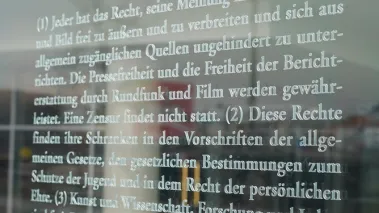
"Grundgesetz 49" installation by Dani Karavan displays Article 5 of the German Constitution, which guarantees freedom of expression, freedom of the press, and freedom of the arts and sciences.
FIRE’s Free Speech Dispatch covers new and continuing censorship trends and challenges around the world. Our goal is to help readers better understand the global context of free expression. Want to make sure you don’t miss an update? Sign up for our newsletter.
German politicians question law criminalizing insults to politicians — rightly so
Deutsche Welle reports that a group of legislators from parties including the Christian Democratic Union and the Greens are advocating reform of Section 188 of the Criminal Code, which provides heightened protection to politicians against insults. Yes, that means pretty run-of-the-mill jokes and memes about politicians, from the mean-spirited to the mild, can currently be punished with fines or a prison term up to three years. And the law does not even require that the butt of the joke press charges.
The law occasionally catches international scorn, usually when an especially absurd case breaks containment of local media and goes global, like last year’s viral 60 Minutes segment about German speech policing. You may be familiar with some of the law’s greatest hits, for lack of a better term, like the investigations and even prosecutions of social media users who have called politicians names like “Schwachkopf” (weak-head) or “pimmel” (penis). Such words may not be particularly nice, but they’re also insults children throw around at each other on the playground. Politicians can presumably survive such barbs — in theory. A commenter was even briefly investigated by police for recently calling Chancellor Friedrich Merz “Pinocchio” on Facebook. (This targeting of online political speech is one of many reasons to be suspicious of Merz’s push for “real names” on the internet.)
Christian Democrat Jens Spahn admits that regardless of the intent behind the law — defenders say it was meant to protect democratic institutions — “what has emerged is the impression: The powerful have created a special law for themselves.” Well…yeah. The law retains popular support, though, according to a poll last month finding that 58% of Germans polled wanted to keep it and only 38% wanted to see it dismantled.
Amending the law would not magically fix all of Germany’s free speech problems, but it would help to reverse the very backwards notion that political figures deserve special protection from the words of the people they’re elected to govern.
Journalists allege censorship at U.S. ambassador’s event in Belgium
Did reporters asking questions of U.S. ambassador Belgium Bill White pose a security threat? That’s what European Correspondent journalists Julius E.O. Fintelmann and Samuel Dempsey allege Belgian police told them after they questioned them and removed them from an event with the ambassador over the weekend.
On Sunday, White held an invite-only event with thousands of attendees in Brussels’ largest public park to celebrate America’s 250th anniversary. Fintelmann and Dempsey had permission to attend the event, and asked questions of other political figures attending. But they say shortly after they asked White a question, to which he replied “no comment,” a group of Belgian police officers working at the event approached them, took their IDs, and began to question them. They “asked whether The European Correspondent had a political leaning, whether we had an agenda, and how we had got into the event (that the American embassy invited us to).” The journalists report that officers were told to remove them because they posed an “active threat.”
About a week before the event, Dempsey also shared that an American citizen living in Belgium contacted the Zac Brown Band to encourage them not to perform at the event. White then emailed this person, Dempsey reports, with the message: “We would like to get in touch with you regarding your email to my friend Zac Brown what’s your best email and number? Pls do let us know because we know it already.”
Canada approves problematic Combatting Hate Act
Canada has now enacted Bill C-9, the Combatting Hate Act, to amend the country’s criminal code to heighten penalties for certain acts and expression deemed motivated by hate. A wide range of civil liberties, religious, and advocacy groups have long opposed some provisions of the bill as well as a lack of recognition of their objections during the legislative process. Their concerns largely centered on the bill’s reforms to hate symbol policing and “intimidation and obstruction offences” outside houses of worship or buildings used by an “identifiable group.”
Bill C-9 creates a new “hate propaganda offence that makes it a crime to wilfully promote hatred against an identifiable group by publicly displaying” designated terrorist symbols, Nazi symbols, nooses or “a symbol that so nearly resembles” one of the above that it is “likely” to be it. A joint statement signed by 65 advocacy groups stresses that this provision “introduces significant legal uncertainty and risks capturing lawful political or cultural expression.”
These groups also voiced concern about the lack of clarity and overbreadth in the restrictions on “intimidation and obstruction.” As the Canadian Bar Association warned earlier this year, “The meanings of the words ‘obstruction’ and ‘interference’ are also very broad. It is not clear at what point a person, their words, or their actions would constitute an obstruction and interference on the face of the amendments.”
Japan pursues flag desecration ban
Japan already bans desecration of foreign flags and is now seeking to apply similar rules to its own national flag. Three parties including the ruling Liberal Democratic Party introduced a bill targeting “publicly damaging, removing, or defacing” Japan’s flag in a “way or situation that evokes significant discomfort or disgust in people.” Violators of the law could face a fine up to $1,250 or two years in prison. Flag desecration remains deeply divisive around the world, including in the United States, but that some perceive it to be a discomforting or disgusting act does not negate the fact that it’s basic political expression. Such expressive activity is protected in the United States thanks to the Supreme Court’s ruling in Texas v. Johnson. “The way to preserve the flag’s special role is not to punish those who feel differently about these matters,” Justice William Brennan wrote for the majority of the Court, but “to persuade them that they are wrong.” Spot on.
More censorship news out of Asia
- In Hong Kong’s neverending quest to crack down on alleged “sedition,” booksellers have been a frequent target of government retaliation. Former district councillor Leticia Wong and her Hunter Bookstore business partner were arrested last week for displaying “seditious” material and “inciting hatred against the Hong Kong SAR government, judiciary, and law enforcement agencies.”
- Thailand’s oppressive lese-majeste law found another victim. A Thai court sentenced a man to 18 months in prison for a comment in a Facebook group dedicated to discussing the monarchy. At least 17 other people have faced similar royal defamation charges for their posts in the “Royalist Marketplace” group.
- Access now appears to be restored, but last month India blocked the messaging app Telegram over allegations that it was being used to share leaked questions to a medical exam. Telegram’s attempt to challenge the ban in Delhi’s High Court failed.
- Iranian singer Parastoo Ahmadi and eight others have been sentenced to 74 lashes each over their involvement in a 2024 live-streamed concert where Ahmadi performed without a hijab.
Paris police ban left-wing party’s concert
Paris police prefect Patrice Faure denied left wing political party La France Insoumise’s attempt to hold a concert on June 21 at the city’s Place de la République. Faure’s decision largely rested on the views of the concert’s expected performers and attendees like rapper Médine, who has reportedly expressed support for the comedian Dieudonné, the target of a number of prosecutions across Europe for antisemitic remarks and Holocaust denial. Other potential attendees of concern were artist Soso Maness, who reportedly started “Everybody hates the police” chants at past events, and activist Assa Traoré, whose presence has “led to significant public order disturbances.”
“The event risks attracting a particularly hostile audience toward law enforcement,” the prefecture warned, “in a highly polarized political context ahead of the next presidential election.”
Arrests continue under Queensland’s ban on ‘from the river to the sea’
Helen O’Sullivan, a 64-year-old grandmother and activist, was arrested under Queensland’s recent hate speech ban after using the phrase “from the river to the sea” at a rally outside Brisbane Magistrates Court. Inside, the court was handling the cases of over two dozen people charged under the same law, for the same offense. Over loudspeaker, O’Sullivan had said she was “speaking against the [Queensland Premier David] Crisafulli government that is attempting to silence valid criticism of the state of Israel” and asserted that “from the river to the sea is a call for democracy and freedom.”
Recent Articles
Get the latest free speech news and analysis from FIRE.
After a congressman challenged a student reporter’s right to record, here’s what journalists should know
Restoring Title IX kangaroo courts is no solution to the ‘Cornell 7’ sexual assault controversy

A UK teen mocked a local politician. Then the police showed up.