Table of Contents
French bill would criminalize ‘from the river to the sea’
Shutterstock
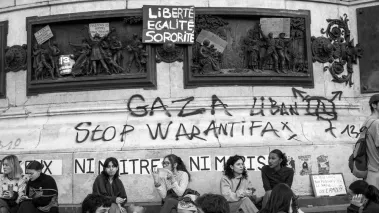
Demonstration for a ceasefire in the Gaza war in Marseille, France, Dec. 09, 2023.
FIRE’s Free Speech Dispatch covers new and continuing censorship trends and challenges around the world. Our goal is to help readers better understand the global context of free expression. Want to make sure you don’t miss an update? Sign up for our newsletter.
Editor’s note: Sarah McLaughlin is going on sabbatical soon, so there may be a bit of a break between future entries. But regularly scheduled content will resume in late June. Stay tuned.
France considers new antisemitism bill
A bill with broad support brought by MP Caroline Yadan is set for debate soon in French Parliament, and it would introduce a broad range of new speech offenses under French criminal law. The bill seeks to expand the existing terror offenses of incitement to terrorism and glorification of terrorism to criminalize “implicit,” rather than just direct, incitement of terror as well as glorification of the perpetrators of terrorist acts.
It would also punish speech calling for the “destruction of a state recognised by the French Republic” with a €45,000 ($53,080) fine and up to five years in prison. “From the river to the sea” is one of the phrases that would be considered advocacy for the destruction of a recognized country. “It’s not specifically about Israel,” Yadan said about the legislation. “But obviously, today, there is only one country in the world whose criticism takes the form of calls for its destruction, and that’s Israel.” Earlier versions of the bill included language banning comparisons between Israel and Nazi Germany, but those provisions have since been removed.
UNC Chapel Hill’s students dabbled in satire. Now the university is investigating.
UNC condemns student satire as “offensive.” But at a public university, even bad jokes are protected speech — and punishing them chills everyone.
France is not the only country to consider banning “from the river to the sea” and similar phrases. The Australian state of Queensland recently banned the slogan, and arrests under the new law have begun. A 70-year-old activist arrested for displaying the slogan at a protest appeared in court this week under the new hate speech laws — and is “pleading insanity.”
“Not that I think I’m insane,” he said. “I think the law is insane.”
Irish media minister targets ‘lopsided’ media
Irish media Minister Patrick O’Donovan said he wants media regulator Coimisiún na Meán to look into the “lopsided” media coverage of recent fuel protests in the country, as well as why he received fewer invites to speak than other officials and commentators. He also objected to comments in the media calling the government’s tone about the protests “lecturing and hectoring.” The National Union of Journalists called O’Donovan’s warnings “sinister and deeply disturbing.”
“One of the things I will be looking at as Minister for Communications is to see if you have a panel discussion, for instance, on a national broadcaster, where there’s three or four from the opposition and one from the government, is that a legitimate debate?,” O’Donovan said. He further added that “in a democracy, all voices should be heard, not just some” — and apparently it’s the role of a government regulator to decide which voices should be heard, and how frequently.
More speech news out of Europe
- France is considering joining the growing list of countries banning social media access for children under 15, with officials arguing the move is necessary to protect young users.
- In Germany, a 67-year-old woman was fined €800 for insulting politician Markus Söder on a sign held during a 2023 protest, but has been acquitted on appeal.
- UK police arrested protesters near a Royal Air Force base used by U.S. forces. Authorities said they were detained “on suspicion of supporting a proscribed organisation” during a demonstration.
Australia’s teen social media ban isn’t working
In Australia, debates over online access and the country’s landmark age-gating legislation continue. Proponents of these laws have argued they are absolutely necessary to protect kids online and the associated risks to privacy and free speech are a price we must be willing to pay. But…what if the laws aren’t even doing what they promise? A new eSafety report finds that among parents with kids on social media before Dec. 10, 2025, about seven in 10 said their child still had an account on Facebook (63.6%), Instagram (69.1%), Snapchat (69.4%), and TikTok (69.3%).
Brazil’s aggressive antiracism laws ensnare tourist
A case in Brazil has drawn international attention after an Argentine tourist was charged with “imitating a monkey and uttering a racist slur” after getting into a dispute with waiters over her bill at a Rio de Janeiro bar. Agostina Páez has since apologized but could face up to two years in prison if convicted. Until recently, Páez was kept under watch by Brazilian authorities and required to wear an ankle monitor, but she was eventually permitted to pay a $20,000 bail and return to Argentina until a judge rules in her case. “Brazil is being painted as this authoritarian country,” prosecutor Fabíola Tardin told The New York Times, “when we are only seeking justice for the harm done.”
Journalists and writers face intimidation, arrest, and imprisonment
- Malaysia convicted blogger Papagomo of sedition for a social media post deemed to have “incit[ed] hatred against the King,” sentencing him to a RM 4,000 fine or jail time. The court ruled the defense had “failed to raise a reasonable doubt,” reinforcing how speech involving the monarchy remains tightly controlled.
- In Iraq, American journalist Shelly Kittleson was kidnapped by unidentified gunmen but has fortunately since been freed.
- Egypt arrested political commentator Ahmed Douma over an article and social media posts. Authorities accused him of spreading “false news and rumors…that would disturb public order,” a charge often used in cases involving dissent.
- Kuwaiti authorities arrested American-Kuwaiti journalist Ahmed Shihab-Eldin on charges of “spreading false information, harming national security, and misuse of a mobile phone. Some of the charges reportedly relate to “footage of a US F-15 fighter jet crash near a base in Kuwait during a reported friendly fire incident earlier in March.” Such arrests have been common lately in the Middle East amid war with Iran. In the UAE, authorities arrested 375 people for filming incidents and sharing what officials described as “misleading information.”
Russia tightens internet restrictions as VPN access disappears
Russia is expanding its control over online speech, blocking hundreds of VPN services that once allowed users to bypass censorship and access independent information. Authorities say the restrictions are necessary to combat “illegal content” and protect national security, and more than 400 VPNs have already been affected, cutting off one of the last major workarounds to government controls.
It’s the end of internet anonymity as we know it (and I don’t feel fine)
Turkey’s push to end online anonymity is a warning that governments everywhere are inching toward a real-name internet.
The changes are part of a broader effort to reshape the country’s digital infrastructure. Analysts describe the shift as the construction of a “digital iron curtain,” with users pushed toward state-approved platforms and away from global networks. In some areas, disruptions have become so severe that people are turning to landline phones as internet access becomes less reliable.
Russia has also designated Tufts University and its Fletcher School as “undesirable organizations,” effectively banning collaboration and exposing affiliates to legal risk. Officials accused the institutions of acting as “instruments of anti-Russian propaganda” and attempting to “undermine public trust.”
Expanding limits on media, culture, and the internet
- In Canada, proposed changes to Ontario’s freedom of information system have sparked pushback from transparency advocates. They argue the reforms could lead to a more “secretive government,” limiting the public’s ability to access records and scrutinize decision-making.
- India is, yet again, expanding its regulation of online expression. Proposed rules reclassify influencers as publishers, putting them under the same oversight as traditional media outlets, a move critics say could “tighten control over online news.”
- Belarus has introduced a sweeping law banning so-called “propaganda” of same-sex relationships, “gender reassignment,” and “childlessness.” The law defines propaganda broadly as information meant to “influence citizens’ perceptions,” with Human Rights Watch saying it reflects a broader effort to “control public discourse, and suppress dissent.”
Blasphemy prosecutions in Nigeria carry death sentences
A Sharia court in Kano sentenced an Islamic cleric to death for blasphemy after determining his remarks insulted the Prophet Muhammad. In a separate case, a Christian father may also face execution after being accused of possessing “blasphemous material,” which he denies.
As is the case in Pakistan, rights advocates have accused these brutal blasphemy laws of being used as a tool to settle disputes among individuals — the fallout from an accusation alone can be so destructive that alleging blasphemy can be enough to derail another person’s life.
Recent Articles
Get the latest free speech news and analysis from FIRE.
After a congressman challenged a student reporter’s right to record, here’s what journalists should know
Restoring Title IX kangaroo courts is no solution to the ‘Cornell 7’ sexual assault controversy

A UK teen mocked a local politician. Then the police showed up.