Table of Contents
You don’t need to live in China to experience China’s censorship
Shutterstock
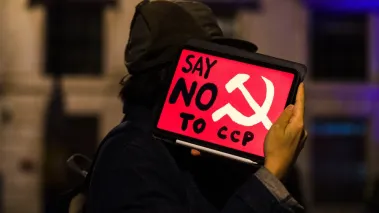
A protester on the streets of London in October 2022.
You’re most likely reading this article from a country that is not China. So, naturally, you might think that China’s censorship laws have nothing to do with you. Not so fast. The interconnectedness of global commerce has created crevices for authoritarian censorship to seep in, and the latest news out of the Victoria and Albert Museum offers a perfect illustration of how it unfolds.
The Victoria and Albert Museum, the United Kingdom’s famed art institution, joins the growing list of institutions that have consented to censorship rules imposed by the Chinese government in order to print goods more affordably in the country. Documents obtained by The Guardian reveal that the museum consented to changes in the catalogue for its new Music is Black exhibition after C&C Offset Printing, its printing partner in China, said a map in the document was flagged by censorship body the General Administration of Press and Publication.
French bill would criminalize ‘from the river to the sea’
Governments worldwide tighten speech controls — from new hate laws to arrests, censorship, and digital crackdowns.
“There is a map on p10 relates to China (there is China border here and we need to use the standard maps from Chinese Government) and GAPP rejected it,” the printer wrote in an email to the V&A. “Our suggestion is to delete this map or use another image.”
An internal email to V&A East director Gus Casely-Hayford complained, “We were aware of sensitivity around contemporary maps but it now clearly applies to historic maps too.” Ultimately, the museum chose to substitute in a different photograph and print the censored version. And this wasn’t the only time they’ve done so. The museum also consented to cut another map from the Fabergé: Romance to Revolution exhibit catalogue as well as a photo of Soviet leader Vladimir Lenin.
Lenin would be too “sensitive” for China’s censorship body, the printers warned.
The V&A defended its decision making process, arguing that it only consents to what it sees as superficial edits. “We sometimes print in China, but maintain close editorial oversight,” the museum said in a statement. “We were comfortable making minor edits, as they did not affect the narrative and we would obviously pull production if we felt any requested change was problematic.”
It’s the end of internet anonymity as we know it (and I don’t feel fine)
Turkey’s push to end online anonymity is a warning that governments everywhere are inching toward a real-name internet.
In isolation, such changes may appear to some as minor or unimportant. But in the aggregate, they add up — and influence in perpetuity how the entire world reads, experiences, and understands material pertaining to China and content it deems politically sensitive. It isn’t just one museum. It’s also book publishers, AI companies, movie studios, hotel chains, fashion houses, and gaming giants. And that’s not to mention the threats made to critics of the Chinese government in countries all around the world, including the United States. Doesn’t seem so minor, does it?
Perhaps worst of all, this influence is operating in higher education on a global scale, introducing both overt and subtle limits on universities and the people who study and teach within them. In the short term, researchers and student dissidents suffer threats and censorship. In the long run, the education, research, and discussion that the entire world relies on for knowledge generation is throttled. I covered this oppressive trend in my book released last year, Authoritarians in the Academy: How the Internationalization of Higher Education and Borderless Censorship Threaten Free Speech.
You may be thousands of miles away from the Chinese government, but its censorship is operating much closer than you think.
Recent Articles
Get the latest free speech news and analysis from FIRE.
After a congressman challenged a student reporter’s right to record, here’s what journalists should know
Restoring Title IX kangaroo courts is no solution to the ‘Cornell 7’ sexual assault controversy
A UK teen mocked a local politician. Then the police showed up.