Table of Contents
Whitman Republican Club denied affiliation — for being Republican
Shutterstock
Right in its student handbook, Whitman College specifically promises every student freedom of expression and association. So, when members of the Whitman Republican Club sought recognition to become a college-affiliated student organization, they had every reason to expect approval through the same review process as any other group.
Instead, the student senate unanimously rejected their application. 25-0.
Was it something they had done? Was it something they forgot? No, the record points somewhere else: It was what they believed.
Immediately before the vote, members of the Associated Students of Whitman College’s Senate grilled the club’s representatives about their political views rather than limiting their questions to the club’s organization, constitution, or eligibility. Instead of using viewpoint-neutral criteria, senators asked probing, ideological questions like, “On the 2024 republican party platform subsection 18, what is your club’s take? Will you call the republican party out for things like this?” and “President Trump has made life hard for all international students. When you don’t get affiliated, what is your plan?”
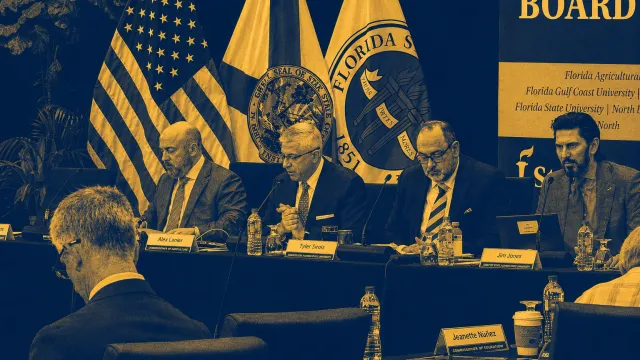
Florida wants colleges out of politics, but its plan has a loophole
Florida wants public colleges out of politics. But a loophole in its neutrality plan could give administrators a new license to speak out.
At the end of the discussion, one senator made their objection remarkably explicit: “You can name yourselves whatever you want, but the language of your constitution is in direct contrast to our own constitution. I would suggest that you scrub the title and make a debate club.”
The senators didn’t identify any problem with the group’s application or reason it would not be eligible for recognition. Despite “creating equal and inclusive opportunities” in the ASWC’s own mission, they told the students to scrap their plans, scrub their name, and make their mission more palatable to the senators reviewing it.
This is blatant viewpoint discrimination.
For student organizations, college affiliation is the gateway to requesting funding, hosting events, and legitimacy. Other ideological groups such as Climate Justice Coalition and Planned Parenthood Generation Action enjoy the benefits of affiliation. Instead of giving the WRC its fair shot at gaining college recognition, ASWC senators cornered and prodded the students to justify or criticize specific platforms of a national political party, then denied their recognition for having the “wrong” political views.
Viewpoint-neutral criteria means that voices that may not be popular can still be heard.
It’s not surprising that some or all of the senators found the club’s Republican views offensive. Virtually every viewpoint is offensive to someone. Whitman recognizes dozens of diverse groups on campus, many with missions or purposes that likely conflict with each other or the ASWC: Like Whitman’s affiliated Don’t Eat The Wheat group, who may have some conflicting values with the also-affiliated Cooking and Baking Club. But to deny one club based on its view threatens the same rights of all groups. If dissent leads to exclusion, what happens to any viewpoint that disagrees with the majority?
In the past, prohibitions on viewpoint discrimination have protected groups whose views were not popular when they sought to form campus organizations. For example, the principle of viewpoint neutrality protected chapters of LGBT organizations in Arkansas and New Hampshire in the 1970s and ’80s when student senates and university trustees refused to “support a homosexual group” or their expression, which was considered “shocking and offensive” at the time. Using only viewpoint-neutral criteria means that voices that may not be popular can still be heard.
No one expects the ASWC — or anyone, for that matter — to wholeheartedly agree with every ideological group on campus. But everyone should expect that it will not deny an ideological group because its views are unpopular or offensive. Without viewpoint neutrality, the benefits of college affiliation are withheld from some groups, purely based on their beliefs.
Though Whitman is a private school, and so not directly governed by the First Amendment, it voluntarily promises students freedom of speech, expression, and association. And the ASWC, as an elected student body, is also obligated to uphold those promises.
The ASWC proved that their “discretion” is more of a popularity contest with senators’ own ideological preferences. When the WRC applies for recognition again, Whitman College must ensure that club recognition is instead a fair and viewpoint-neutral process. And if the ASWC again fails to use neutral criteria, Whitman must intervene and grant WRC’s affiliation. Anything less is an egregious violation of the very free speech principles that Whitman prides itself on touting.
The Foundation for Individual Rights and Expression is a free speech charity that defends the rights of students and faculty members — no matter their views — at public and private universities and colleges in the United States. If you are a student or a faculty member facing investigation or punishment for your speech, submit your case to FIRE today. If you’re faculty member at a public college or university, call the Faculty Legal Defense Fund 24-hour hotline at 254-500-FLDF (3533). If you’re a college journalist facing censorship or a media law question, call the Student Press Freedom Initiative 24-hour hotline at 717-734-SPFI (7734).
Recent Articles
Get the latest free speech news and analysis from FIRE.
VICTORY: New Jersey drops complaint against school board member targeted for asking constituents about taxes

FIRE sues Los Angeles City Council over policy banning certain words during public comment

It was never just going to be about keeping kids off social media