Table of Contents
Maryland bill would end ‘free speech zones’ on public campuses
Shutterstock.com
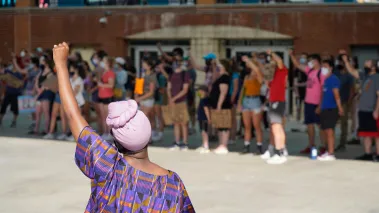
A University of Maryland student at a Black Lives Matter protest on campus in June 2020.
Raeba Pradhan is a FIRE program associate for legislative and policy.
On Feb. 12, a group of Maryland legislators introduced HB 1322, the Maryland Campus Area Free Expression Act. The bill would prohibit public colleges and universities from restricting student speech to misleadingly labeled “free speech zones,” clamping down on spontaneous expression, and charging students viewpoint-discriminatory security fees, among other provisions.
The legislation is based on FIRE’s CAFE Act and is sponsored by Maryland House of Delegates members Grammer, Arikan, Chisholm, Fisher, M. Morgan, Nawrocki, and Szeliga. This legislation aims to ensure students at public universities can fully exercise their First Amendment rights, and to safeguard Maryland’s institutions as places where students are exposed to an array of ideas.
FIRE has long observed how this sort of micromanagement can function like a free speech quarantine, allowing schools to banish student and faculty speakers to tiny outposts on the fringes of campus.
This is a crucial step in light of recent events at the University of Maryland, College Park. On Sept. 1, 2024, the university announced it would only allow pre-approved, school-sponsored events to take place on Oct. 7, the anniversary of the Hamas-led attack on Israel that kicked off the war in Gaza. Among those banned were Jewish Voice for Peace and Students for Justice in Palestine, who sought to hold an interfaith prayer vigil. Despite having already secured a permit, they were told their event would have to wait.
The university’s SJP chapter quickly filed suit. FIRE, the American Civil Liberties Union, the ACLU of Maryland, and the Knight First Amendment Institute at Columbia filed a friend-of-the-court brief in support, pointing out that the university’s “categorical ban on students’ expressive events” could not survive First Amendment review. The court agreed, issuing a preliminary injunction that allowed the students’ vigil to proceed. The university ultimately paid $100,000 as part of a settlement.
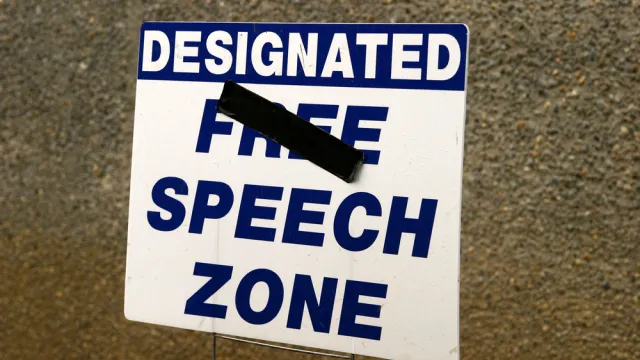
Free Speech Zones
Free speech zones limit expressive activity to small and/or out-of-the-way areas. They are usually unconstitutional on college campuses.
Nor is UMD the only public university in Maryland making missteps when it comes to students’ expressive rights. Towson University’s policy on expressive activities requires students to give notice three business days in advance for all planned expressive activities involving more than 10 people. Even if such an activity initially involves fewer people than that, the university will still move it to “one of the Designated Demonstration Areas” when it grows beyond this threshold.
But 10 people is simply far too low a threshold. After all, Towson has nearly 20,000 students. If a group of 11 friends wants to gather in the quad and speak, protest, or hand out literature, they shouldn’t be forced to give advance notice or move to a specific area. FIRE has long observed how this sort of micromanagement can function like a free speech quarantine, allowing schools to banish student and faculty speakers to tiny outposts on the fringes of campus.
It’s time for Maryland’s colleges and universities to put an end to these policies. HB 1322 would do that. Schools would be required to respect the publicly accessible outdoor areas of campus as forums for student expression, subject only to reasonable time, place, and manner limitations. Similar protections prohibiting “free speech zones” — really, areas where free speech is quarantined — have already been enacted in 24 states. If Maryland joins them, it will enshrine essential protections for years to come.
Recent Articles
Get the latest free speech news and analysis from FIRE.

Why you should talk to strangers w/ Fin Colleton and Kratima Divakar
Podcast
Silencing social media won’t stop the unrest in France
FIRE is bringing the Free Speech Forum to the West Coast!