Table of Contents
Free Speech Zones
Research & Learn
On far too many campuses nationwide, universities restrict students’ expressive activities to limited areas — so-called “free speech zones.” College campus free speech zones, like any other unreasonable restriction on a public forum, are unconstitutional.
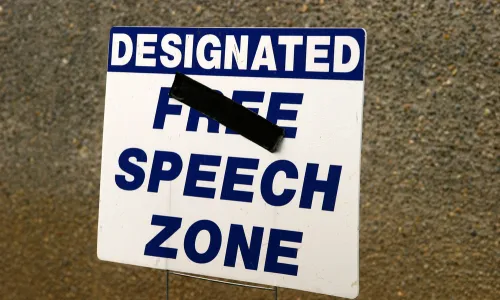
What are free speech zones?
A "free speech zone" is a designated area of a college or university campus where students, faculty, or visitors are permitted to engage in activities such as protesting and displaying signs, giving speeches, petitioning, leafleting, or preaching. In some instances, free speech zones represent a tiny fraction of the open, public space on campus, and too often, colleges and universities maintain policies that limit public displays of student and faculty expressive activities to out-of-the-way areas on campus.
At public universities, free speech zones are often in tension with the First Amendment. As government actors, public colleges may lawfully impose reasonable “time, place, and manner” regulations on campus expressive activity like speeches, protests, or literature distribution. But courts have been very clear that any such regulations must (1) be viewpoint- and content-neutral, (2) be narrowly tailored in service of a significant governmental interest, and (3) leave open ample alternative channels for expressive activity.
In other words, a college or university could ban the use of amplified sound near dorms after 10 p.m., or prohibit students from protesting in a way that blocks roadways or the ability of others to exit or enter campus buildings. In both of those cases, the university’s regulation is reasonable, is generally applicable regardless of the viewpoint expressed, is narrowly tailored in service of a significant governmental interest, and leaves students with other means to express themselves.
Even though speech zone regulations are ostensibly content neutral (everyone must comply, regardless of subject or speaker), it is difficult to argue that the actual dismantling of traditional and designated public forums — and the confinement of free speech that results from this — is a regulation that is “not substantially broader than necessary” to achieve the university’s purpose. Likewise, at private universities that promise students freedom of expression, free speech zones are at odds with their own commitments to free speech.
Students who wish to use free speech zones often have to comply with onerous requirements. For example, they may have to register an event with administrators weeks in advance, or adhere to strict time limits on their expressive activity. By treating campus expression as something to be hidden, regulated, and monitored instead of encouraged and celebrated, colleges and universities that exile expressive activity to “free speech zones” teach students the wrong lesson about life in our liberal democracy.

Examples of free speech zones
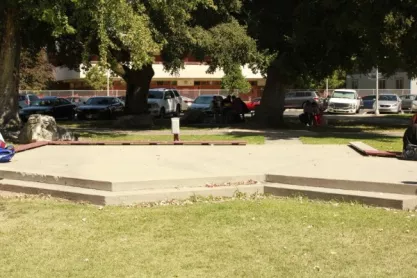
In contrast, there’s nothing “reasonable” about most free speech zones. For example, Modesto Junior College in California required students to request administrative permission to use the school’s tiny free speech zone (described by one administrator as a “little cement area”) at least five days in advance, and would only allow each student to use the zone for eight hours per semester. It took a federal First Amendment lawsuit coordinated by FIRE to change the policy.
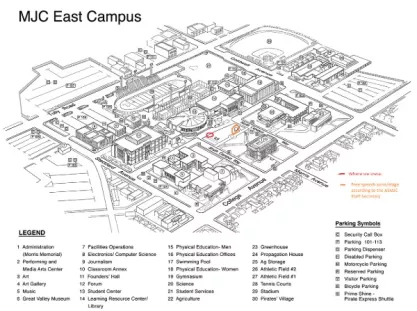
And, below, a photo of the actual cement slab.
Similarly, Valdosta State University in Georgia abandoned its free speech zone only after FIRE intervened. Until the policy revision, Valdosta State had limited free expression on its entire 168-acre campus to one small outdoor stage. What’s more, Valdosta State had allowed students to use the stage only between the hours of noon and 1 p.m. and 5 to 6 p.m., and even then only on weekdays — hardly the “reasonable” time, place, and manner restrictions permitted by law.
In July 2014, FIRE launched our Stand Up For Speech Litigation Project (SUFS), through which we coordinated legal challenges to numerous free speech zone policies nationwide. We’ve challenged free speech zones on behalf of a student distributing animal rights literature at California State Polytechnic University, Pomona; a student advocating for Second Amendment rights at Blinn College in Texas; a student asking fellow students at California’s Citrus College to sign a petition protesting the National Security Agency; and a Los Angeles Pierce College student handing out Spanish-language copies of the Constitution. FIRE also challenged policies at University of Hawaii at Hilo, California State Polytechnic University, Pomona, Modesto Junior College, and Blinn College, where a student was told she would need “special permission” to display a gun rights sign and collect signatures for a student group on campus. Beyond the schools directly affected, FIRE has put other public colleges and universities on notice that they maintain free speech zones at their legal peril, almost certainly prompting additional revisions.
As these lawsuits demonstrate, free speech zones are often outrageous. (After all, Americans largely think of the entire country as a “free speech zone.”) The good news is that FIRE has made significant progress in the fight against them.
Fighting free speech zones
Thanks in part to our successful lawsuits, FIRE’s annual Spotlight on Speech Codes survey of college and university speech policies indicates that fewer campuses maintain free speech zones each year. In 2013, our research found that roughly 1 in 6 surveyed institutions, or about 16 percent, quarantined expression to a free speech zone. As of 2018, that ratio had fallen to roughly 1 in 10, and by 2022 it had dropped even further to 1 in 20 institutions.
Spotlight on Speech Codes
FIRE surveys speech codes at America’s top colleges and universities, providing readers with key data on individual schools and national trends.
This welcome trend has been accelerated by states passing anti-free speech zone legislation inspired by model legislation authored by FIRE. As of December 2018, eleven states had enacted laws prohibiting these restrictive policies: Virginia, Missouri, Arizona, Kentucky, Colorado, Utah, North Carolina, Tennessee, Florida, Georgia, and Louisiana.
However, based on our interactions with students around the country, we know that the problem is far from solved. There’s still work to do. Despite being rejected by both courts of law and the court of public opinion, free speech zones may still be found at our nation’s colleges and universities. That’s where FIRE comes in: If your campus maintains a free speech zone, we want to hear about it.
Additional reading on free speech zones
- "VICTORY: Speech rights of 150,000 students to be restored as Los Angeles Community College District settles lawsuit, will abandon Pierce College’s tiny free speech zone" (Dec. 13, 2018).
In November 2016, [student plaintiff Kevin] Shaw attempted to distribute Spanish-language copies of the U.S. Constitution and recruit members for a new chapter of the student organization Young Americans for Liberty along the main campus thoroughfare at Pierce College. He was approached by an administrator who told him that he could not distribute literature outside the free speech zone, a tiny, 616-square foot area comprising about .003 percent of the total area of the college’s 426-acre campus.
Shaw was also told that he must fill out a permit application to use the free speech zone — requiring him to get a permission slip to exercise his First Amendment rights. He was informed that he would be asked to leave his own campus if he refused to comply.
- "Bill to prohibit campus ‘free speech zones’ introduced in U.S. Senate," Tyler Coward, (Feb. 9, 2018).
The bill, called the “Free Right to Expression in Education Act,” would prohibit public institutions of higher education from quarantining free expression into small, misleadingly labeled “free speech zones” on their campuses. If enacted, the measure would free tens of thousands of public university students from these restrictive, unconstitutional zones.
- "For Olympic Free Speech Zones, China Takes Page From American Universities," Will Creeley (July 24, 2008).
Designating special protest zones? Requiring permits for expressive activity? Reviewing the content of that expressive activity in advance?
Sounds suspiciously like China has been studying up on the methods employed by some universities over here in the States, because the similarities are too obvious to ignore.