Table of Contents
Frank Kameny was fired for being gay. What he did next changed America.
FIRE / Chris Henke
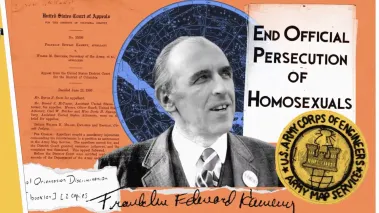
This year, the United States celebrates its 250th anniversary. To commemorate the occasion, FIRE is proud to present the limited series “Figures of Speech,” looking at the heroes and villains of free speech in American history. We began with Joseph McCarthy, the senator who scared America silent. Then we looked at Thomas Paine, American history’s winter soldier. Now we turn to Frank Kameny, one of the great leaders of the early gay rights movement.
It’s hard to think of an American whose life better illustrates the effectiveness of free expression than Frank Kameny.
Born in 1925 and raised in the Richmond Hill section of Queens, Kameny was provided with a solid middle-class upbringing by his father, an immigrant from Poland, and his mother, a secretary from the Lower East Side. As a child, Kameny looked to the stars at night and settled on becoming an astronomer to uncover the secrets of the universe. His own secret would stymie those plans, but his response to adversity changed the course of history.
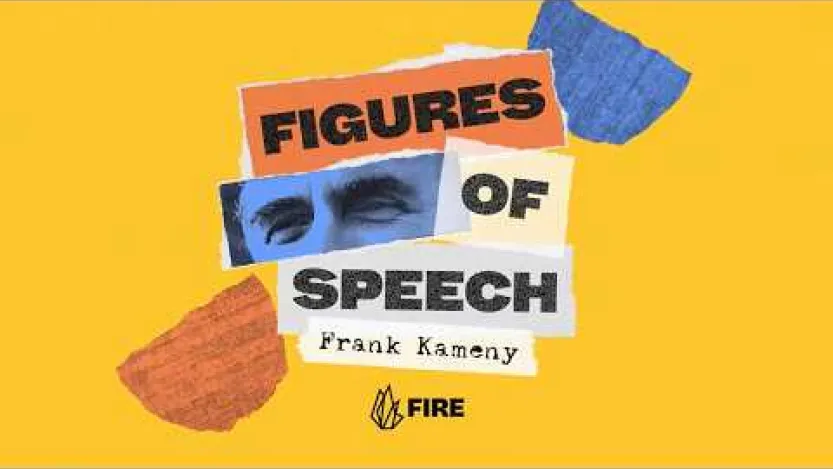
After seeing frontline combat in Europe, Kameny earned a PhD in astronomy at Harvard, and in the fall of 1956, he moved to Washington, DC, to take a teaching job at Georgetown University.
Kameny’s skills were in high demand. The Cold War competition with the Soviets was expanding into outer space, and the following year, he was hired by the Army Map Service, the military’s cartographic agency. His passion for celestial exploration mirrored a personal process of self-discovery, as he began surveying the city’s subterranean gay scene, spending most evenings at one of the handful of gay bars or at private after-hours parties. Fulfilled by his job, confident in his abilities, and increasingly comfortable in his identity as a homosexual, Kameny saw a future for himself as bright as the stars he had begun to gaze at through the starter telescope his parents gave him as a child.
And then his secret caught up with him. On Oct. 4, 1957, the Soviets officially kicked off the space race by launching the first satellite, Sputnik 1, into orbit around the Earth. Kameny at the time was conducting fieldwork at an observatory 12,000 feet above sea level, on the Big Island of Hawaii. It was an inconvenient place to be when, just a few weeks later, a letter arrived from the Civil Service Commission ordering him back to Washington within 48 hours.
After Kameny arrived in Washington, he waited several weeks before he was summoned to a meeting at Army Map Service headquarters. Upon his arrival, a pair of investigators from the CSC were waiting. They had in their possession the record of his arrest the previous year in a San Francisco public restroom on charges of disorderly conduct. Kameny, according to the report, had solicited sex from an undercover police officer.
How Anthony Comstock became America’s most powerful censor
Anthony Comstock turned Victorian panic into federal censorship, criminalizing “obscene” speech and policing American morality. This is his story.
“We have information that leads us to believe you are a homosexual,” one of the investigators stated. “Do you have any comment?”
At the time, homosexuality was illegal in all 50 states, classified as a mental disorder by the medical establishment, and condemned from the pulpits of every major religious denomination. All Kameny would tell them was that his sexual activity was none of their business. As far as his interrogators were concerned, this was as good as an admission of guilt. On Dec. 20, Kameny was duly fired, and his security clearance was revoked.
“Are Homosexuals Security Risks?” the gay magazine ONE had asked on the cover of its December 1955 issue. Noting that “howls of righteous indignation” had been raised when Sen. Joe McCarthy smeared Gen. George Marshall as a Communist puppet, the editorial lamented the conspicuous lack of “protest against the infamous blanket dismissal of homosexuals from government jobs without a public hearing.”
There were no civil libertarians willing to defend the due process rights of homosexuals as they did those accused of disloyalty. In January, the American Civil Liberties Union, founded in 1920 “to defend and preserve the individual rights and liberties guaranteed to every person in this country by the Constitution and laws of the United States,” had decided that it was “not within the province of the Union to evaluate the social validity of laws aimed at the suppression or elimination of homosexuals” from public employment.
Prohibited from working for the federal government, Kameny applied for jobs in the private sector. But because President Dwight Eisenhower’s Executive Order 10450 prohibiting homosexuals from government employment applied to contractors, this Harvard-trained astronomer eager to serve his country at the height of its interstellar competition with the Soviet Union was rejected everywhere he looked. With no source of income and his savings drying up, Kameny accommodated himself to a penury that would remain a constant throughout the rest of his life. Over one particularly difficult eight-month period, he subsisted on twenty cents’ worth of food a day. A pat of butter for his mashed potatoes costing five cents was a luxury he could rarely afford.
Though he had been, by his own description, “shy and retiring” as a young man, Kameny was “radicalized” by the way his government had treated him. How could his homosexual orientation possibly affect his work as an astronomer or, as he one day hoped to be, an astronaut floating hundreds of miles away from Earth’s surface? On the contrary, it was the government that had wronged him. “I simply felt something had to be done,” he recalled.
And so, Kameny did what no gay man or woman in his position had yet done: He fought back.
Thomas Paine: American history’s winter soldier
Two hundred fifty years after "Common Sense," Thomas Paine’s life reminds us that free speech and free thought are the lifeblood of a free society.
In late 1958, after a futile year spent searching for work, Kameny contacted the ACLU. In line with its position of neutrality regarding the “suppression or elimination of homosexuals,” the national organization declined to take up his case. But it referred him to its Washington, DC, chapter, where a sympathetic staff attorney acting in a personal capacity helped him file a lawsuit against the army in district court. In so doing, Kameny became the first private citizen to challenge the federal government over its discrimination against homosexuals, a deed made more noteworthy by his decision to attach his name to the case rather than post it to the docket pseudonymously.
It’s hard to overstate the magnitude of the cost to Kameny as an individual, or the significance of the societal changes he would achieve, by openly confronting the government over its oppression of homosexuals.
On Dec. 22, 1959, district court judge Burnita Matthews granted the federal government’s motion to dismiss Kameny’s case against the army, and the following August, the U.S. District Court for the District of Columbia denied his petition for rehearing. To Kameny, whose determination to right the wrongs inflicted upon him would only grow stronger with each and every obstacle placed in his way, these were but temporary setbacks. Announcing his intention to continue his legal challenge, alone if necessary, the accidental activist set the tenor for what would be a decades-long campaign for equality:
I am not a belligerent person, nor do I seek wars, but having been forced into a battle, I am determined that this thing will be fought thru to a successful conclusion, come what may, and that as long as any recourse exists, I will not be deprived of my proper rights, freedoms and liberties, as I see them, or of a career, profession, and livelihood, or of my right to live my life as I choose to live it, so long as I do not interfere with the rights of others to do likewise.
Opening the nation’s closet door ever so slightly, Kameny lit a path for millions of men and women to follow him out. In 1961, he cofounded the Mattachine Society of Washington, DC, one of the country’s first gay rights organizations. Four years later, he organized the first gay rights protest outside the White House.
His constant lobbying, litigating, and lecturing helped bring about substantial change, from the American Psychiatric Association’s removal of homosexuality from its Diagnostic and Statistical Manual of Mental Disorders in 1973 and the Civil Service Commission’s lifting of its ban on gay employment in 1975. In 1971, he became the first openly gay person to run for Congress when he campaigned to be the District of Columbia’s non-voting delegate.
A clear and consistent advocate of the First Amendment, Kameny happily debated all comers and defended their right to speak no matter how passionately he disagreed with their views. The fruits of this successful strategy can be seen all around us, in a country more open, equal, and free.
Recent Articles
Get the latest free speech news and analysis from FIRE.
Your speech, their rules: How foreign governments censor Americans

New Mexico's $25 billion verdict against Meta is fundamentally about speech
Silencing social media won't stop the unrest in France