Table of Contents
Fearing controversy, schools cancel graduation speeches
Mutaz Albar / CC BY 3.0
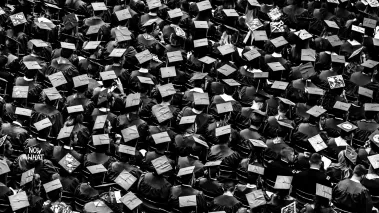
A student holds a sign saying "Now What" during a graduation ceremony in Indiana on May 3, 2014.
After studying engineering at Rutgers, Rami Elghandour began chasing a problem that has haunted medicine for decades — how to teach the body to kill cancer cells without destroying itself in the process. This spring, his biotechnology company, Arcellx, unveiled a treatment that moves the science closer to that goal than ever before. In conference halls and investor calls, the reaction bordered on astonishment. Last month, Gilead Sciences bought Arcellx in a deal valued at $7.8 billion.
Elghandour credits much of his success to his mother. In 1989, she left a comfortable life in Egypt, and the fashion boutique that was her lifelong dream, for the uncertain promise of opportunity in America. Watching her rebuild her career shaped his own approach to leadership. Each year, for example, he hosts about 60 students from Rutgers’ Road to Silicon V/Alley program. The meetings often go long, but Elghandour is happy to take the extra time, he says, “because it is refreshing to talk openly about the things that matter to students.”
So it was no surprise when Rutgers invited Elghandour to give the engineering school’s graduation speech this year. But the speech was promptly canceled after students (about five of them, Elghandour estimates) complained about remarks he’d made on social media. The school specifically cited one post in which he opined that Israel was committing genocide and “running dungeons where they train dogs to sexually assault prisoners.” In other words, a former student returning as a billionaire innovator at the forefront of cancer research was prevented from addressing 800 students because a handful of them disliked his politics. Regardless of one’s feelings about Elghandour’s opinions, there’s no denying that this is a standard that could be used to torpedo virtually any speaker, with opinions on this or any other topic. Elghandour later said this sends a dangerous message to students. Namely, “Don’t you dare speak up and say anything that you believe.”
A pattern emerges
As though to prove that point in the most obvious way possible, earlier this month, Dr. Morton Schapiro withdrew as the commencement speaker for Georgetown University Law Center after students protested his selection due to his support for Israel. Maybe it’s just the Israeli/Palestinian issue? No such luck. Around the same time, Congressman Rich McCormick said he still plans to speak at Morehouse School of Medicine – his alma mater – despite student backlash over the fact that he supports restricting immigration and has introduced legislation to prohibit using federal funds to perform transgender surgery on minors. Meanwhile, Drexel University’s College of Computing and Informatics’ original commencement speaker, David Kaganovsky, “mutually agreed” to step back from speaking after his “problematic social media posts came to students’ attention.”
Unfortunately, year after year, school after school has decided that it’s easier to cancel graduation speeches (or pressure speakers to drop out) than brave a threatened controversy. The only way to avoid that would be to find a speaker who has never made a controversial remark in their life (or, at least, not online). But who wants to hear a speech from someone like that? As Will Creeley, FIRE’s legal director, has said, “If we treat ideas we don’t agree with as barred from campus, then really what’s left are only the most inoffensive, and by extension most uninteresting, folks.”
In a recent piece, “Cracking down on graduation speeches won’t solve the problem on campus,” the editorial board of The Washington Post notes that American universities are under incredible pressure to prove they are addressing rising antisemitism. (In the past, other issues have been at the forefront, of course, with similar results.) This pressure can result in positive change, but it also inevitably produces “performative measures that border on censorship.” As an example, the board cites New York University’s decision this past March to end live speeches entirely at some of its graduation ceremonies:
This is a lazy way to prevent more embarrassment because it avoids addressing the fundamental problem, which is that universities still need to do a better job of preparing students to engage in civil and respectful discourse once they enter the real world . . . too many elite college campuses became crucibles of conformity in recent years. People with unpopular ideas too often got shouted down or even canceled. Criticizing Israel became a shibboleth.
The solution is not to shut down live speeches. It’s to teach kids that using a graduation ceremony to scream and yell about their personal political views is a stupid and ineffective way to make the world a better place. The Foundation for Individual Rights and Expression says that it’s ultimately up to the university how it wants to format its ceremonies, which is correct, and that it’s good to allow community members to “express themselves liberally on campus.”
Instead of live speeches, the school has decided to play pre-recorded remarks by student speakers on a jumbotron while the speakers themselves sit silently on stage. As Steven Thrasher writes for Literary Hub, “Seeing ‘speakers’ sit on stage, mute, while a video of themselves is played for their parents will make them seem, I imagine, as if they are presenting a ‘proof of life’ video from their kidnappers before being allowed to get their diplomas or leave the stage.”
This is not a new problem. FIRE’s deplatforming database documents instances of campus censorship going back to 1998. Amazingly, 48% of all deplatforming efforts succeed, with 959 out of 2,000 recorded attempts resulting in a cancellation, disruption, or a similar outcome. Since 2014, the problem has exploded. In the 12 years since, our data shows that 67% of all recorded deplatforming attempts have taken place in this span of time. Commencement speakers make up about 19% of all campus disinvitation campaigns, targeting 382 speakers out of 2,000 total disinvitation efforts. Why does it keep happening?
After a few colleges cave to disinvitation attempts, they provide cover for others to do the same. Today’s would-be disruptors now have a surfeit of disinvitations to draw inspiration from. Two schools in particular, which we will look at below, illustrate this dynamic in stark relief. They also share a troubling pattern: universities are hiding behind vague “safety concerns” rather than standing up to political pressure campaigns.
Utah Valley bends the knee
In the wake of Charlie Kirk’s assassination on its campus last September, Utah Valley University vowed to strengthen protections for free speech and planned a civic education program to that effect. But only a few months later, Sharon McMahon, the bestselling author and civics educator dubbed “America’s government teacher,” was uninvited from giving a graduation speech at the school for being “anti-Charlie Kirk.”
The problem began when Jack Posobiec, a host and contributor at Turning Point USA, the conservative nonprofit co-founded by Kirk, commented on the decision to invite McMahon. He wrote on X, “What is going on here, @uvu_president?” State Rep. Trevor Lee replied that taxpayer funds should be withheld from the school. Senator Mike Lee also voiced opposition, and UVU College Republicans followed suit.
Their objection? After Kirk was killed, McMahon made a post — since deleted — listing quotes from Kirk along with the caption, “These aren’t sound bites taken out of context. Millions of people feel they were harmed, and the murder that was horrific and should never have happened does not magically erase what was said or done.”
How two Clemson professors fought a wave of censorship
After Clemson fired faculty over posts about Charlie Kirk’s killing, two professors spoke out — and earned a Berkson Award in the process.
The pressure campaign worked. UVU withdrew its invitation, citing “increased safety concerns,” and proceeded without a speaker for the first time, leaving 13,400 graduates — about one-third of whom are the first in their families to graduate from college — without a keynote address. But these safety concerns did not arise in a vacuum. As McMahon said, “The security issues really did not even come about until there was a coordinated effort on the part of Utah’s state and federal lawmakers and Turning Point USA to try and pressure the school into canceling.”
If true, the irony is painful. This is the very campus where Kirk was murdered for speaking his mind. The lesson its administration appears to have drawn from that tragedy is not that free expression must be defended at all costs, but that controversial speakers should simply be kept away from the podium. At Utah Valley, the fear of blowback has now become an institutionalized reason to silence speech. This is a textbook example of how threats of violence are used to launder political censorship under a palatable “safety” rationale, and how jawboning by government officials can coerce a public university into silencing a speaker it had freely chosen.
In a biting essay for The Free Press, “Why The Campus Where Charlie Kirk Was Killed Canceled My Speech,” McMahon wrote, “The First Amendment and Utah law protected Charlie Kirk’s right to speak on a public campus. It protects students’ right to protest against him. It protects my right to condemn his murder while speaking honestly about his public rhetoric. It protects a Utah citizen’s right to criticize me. But it does not protect public officials who use the power of their office to make a public institution punish a citizen for protected speech. That is the difference between criticism and coercion.”
South Carolina State picks a fight
The situation at South Carolina State University — the state’s only publicly funded historically black university — raises equally troubling questions about who actually controls the commencement stage. The school invited current Lt. Gov. Pamela Evette, who is also running for governor in the Republican primary, to speak at its commencement in May. But before any public announcement was made, students organized protests, a petition quickly gathered more than 20,000 signatures, and Alexander Conyers, the university’s president, caved to the pressure.
“This felt like a slap in the face to me and my fellow graduates,” said Summer Gray, a senior at the school who started the petitions to get Evette’s speech canceled. “What made me start this petition is the fact that they invited a speaker who is against everything we believe in as HBCU students. She openly stated that she is against DEI, and coming to speak to people of color with that belief is disrespectful.”
Of course, students have every right to organize, petition, and protest a speaker selection. But rather than standing by its invitation or articulating a principled reason for the change, the school defaulted to the same “safety” rationale, without saying whether any concrete threat had been made.
This case also highlights how such cancellations, regardless of the speaker’s political affiliation, invite escalating retaliation. After the school canceled her speech, Evette reposted a letter from a small group of Republican lawmakers asking the House Ways and Means Committee chair to cut more than $35 million in state funding proposed for the university next year. Evette added, “The far left has silenced freedom of speech and pushed its radical, anti-American agenda for far too long . . . not one dime of taxpayer money should ever go to a school that discriminates against conservative views. It certainly won’t happen when I’m governor.”
NYU holds its ground, kind of
Students at NYU similarly organized to object to Dr. Jonathan Haidt as a graduation speaker. In a letter to the university, student government leaders called Dr. Haidt's selection "deeply unsettling," arguing that another speaker would “more accurately reflect the values and diversity of its graduates." This disinvitation attempt is especially ironic given that Dr. Haidt is an outspoken critic of cancel culture and co-author of The Coddling of the American Mind, which argues that schools have cultivated a mentality of fragility and emphasized personal safety and comfort over problem-solving and critical thinking skills. Thankfully, unlike South Carolina State and Utah Valley, NYU decided to stand by Dr. Haidt's invitation.
This is not to say that NYU is a bastion of speech protection, as the university has severely cracked down on student speech at graduations. In 2025, NYU faced backlash for withholding a student’s diploma after he spoke during his graduation speech about the “genocide currently occuring.” And, as noted above, NYU is now using pre-recorded speeches, despite, as students have pointed out, recently pushing forward an initiative to get students off screens and interacting in person.
Cracking down on student speakers
NYU is not the only university cracking down on student speakers. In 2024, the University of Southern California canceled valedictorian Asna Tabassum’s speech, citing “security risks.” As is often the case, the university never specified what, if any, threats had been made. It did, however, indicate to Tabassum that the decision was based on her pro-Palestinian activism. After backlash to the cancellation of her speech, multiple invited alumni speakers were also canceled. Tabassum later wrote:
As your class Valedictorian, I implore my USC classmates to think outside the box . . . I challenge us to respond to ideological discomfort with dialogue and learning, not bigotry and censorship.
The following year, George Washington University investigated a student who called for divestment from Israel during her speech. MIT’s class president was barred from her own graduation ceremony after giving a pro-Palestinian speech during commencement the day before, in which she said “free Palestine,” adding, “the MIT community that I know would never tolerate a genocide.”
Now, during the 2026 commencement season, some schools are taking a more proactive approach to avoid controversy. Like NYU, CUNY School of Law has also reportedly nixed live speeches. Stanford tried to ban student speeches, but reversed course in response to student and faculty pushback. NYU and other schools are also announcing limitations on what speakers can wear — no decorated caps, sashes, stoles, cords, pins, or scarves.
Conclusion
From a purely legal perspective, schools having speakers make only pre-recorded speeches is fine. It’s their event, and universities and colleges can decide what they want to focus on and what kind of comments are out of bounds. If the school doesn’t want people to promote their parents’ businesses, discuss their sexual preferences, or share their political beliefs, that’s their call. But it is sad to see academic institutions so seemingly afraid of their own students, including students who won’t even be on campus any longer.
And, in making these cowardly decisions to revoke invitations or limit student speech, universities often only succeed in creating new or additional controversy while eroding already crumbling student and faculty trust in university administrations to protect speech.
Recent Articles
Get the latest free speech news and analysis from FIRE.
Venezuela is a cautionary tale w/ Jim Epstein and Germania Rodriguez Poleo
Podcast
FIRE sues Los Angeles City Council over policy banning certain words during public comment
It was never just going to be about keeping kids off social media