Table of Contents
Woodrow Wilson: America’s worst president for free speech
Jackson Fleagle / FIRE
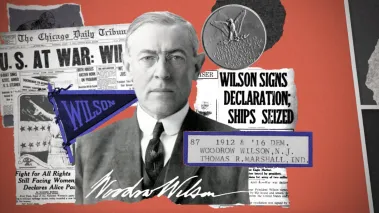
This year, the United States celebrates its 250th anniversary. To commemorate the occasion, FIRE is proud to present the limited series “Figures of Speech,” looking at the heroes and villains of free speech in American history. We began with Joseph McCarthy, the senator who scared America silent. Then we looked at Thomas Paine, American history’s winter soldier. Now we turn to Woodrow Wilson, our worst president when it comes to free speech.
On Feb. 9, 1919 — the eve of an ill-fated vote on the 19th Amendment — the National Woman’s Party burned President Woodrow Wilson in effigy.
Suffragettes had been protesting outside the White House for years at this point, and were furious with Wilson’s disinterest in supporting their cause. After years of pressure, Wilson had finally paid lip service in support of the cause, but this commitment had come without action. “We burn not the effigy of the President of a free people, but the leader of an autocratic party organization,” suffragist Sue White declared. This sentiment was echoed by protest signs and banners that read “The President is responsible for the betrayal of American women,” and “He preaches democracy abroad and thwarts democracy here.”
These criticisms were right.
Wilson had become quite successful at denying people their right to be heard. By 1919, he had secured his reputation as the worst president for free speech in American history. Thousands of arrests, prosecutions, convictions, and even deportations for speech occurred under his stewardship and instruction. He had even successfully established the first modern propaganda institution in American history, which also controlled and stifled the dissemination of any speech counter to his preferred narratives.
Wilson’s iron grip on American speech was short-lived, but devastating at a scale not seen before or since.
Thomas Woodrow Wilson was born in Staunton, Virginia, on Dec. 28, 1856, and grew up in the midst of the Civil War and Reconstruction eras. He was one of only two presidents, the other being John Tyler, to have been citizens of the Confederate States of America. It was an upbringing that was consistent with the racist policies and sentiments Wilson would carry with him into the White House. He later re-segregated the federal government and promoted Ku Klux Klan propaganda, such as by showing the film The Birth of a Nation at the White House and lavishly praising it.
Wilson would study history, political philosophy, and German before earning his PhD in history and political science. Soon after, he became president of Princeton University, where he became a prominent advocate for progressive education. He later served as governor of New Jersey from 1911 to 1913, wherein he engaged in various progressive actions including antitrust laws and workers compensation legislation, as well as reforms regulating child labor and increasing standards for factory working conditions. This won him widespread recognition as a leader in the Progressive movement and made him a prominent contender for the presidency, which he won in 1912.
How Anthony Comstock became America’s most powerful censor
Anthony Comstock turned Victorian panic into federal censorship, criminalizing “obscene” speech and policing American morality. This is his story.
When World War I broke out in 1914, Wilson was praised for maintaining neutrality and keeping America out of the conflict, as well as for attempting to broker peace between the warring powers. His position was so popular, in fact, that it was used extensively during his reelection campaign, which used the slogan “He Kept Us Out of War.”
This, however, wouldn’t last — nor would his overall approval by the masses.
In 1917, after several military escalations, the United States officially declared war against Germany and Austria-Hungary. It soon became important to Wilson to not only succeed in the war effort, but to garner support and tamp down on any opposition. Via executive order, Wilson formed the Committee on Public Information to influence public opinion through the use of all available media — including posters, pamphlets, newspaper releases, films, school campaigns, and more. A volunteer pool of 75,000 men was recruited for the effort, which spanned the country in various languages and formats.
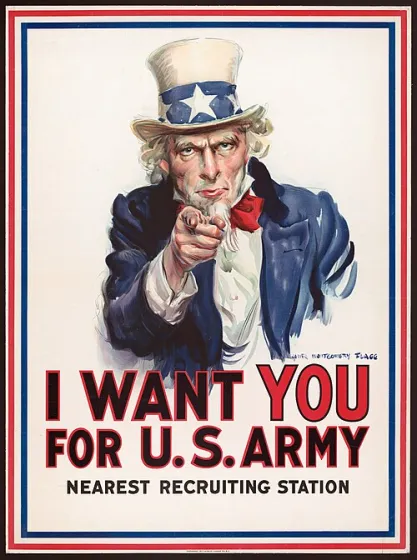
Importantly, the Committee’s duty also included the suppression of any news or sentiment that ran counter to the pro-war narrative — of which there was plenty. Under the leadership of investigative journalist George Creel, the CPI pressured American media outlets to censor news stories. It also coordinated with various other government agencies, including the Post Office, to stifle the dissemination of dissident messaging. In his memoirs, Creel would later gloat that the CPI “reached deep into every American community” and that there “was no part of the great war machinery that we did not touch, no medium of appeal that we did not employ.”
All of this occurred at Wilson’s direction, but the censorial efforts didn’t end there. Shortly after the U.S. entered the war, Congress passed the Espionage Act at Wilson’s behest. The law granted postal officials the authority to ban and prevent the circulation of newspapers from the mail, and declared that anyone convicted of obstructing the draft would face a $10,000 fine and up to 20 years in jail. With this newfound power, the government was able to destroy the distribution channels of more than 70 publications deemed disloyal to the cause.
This was the motivating factor for Wilson: silence any and all dissent. “If there should be disloyalty,” he wrote in a letter to Congress, “it will be dealt with a firm hand of repression.”
The Espionage Act was soon amended into what would become the Sedition Act of 1918, granting even more censorial powers to the government. The revised law maintained the Espionage Act’s control of content sent through the mail, but also criminalized anyone who interfered with the draft or who willfully made “false statements with intent to interfere with the operation or success of the military or naval forces of the United States.”
Perhaps most critically, the Sedition Act also criminalized anyone who would “willfully utter, print, write, or publish any disloyal, profane, scurrilous, or abusive language about the form of government of the United States, or the Constitution of the United States, or the military or naval forces of the United States.” This put into the government’s crosshairs anyone who advocated for labor strikes, campaigned against the draft, showed support for countries at war with the U.S., or who could have been interpreted as having lied about any of it.
Frank Kameny was fired for being gay. What he did next changed America.
After losing his career for being gay, Frank Kameny challenged the government and helped spark the modern gay rights movement.
With that, President Woodrow Wilson had granted himself and his administration immense power to silence speech, stifle dissent, and control the American narrative through the remainder of the Great War. Under his leadership, more than 2,000 prosecutions, 1,000 convictions, 4,000 arrests, and 800 deportations occurred in response to speech considered incitement to violence, espionage, sedition, and wrongthink. This includes the infamous Palmer Raids as well as the First Red Scare — a series of tribunals, arrests, and suppression attempts against suspected communists, socialists, anarchists, labor unions, and other dissenters.
There’s a poetic symmetry to the fact that Wilson wasn’t actually in the White House the day he was burned in effigy. He had been in Paris for weeks helping to formalize an end to World War I — and playing a major role in the founding of the League of Nations. But the reverberations of his censorial policies continued without him. Dozens of protesters were arrested that day — so many, in fact, that police had to commandeer private vehicles to transport prisoners once their paddy wagons were full.
As predicted, the Senate vote on the 19th Amendment did not pass the following day. It would be subsequent pressure from suffragists and a vote during a special session of Congress — called by Wilson, who was increasingly concerned about his administration’s reputation — that would allow the Amendment to pass in May of 1919. It was ratified a year later, officially giving voice to those who to that point had been silenced.
Wilson suffered a debilitating stroke in October 1919, ending his aspirations for a third presidential term. He died in February of 1924 at the age of 67, and he has remained a controversial figure ever since. While many praise his progressive policies and work in antitrust and labor legislation, as well as his efforts to secure peace during World War I, his overt racism and expansion of federal power draw significant and rightful criticism.
But it is his devastating and draconian crackdown on free expression, which remains unmatched on American soil, that makes Woodrow Wilson one of the worst villains for free speech in our nation’s history.
Recent Articles
Get the latest free speech news and analysis from FIRE.

Venezuela is a cautionary tale w/ Jim Epstein and Germania Rodriguez Poleo
Podcast

FIRE sues Los Angeles City Council over policy banning certain words during public comment

It was never just going to be about keeping kids off social media