Table of Contents
How two Clemson professors fought a wave of censorship
FIRE
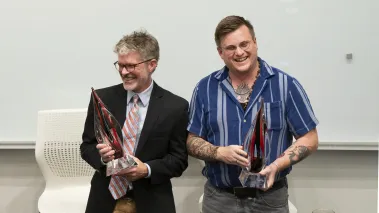
Clemson faculty members Charlie Kurth, left, and Mike Gregory, right, receive the Berkson Courageous Colleague Award.
The shock hit Clemson before the facts had fully settled. Charlie Kirk was dead. Within minutes, the ghastly footage of his murder circulated online. For many, the initial response was horror. Others found the killing justified. Some even joked about it.
At Clemson University, students gathered hours after the attack to mourn Kirk, the founder of Turning Point USA. But the sadness was soon accompanied by an ominous chilling effect on speech as administrators began targeting any faculty or staff perceived to have justified or celebrated the shooting.
“As free speech advocates,” FIRE’s Adam Goldstein wrote at the time, “it places us in a painful position. Charlie Kirk’s assassination was an attack on free speech and open discourse. In a free society, we must not be afraid to express our views, no matter how strongly some might oppose them. That’s the point of free speech. But it is precisely for that reason why we must not respond to mockery of Kirk’s assassination by canceling everyone who offends us: because that too creates a society where people are afraid to express themselves.”

Berkson Courageous Colleague Award
The award honors and celebrates faculty who go above and beyond to courageously defend their colleagues’ rights to free speech and academic freedom.
The award honors and celebrates faculty who go above and beyond to courageously defend their colleagues’ rights to free speech and academic freedom.
These words too often fell on deaf ears. In the immediate aftermath of the shooting, Clemson fired two professors for social media posts about Kirk’s death. One was Joshua Bregy, who shared a post saying, “Karma is swift and sometimes ironic,” as well as one of Kirk himself saying, “Play certain games, win certain prizes.” The other was Melvin Earl Villaver Jr., who called Kirk a racist and a white supremacist and shared multiple posts celebrating and mocking his murder. Clemson initially stood by the professors, but after public backlash, both were gone within days. Clemson also fired a third staff member.
But this particular story isn’t about them — it’s about two of their colleagues. When Clemson faculty members Mike Gregory and Charlie Kurth saw what was happening, they refused to stay silent about it. Socrates constantly pulled philosophical lessons from political events of the day, engaging with the fallout over Athens’ loss of the Peloponnesian War and Athenian anxieties about dissent. In that longstanding tradition, Gregory and Kurth likewise incorporated Kirk’s killing and its aftermath into their courses, using it to bring dry arguments about civic values to life to encourage students to join the conversation.
“The only way for people to stop being scared of difficult issues is to put them in front of them and let them handle it,” said Gregory. “People realize that it’s not scary, that we don’t need to be fragile with each other around these issues. There are good ways to talk to each other.”
When they saw Clemson fire their colleagues, Kurth and Gregory sprang into action. Gregory wrote an op-ed criticizing the school for “a pattern of capitulation” in punishing faculty, while Kurth put a sign on his office door reading, “My employer is morally bankrupt.” The sign generated some attention online, including from one former South Carolina House representative who posted his disapproval on X.
But Gregory and Kurth weren’t done. “We no longer know what speech will be tolerated or punished,” they co-wrote in an article for the Chronicle of Higher Education, “Who Will Clemson Censor Next?” The result, they added, was simple: “self-censoring and silence.”
Looking beyond Clemson at the larger wave of cancel culture in the wake of Kirk’s murder, they added, “Across these cases, universities appear less guided by consistent standards than by external outrage. Terms like ‘disruption,’ ‘misalignment,’ or ‘institutional values’ function as catch-alls, invoked only after political actors or social-media campaigns generate pressure. The result is a chilling effect in which speech protections hinge not on content but on who objects and how loudly.”
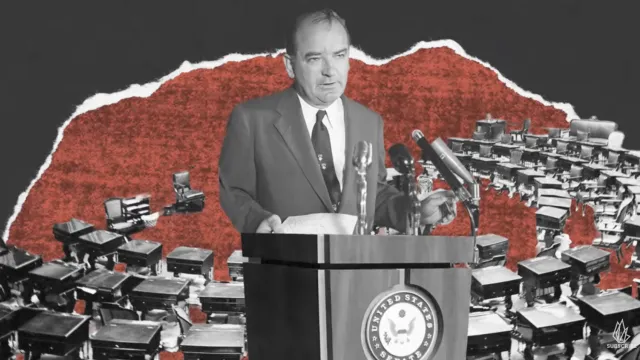
How McCarthy scared America silent
A paranoid senator, a terrified nation, and the birth of modern political censorship. This is the chilling story of how McCarthyism came to haunt America.
On May 6, FIRE visited Clemson’s campus to honor Kurth and Gregory with our second-ever Berkson Courageous Colleague Award for boldly defending the expressive rights of their colleagues. FIRE created the Berkson Courageous Colleague Award in 2023 to honor faculty who go above and beyond to defend free speech and academic freedom, oftentimes at personal or professional cost. The award is named for Mark Berkson, a professor at Hamline University who spoke out in support of a colleague who was fired for showing images of Muhammad in her art history class. Berkson embodied the award's values, namely courage in the principled defense of academic freedom and free speech, often at professional or personal cost.
At Clemson, FIRE hosted a 45-minute panel discussion with Gregory and Kurth in which they talked about defending free speech on campus in the midst of a firestorm of controversy around Kirk’s death. “I think that it can break through a bit of a chilling effect when you go public with some of these things,” said Gregory. “Of course, there’s risk. But the public nature of these things can have the effect of cutting through some chilling effects.”
Kurth said he wanted to remind the university that while it was probably getting a lot of pressure from politicians and donors, it had a duty — first and foremost — to its faculty and students. “The ability to speak publicly as Mike and I did,” he said, “and as others have done, is an important way to show that there are other constituents — the students, the faculty — who presumably the universities are here for, who need to be paid attention to as well.”
He added, “It’s not about checks. It’s not just about political influence. There has to be more.”
Recent Articles
Get the latest free speech news and analysis from FIRE.

Venezuela is a cautionary tale w/ Jim Epstein and Germania Rodriguez Poleo
Podcast
FIRE sues Los Angeles City Council over policy banning certain words during public comment

It was never just going to be about keeping kids off social media