Table of Contents
Colorado repeals e-filing requirement that attorneys pledge not to assist federal immigration enforcement
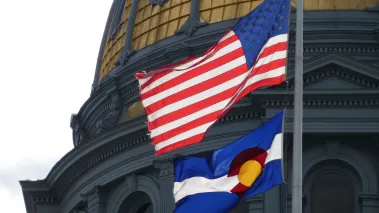
SamBrown711 / Shutterstock.com
DENVER, June 5, 2026 — After a public outcry, Colorado has repealed the state’s recently imposed requirement that private attorneys seeking to access the state’s court system pledge under penalty of perjury not to assist federal immigration enforcement.
On Thursday, Gov. Jared Polis signed into law House Bill 26-1276, the “Protect Safety of Individuals Who Are Immigrants” Act. Nestled in the bill’s language was a provision amending state law to clarify that Colorado rules against sharing information with federal immigration officials do not apply to private attorneys accessing the electronic filing system for state courts, ending a brewing First Amendment controversy.
“I’m glad that Colorado has backed down from a First Amendment fight they weren’t going to win,” said attorney Ian Speir, of Covenant Law in Colorado Springs, who first drew attention to the unconstitutional demand. “Colorado might be able to tell its own lawyers what they can say to ICE. But I work for my clients, not the government.”
Attorneys throughout the state received an emailed notice today informing them that, with the passage of the new bill, the certification requirement had been lifted. And not a moment too soon — if Colorado’s bill hadn’t repealed the requirement, the Foundation for Individual Rights and Expression was prepared to file a First Amendment lawsuit on behalf of Speir seeking an injunction to force the state to lift it.
“Under the First Amendment, the government cannot condition an attorney’s access to courts on a promise not to use information for a lawful purpose the state disfavors,” said FIRE senior attorney Greg Greubel, Speir’s counsel. “Kudos to Colorado legislators and the governor for acting quickly to resolve this issue, but it’s troubling that the state attempted this in the first place.”
In 2021, Colorado passed a law that required any third party accessing records managed by a state agency to certify under penalty of perjury that they will not provide private personal information to federal civil immigration enforcement. In 2025, Colorado passed a second law to expand the definition of “state agency” to include the legislative and judicial branches.
That second change in law went relatively unnoticed until March 2026, when Speir attempted to access the state’s e-filing system. For the first time, he was greeted with a prompt reading, in part: “I certify under penalty of perjury that I will not use or disclose personal identifying information . . . obtained from this database for the purpose of investigating for, participating in, cooperating with, or assisting in federal immigration enforcement.”
Speir was unable to proceed unless he certified his compliance with the state’s demands. And because Colorado requires attorneys to use the e-filing system to litigate in state court, he was effectively locked out of the legal system until he agreed to the certification.
Ultimately, Speir agreed to the terms under protest, for his clients’ sake. But rather than taking this violation of his First Amendment rights sitting down, he screenshot the prompt and alerted his X followers. “This is outrageous draconian overreach,” he said. Speir’s tweet went viral, receiving nearly 7,000 retweets and 15,000 likes, and prompted a House Judiciary Committee investigation.
The widespread outrage was certainly justified, as Colorado’s certification violated the First Amendment in multiple ways.
- The First Amendment requires that laws restricting speech be viewpoint neutral. But Colorado’s law plainly wasn’t — attorneys were allowed to share information in a way that hampers federal immigration enforcement, but were barred from using it to help federal immigration enforcement.
- The terms used in the certification were unconstitutionally vague. Attorneys have to know when they are or are not violating the law, but there’s no clear red line for when their speech crosses into “assisting” and “cooperating with” federal immigration enforcement.
- Colorado’s certification was not narrowly tailored to a compelling interest. If the state’s concern was simply the misuse of personal data, for example, there are already content-neutral rules that prohibit and punish attorneys who engage in that conduct. Colorado can’t impose a viewpoint-based speech restriction when narrower tools already exist.
Legal issues aside, Colorado’s bill set a terrible precedent that was all too likely to be replicated across the country. If blue states can force attorneys to pledge not to cooperate with federal immigration enforcement, there is no reason red states couldn’t force attorneys not to cooperate with, say, federal environmental or labor enforcement. Every attorney across the country would be at risk of becoming pawns of the state with each new foray into the culture wars.
Hopefully, Colorado’s new law marks the end of states attempting to lock access to the courts behind unconstitutional pledges. If not, FIRE remains ready to act.
The Foundation for Individual Rights and Expression (FIRE) is a nonpartisan, nonprofit organization dedicated to defending and sustaining the individual rights of all Americans to free speech and free thought — the most essential qualities of liberty. FIRE educates Americans about the importance of these inalienable rights, promotes a culture of respect for these rights, and provides the means to preserve them.
CONTACT:
Alex Griswold, Communications Campaign Manager, FIRE: 215-717-3473; media@fire.org
Recent Articles
Get the latest free speech news and analysis from FIRE.

VICTORY: New Jersey drops complaint against school board member targeted for asking constituents about taxes

FIRE sues Los Angeles City Council over policy banning certain words during public comment

It was never just going to be about keeping kids off social media