Table of Contents


When police treat free speech as suspicious activity
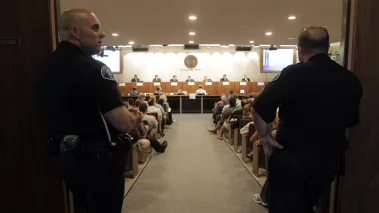
AP Photo/Jae C. Hong
Costa Mesa police Sgt. Phil Myers, left, and Lt. Mark Manley attend a city council budget hearing in Costa Mesa, California, June 21, 2011.
Think of a political or social issue you care about. Now imagine your local city council is considering taking some action related to that issue. You decide to show up to the public comment period and make your voice heard. Then you learn that local police will be monitoring the meeting, looking specifically for “unusual questions,” “verbal conflict,” “emotional confrontations,” “social media amplification,” and more. Such conduct will be treated as “suspicious behavior” posing “public safety risks.”
Would you think twice about freely sharing your opinion? Unfortunately, that thought experiment isn’t hypothetical. In a recent report, 404 Media published a bulletin from a government-owned intelligence hub called the Orange County Intelligence Assessment Center. The bulletin warned law enforcement to monitor a July 21, 2026, city council meeting in Costa Mesa, California, at which critics of automated license-plate reader cameras planned to express their concerns. “While no credible threats were identified directed towards this event,” the bulletin said, “overall public sentiment has been predominantly negative, with numerous online comments expressing opposition to the cameras and calling for their removal.”
California college police officer threatens to arrest student over anti-police flyers
A California college police officer threatened a student over anti-police flyers. The school retrained officers, but questions remain about students’ rights.
So because the public is expressing opposition online, police will now be watching the meeting for any “unusual questions” or “verbal conflict”? Whether you support surveillance technology or are certain it will be the death of freedom, you should be free to express that view without fear.
Of course, law enforcement agencies can develop legitimate concerns about monitoring and preventing actual threats to public safety at city council meetings. In fact, free speech values demand that they do so — violent responses to speech make the climate for free expression worse for everyone. Think of Charlie Kirk. Or Salman Rushdie. Or Gabby Giffords. Remember Martin Luther King Jr. and the magazine Charlie Hebdo. Violent attacks against controversial speakers not only violate the rights of the speakers, but have negative consequences for free speech in general. FIRE has found that half of students surveyed shortly after Charlie Kirk’s assassination in 2025 were “less comfortable attending or hosting controversial public events on their campus.” Supreme Court Justices Elena Kagan and Amy Coney Barrett testified before Congress this summer, describing rising threats to their physical safety.
Tragically, participating in public discourse in 2026 requires a certain amount of physical courage. Law enforcement is properly and crucially charged with preventing violent responses to controversial speakers. But when that vigilance turns into prophylactic tracking and monitoring protected speech, we have a problem.
First, encouraging the police to surveil First Amendment-protected activities, like speaking emotionally or asking unusual questions at public meetings, discourages people from engaging in those activities. Bulletins like the one 404 Media obtained create a chilling effect, causing people to self-censor. Elected officials should know how their constituents really feel about automated license plate readers, or any other contested issue.
Second, it’s a short drop from encouraging the cops to surveil protected speech to encouraging them to retaliate against that speech. After all, why should the cops monitor so-called “suspicious activity” if not to take some action when they encounter it? It’s not difficult to imagine a police officer relying on the intelligence bulletin as a permission slip to target critics of plate readers.
Third, law enforcement tracking of protected speech blurs what should be an extremely bright line between protected speech and true threats or actual violence. True threats are a narrow, carefully defined category of speech outside the First Amendment’s protection. But distinguishing serious expressions of an intent to commit unlawful violence (true threats) from charged political rhetoric (protected speech) is essential to keeping the government from interfering with, retaliating against, or chilling discourse on important issues. And alarmingly, the line between free speech and its opposite — actual violence — needs reinforcing now more than ever. According to a December 2025 FIRE survey, nine out of 10 undergraduates believe “words can be violence.”
Student journalists know their rights. Universities should too.
Student journalists know their First Amendment rights. Universities must do more to protect those rights, not stand in the way of their reporting.
It’s essential that law enforcement get this right. Just look at countries that target and surveil speech that would be protected under the First Amendment.
China, which relies on a surveillance network so vast that estimates suggest the country has roughly three cameras for every seven people, sentenced a student to “six years’ imprisonment for joining pro-democracy protests in Australia.” With the help of an array of digital surveillance tools, Iran arrested around 50,000 anti-government protesters, some of whom have been executed. And thanks to Russia’s comprehensive network of CCTV cameras and biometric databases, the “days when outspoken Russians could flee to remote towns to avoid the authorities, as they did during Stalin’s purges, are largely over.”
We’re seeing surveillance and retaliation for protected speech here in the United States too. In a recent FIRE case, ICE tracked a Rochester resident to a New York City hotel where he was staying with his 7-year-old daughter because of one critical email in which he compared then-ICE Director Todd Lyons to a Nazi and said his conscience would haunt him. Elsewhere, documents obtained by USA Today revealed “what legal observers feared: Protesters are being tracked and logged into a secret database for what they argue is exercising protected First Amendment speech” related to ICE activities. The Orange County intelligence bulletin from this summer is another data point in an increasingly concerning pattern.
We must not allow even legitimate concerns about safety to tempt us to loosen the constraints that the First Amendment places on the government. As FIRE President and CEO Greg Lukianoff has said, “You are not safer for knowing less about what people really think.”
Recent Articles
Get the latest free speech news and analysis from FIRE.
FIRE statement on President Trump's repeated threats against the media
California college police officer threatens to arrest student over anti-police flyers
Policing Halloween costumes won’t eliminate hate on campus