Table of Contents
Restoring Title IX kangaroo courts is no solution to the ‘Cornell 7’ sexual assault controversy
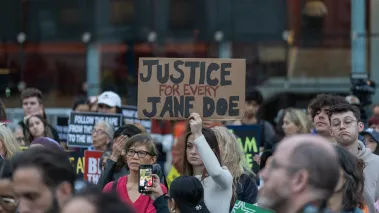
There's a groundswell of demand to “do something” in the wake of the sexual assault claims at Cornell. But amid the outrage and concern over the incident, it’s critical to remember that one attempted remedy we actually know will not work is to return to a campus justice system in which the burden of proof is on the accused and basic civil liberties are cast aside. That social experiment has already been run. It failed.
Title IX, the law against sex discrimination in federally funded education programs, was passed in 1972. Debates at the time focused on how it would affect single-sex colleges and college athletics. Explicitly aimed at sex discrimination, the text of the law itself mentions neither sexual assault nor sexual harassment. Those became matters for Title IX gradually over the next couple of decades, as courts determined that sexual assault and sexual harassment were both forms of sex discrimination, and therefore covered under Title IX.
The Jane Doe lawsuit against Cornell and the accused students (as well as a fraternity, a sorority, and a local bar) hit national news at nearly the same time that the Trump administration officially removed the Biden-era regulations from the Federal Register. While almost certainly not related, some have connected the two, citing the Cornell incident to argue that regulations surrounding Title IX need to be changed again to reduce due process protections for the accused.
The Democratic Women’s Caucus in Congress, for example, has called for strengthening and expanding Title IX protections. “Just yesterday, Trump and Republicans eroded the processes in place for sexual misconduct investigations” by officially reinstating the 2020 regulations, the caucus said in late September. And the National Women’s Law Center pointed to the Cornell situation to argue that the 2020 rules removed “obligations for educational institutions to respond to sexual harassment” and have “led to fewer survivors wanting to report because they view the Trump administration’s 2020 rule as not one that is intended to protect them.”
Given the lurid and appalling details of the Cornell case, it’s no surprise we’re seeing calls to make such alleged misconduct easier to punish.
But we don’t have to guess about whether this would be a bad idea. As a nation, we have already run a generation-long experiment of having the higher ed sector conduct Title IX complaint processes unburdened by even rudimentary protections — and it was a disaster. Since FIRE’s inception in 1999, we have seen case after case in which colleges held sexual misconduct “hearings” hardly worthy of the name, routinely denying accused students (and sometimes also the alleged victims) basic protections such as:
- The presumption of innocence;
- Notice to the accused student what he or she has allegedly done wrong, and the day; and location of the alleged wrongdoing;
- Notice of what rules were allegedly violated;
- The ability to review the evidence;
- The right to call and question witnesses at a disciplinary hearing;
- The ability to question the person making (or denying) the accusation;
- The right to impartial fact-finders.
That list of omissions may seem incredible. How could any proceeding be fair without these fundamental protections?
But it’s no exaggeration. For several years, FIRE produced Spotlight on Due Process reports to highlight the grim campus reality. In the first of those reports, issued in 2017, we rated the top 53 schools in that year’s U.S. News & World Report rankings based on 10 fundamental elements of due process, including all of those listed above. None of them fully provided all 10 protections. One school actually had a sexual misconduct policy that didn’t provide any of the 10 protections, even in part. Thirty-nine of the 53 schools did not even guarantee students the right to be presumed innocent until proven guilty, and 37 did not allow for meaningful cross-examination.
Elementary due process protections are essential for a credible system
Americans old enough to have been in high school or college around the turn of the millennium will likely remember at least two of the most prominent campus sexual assault stories: the 2006 Duke Lacrosse rape accusations, and the 2014 Rolling Stone story about an alleged incident at a University of Virginia fraternity house. Both stories turned out to be fraudulent. Both ended with millions of dollars being paid out in the wake of lawsuits, and the destruction of the careers of Mike Nifong, the Durham County district attorney disbarred for his persecution of the accused Duke students, and Sabrina Rubin Erdely, the author of the Rolling Stone piece.
It would be foolish to extrapolate from these two cases that allegations of campus sexual assault are likely to be false. But it is equally foolish to come away with the conclusion that it's not worth implementing basic protections to prevent false accusations from ruining the lives of those who are unjustly (or even just erroneously) targeted. Indeed, one need not get anywhere near an alcohol- and drug-fueled fraternity party to become involved in a campus Title IX controversy.
Because sexual harassment allegations frequently involve claims about sex-related expression (and sometimes only expression), the same campus courts and proceedings that deal with situations like the “Cornell 7” also deal with accusations that cover nothing more than speech someone claims to have found offensive. Both are adjudicated under the aegis of Title IX.
A generation of Title IX abuse to silence protected expression
Since FIRE’s inception, we have warned about the use of Title IX sexual harassment policies to police pure expression rather than conduct. In one of FIRE’s very first cases, more than 26 years ago, we wrote to Columbia Law School about an investigation into a well-known criminal law professor based on charges that he had created a hostile environment for his students by using an exam hypothetical that discussed violence against women. (Columbia ultimately agreed the speech was not harassment.) And then we spent decades repeating varieties of that over and over again to colleges from sea to shining sea: in 2000 (again), the University of Oklahoma. In 2001, Tufts. In 2004, Occidental and the University of New Hampshire. To New Jersey’s William Paterson University, as well as to the University of Pennsylvania, in 2005. To Temple in 2006. To East Georgia College in 2009. To Yale in 2010. (This is just a subset of public cases from the 2000s; it does not include cases in which FIRE was privately involved.)
The next decade only provided more of the same. Making things worse was a “Dear Colleague” letter issued by the U.S. Department of Education’s Office for Civil Rights in April 2011 that aimed to get schools to enforce Title IX in a manner that guaranteed that more of the accused would be found responsible for sexual misconduct, regardless of whether or not they were actually more likely to have committed the offense.
By effectively ordering schools to use a “preponderance of the evidence” standard instead of a higher standard such as “clear and convincing evidence,” the “Dear Colleague” letter, in a stroke, made it far easier to officially brand someone a harasser or even a rapist, at a level of certainty only infinitesimally better than a coin toss. It also encouraged schools to adopt a “single investigator” model where one person could serve as the investigator, prosecutor, and judge over Title IX hearings, with all the conflicts of interest that entails.
Colleges quickly implemented these changes, leading to an even greater flood of instances in which the rationale of sexual harassment was used as an excuse to silence protected speech. Again, cases at the University of Denver in 2011, the University of Colorado in 2013, the University of Alaska-Fairbanks in 2013-14, Louisiana State University and Northwestern in 2015, the University of Delaware and Brooklyn College in 2016, and Wichita State and Northwestern (again) in 2017 represent just a small subset of instances of 2010s-era Title IX abuses. By 2017, FIRE was aware of at least 180 lawsuits over unfair disciplinary procedures in the wake of the 2011 “Dear Colleague” Letter.
The situation at Northwestern University deserves special consideration because it illustrates so well the danger this expansive Title IX regime posed to expression about sex and gender. Both cases deal with Professor Laura Kipnis, a feminist film professor whose alleged Title IX offense, warranting a 72-day-long investigation, was . . . criticizing the university’s Title IX regime in an essay for the Chronicle of Higher Education titled “Sexual Paranoia Strikes Academe.” Northwestern University, a perennial resident on just about every list of top colleges in the United States, with massive resources and access to the finest attorneys, took more than three months to determine whether it is a violation of Title IX to criticize Title IX. (It is not.) Actually, that’s too charitable to Northwestern; it only dropped the investigation after Kipnis wrote a follow-up essay for the Chronicle titled “My Title IX Inquisition” that detailed the ludicrous process of the investigation and embarrassed Northwestern into throwing in the towel.
But wait — there’s more!
Northwestern wasn’t done with Kipnis yet. Kipnis, already the author of several books, wrote another one about her Title IX experience, publishing “Unwanted Advances: Sexual Paranoia Comes to Campus” in April 2017. Can you guess what happened next? Sure you can! Just guess the most absurd possible thing Northwestern could do in response to the book.
That’s right: Northwestern launched another bogus Title IX investigation into Kipnis for the offense of writing a book criticizing the events of two years prior, when Northwestern launched a bogus investigation into Kipnis for criticizing the Title IX investigation process. Harvard Law School Professor Jeannie Suk Gersen broke the news in a New Yorker essay titled “Laura Kipnis’s Endless Trial by Title IX.” The title of Gersen’s essay itself makes a critical point: while Kipnis was ultimately cleared in all of these Title IX investigations, the “endless trial” enabled by the process was itself more than enough to punish the outspoken and chill the speech of those who don’t feel they can afford to speak out.
Title IX abuses spur needed reform
These kinds of abuses committed in the name of Title IX had, especially after the 2011 “Dear Colleague” letter, become too common and severe to ignore. Accused students filed over 700 lawsuits alleging procedural violations, resulting in over 200 rulings (and likely even more settlements) favorable to the rights of the accused. With courts traditionally reluctant even to consider second-guessing college disciplinary measures, these numbers were eye-opening. FIRE was challenging the letter itself in court when Donald Trump won the 2016 presidential election, and the new administration made promises of reform.
In September 2017, then-Secretary of Education Betsy DeVos rescinded the 2011 “Dear Colleague” letter, with the department ultimately going through the proper notice-and-comment process needed to implement unambiguous, legally binding regulations on how colleges administered Title IX.
That process lasted until 2020, when the new regulations finally went into effect, with an explicit acknowledgment that the Department of Education would apply the Supreme Court’s speech-protective standard for peer harassment in the education context, as well as new and badly needed guarantees of basic due process for those involved in Title IX proceedings, including:
- Proper notice of the allegations against the accused, including the identities of the parties and the date and location of the alleged incident;
- The right of all parties to inspect and review the gathered evidence, including exculpatory evidence;
- The right to cross-examine all parties and witnesses (through an advisor);
- The right to an advisor of one’s choice, who may be a lawyer;
- The right to a live hearing with a fact-finder who is not also the “prosecutor”;
- The right to a written finding, and to appeal that finding.
These are the very rudiments of a fair hearing that were missing from Title IX adjudications for decades, and the changes received heartening cross-partisan support, including from federal appeals courts. Several courts had already found that constitutional due process required institutions to provide some of these procedural protections, so it’s not as though adding them was unworkable. Additionally, the Los Angeles Times editorial board — hardly a Trump ally — opined in 2020 that the rules made “reasonable changes for the most part, curbing some of the excesses of the previous system.”
The Biden campaign promised to rescind those regulations if elected. It tried to keep that promise, restarting the regulatory process and promulgating new regulations that eliminated the guarantees of a live hearing, cross-examination, weakened the right to an advisor, and allowed the single-investigator model in which a single administrator could serve as prosecutor, judge, and jury. Thankfully, most of the changes were quickly blocked by multiple federal courts and have now been removed from the books.
The need for basic due process protections should be as nonpartisan an issue as one can imagine, given that nobody, Democrat, Republican, or otherwise, would choose to be subjected to a kangaroo court should they be the ones accused.
Cornell’s fraternity shutdown demonstrates once again that due process and expression are inextricably linked
Cornell’s latest move in the controversy almost seems intended to illustrate that free expression, right alongside due process, is imperiled when colleges make policy by reacting in the face of controversy rather than according to the principles that would best serve their students and the institution in the long run.
On Tuesday, Cornell President Michael Kotlikoff announced that “All parties and social events in Interfraternity Council (IFC) houses at Cornell will be suspended for the remainder of the 2026-2027 academic year” to “provide time for a thorough review of fraternity life at Cornell to determine whether and how it can safely continue.” How this will be enforced is an open question, but at least some social events held by fraternities have an expressive component, such as the philanthropy events required by practically every national Greek organization (and, apparently, all of Cornell’s IFC fraternities).
What, if anything, constitutes a party or social event versus an expressive event? More to the point, when the university president decrees that “[t]here will be zero tolerance for violations of this directive,” would you take the risk of hosting any event or gathering, no matter how non-festive or expressive?
And who will bear the brunt of this ban? Five of the seven students accused are no longer at Cornell, including the two who were expelled, and the Chi Phi fraternity chapter at whose house the incident allegedly took place was shut down in 2024. Cornell’s punishment of the fraternity system therefore falls only on the members of the fraternities who were not involved in the incident, and which is flatly guaranteed to include a large number of individuals who can only be considered completely innocent of any wrongdoing. Many would not have even been present on campus in 2024.
That’s the reason guilt by association is so offensive to the American conception of justice: It guarantees that the innocent will be punished along with the guilty.
Nor is it defensible for Cornell to implement these restrictions in the name of "strengthening campus safety” almost two full years after it was made aware of the incident in question. If Cornell administrators truly believe the incident warranted a shutdown of all fraternity social events in the name of campus safety, waiting 23 months to do so while students remained in danger would be utterly unconscionable. Given that such a level of callousness seems unlikely, one can only conclude that the ban on social events is a move aimed at public relations rather than public safety, and one more certain to chill protected speech than it is to protect student safety.
The proverbial definition of insanity is doing the same thing over and over again and expecting a different result, yet that’s precisely what those advocating a return to a Title IX scheme that disregards both due process and freedom of expression propose to do. It won’t work, and it’s long past time for that failed experiment to be abandoned for good.
Recent Articles
Get the latest free speech news and analysis from FIRE.
After a congressman challenged a student reporter’s right to record, here’s what journalists should know
A UK teen mocked a local politician. Then the police showed up.

VICTORY: New Jersey drops complaint against school board member targeted for asking constituents about taxes