Table of Contents
Calls for censorship are a familiar wartime mistake
Shutterstock.com
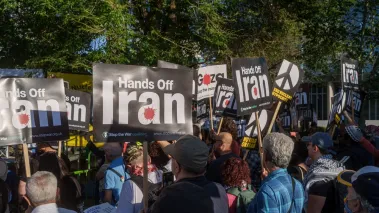
Protesters gather with Palestinian flags and "Hands Off Iran" signs during a demonstration near the US Embassy in London.
It’s like clockwork. War breaks out. Then come the calls for censorship.
After the war with Iran began over the weekend, the group Columbia University Apartheid Divest tweeted “Marg bar Amrika” — Persian for “death to America.” The group is not a recognized student organization at Columbia University, and it’s unclear who operates its X account. But that didn’t stop demands for punishment.
Investor Bill Ackman assumed the speakers were Columbia students and argued they should not be “permitted to attend a taxpayer-funded university with their tuition funded with government guaranteed student loans.” Rep. Elise Stefanik called for their expulsion and deportation. Sen. Ted Cruz echoed the sentiment, tweeting “Expel all of them.”
The group’s tweet is unquestionably protected speech. The Supreme Court has twice held that even flag burning — often a visceral, symbolic expression of contempt for the nation — is constitutionally protected. As the Court famously declared, “If there is a bedrock principle underlying the First Amendment, it is that the government may not prohibit the expression of an idea simply because society finds the idea itself offensive or disagreeable.”
That principle does not crack when bombs start falling. The government may not censor protected speech directly, nor may it pressure private actors to censor — whether they be social media companies or private universities like Columbia.
The most acute challenges to free expression often come during times of war. The Sedition Act of 1798 criminalized criticism of the federal government amid fears of war with France. During World War I, the Espionage Act led to more than 2,000 prosecutions for speech ranging from teaching that Christians should not kill in war to protests over draft exemptions. The Cold War brought McCarthyism, blacklists, and loyalty oaths.
After each of these periods, Americans came to regret the country’s censorship frenzy. The Sedition Act expired in disgrace; those convicted under it were pardoned. Many World War I-era sentences were later commuted, and the Supreme Court justices who upheld them came to regret the hysteria of the period. “McCarthyism” itself has become a slur in American life — a shorthand for reckless repression.
Not every war needs to be followed by censorship and then regret. We can learn from this historical pattern and refuse to censor in the first place.
America gains nothing by undermining the freedoms it claims to defend. Protecting speech during wartime is neither easy nor popular. But it is precisely in such moments that constitutional principles matter most. Civil liberties organizations exist to defend rights not when it’s easy, but when it’s difficult. We at FIRE have done so repeatedly: after September 11, during the Iraq War, and after October 7 — and we are prepared to do so again now.
If you face censorship for expressing your opinions about the war, pull the FIRE Alarm and submit a case on FIRE’s website today.
Recent Articles
Get the latest free speech news and analysis from FIRE.

New Mexico's $25 billion verdict against Meta is fundamentally about speech
Silencing social media won't stop the unrest in France

FIRE is bringing the Free Speech Forum to the West Coast!