Table of Contents
Finnish Supreme Court fines politician for hate speech over religious pamphlet
Shutterstock.com
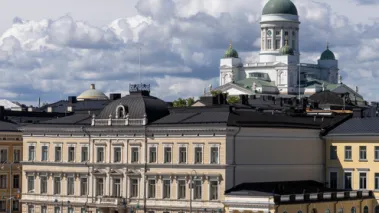
Helsinki Cathedral rising above the Finnish Supreme Court.
FIRE’s Free Speech Dispatch covers new and continuing censorship trends and challenges around the world. Our goal is to help readers better understand the global context of free expression. Want to make sure you don’t miss an update? Sign up for our newsletter.
Finnish politician found guilty over ‘Male and Female He Created Them’ pamphlet
After a seven-year legal battle, Päivi Räsänen, a member of Finnish parliament and politician from the Christian Democrats, was acquitted last week on one charge of hate speech, but found guilty for a separate charge over a pamphlet she posted twice online. Räsänen was found not guilty over a 2019 tweet criticizing the Evangelical Lutheran Church of Finland’s decision to support a Pride event and citing Romans 1:24–27. But in a 3-2 decision, Finland’s Supreme Court found Räsänen and her co-author Lutheran Bishop Juhana Pohjola guilty of incitement against a group for reposting their 2004 pamphlet, “Male and Female He Created Them,” on the internet.
The pamphlet shared the author’s view of biblical marriage as well as criticism of homosexuality. The court said that Räsänen “must have understood that, for example, claiming that homosexuality is a disorder of psychosexual development is, in light of the prevailing medical understanding, an incorrect assertion.” Räsänen was fined the equivalent of $2,080. Alliance Defending Freedom, which represents Räsänen, says the court also ruled that the offending statements from the pamphlet be “removed from public access and destroyed.”
“This creates uncertainty, not only for me, but for every citizen who wishes to express their beliefs, or even more concerning for anyone who has expressed their opinions in the past,” Räsänen said. She is considering appealing to the European Court of Human Rights and other Finnish political figures, including Minister of Justice Leena Meri, have objected to the ruling and are calling for reform.
Hong Kong rolls out broader national security law powers. Travelers, Americans included, should be cautious.
The images a Florida city says only it can use
Cape Coral is threatening critics with fines and jail for using its logo, raising serious First Amendment concerns.
Hong Kong expanded powers under its National Security Law to give authorities the ability to require suspects in “national security” investigations — which often focus on pure political speech and government criticism — to reveal passwords to their electronic devices.
The U.S. Consulate General in Hong Kong & Macau issued a warning in response, correctly noting that this law applies to anyone and everyone who passes through Hong Kong, including the millions who travel through Hong Kong’s airport each year — and officials weren’t pleased. Beijing officials summoned the U.S. envoy in Hong Kong to express “strong dissatisfaction and firm opposition” to what they called foreign interference.
Hong Kong police also arrested independent bookstore staff for allegedly selling “seditious” publications, including a biography of jailed media figure Jimmy Lai, as authorities expand enforcement of national security laws against printed materials.
Busy week for free speech in the UK, including a new bill addressing the UK’s ever-growing censorship problem
If you read FIRE’s Free Speech Dispatch, then you’ll know the United Kingdom has been in a free speech freefall for some time now, from arresting social media users and peaceful protesters to regularly crafting new regulations harming online expression. Recognizing the UK’s need for codified speech protections, the Adam Smith Institute has written a model Freedom of Speech Bill intended to limit the government’s ability to infringe upon free expression. The bill offers some strong features, like the assumption that speech is protected unless it falls into a specific unprotected category, remedies against strategic lawsuits against public participation, and an analogue of the U.S.’s Section 230. But other provisions would raise new concerns, like amending the Employment Rights Act 1996 to constrain private employers from firing employees based on lawful expression outside of the workplace — a potential challenge to free association rights.
The UK should use this as an opportunity to discuss how to best create reforms to protect free expression, online and off. And that’s not the only free speech news across the pond. Here’s the latest from another busy week:
- Metropolitan Police have reversed their decision to stop arresting pro-Palestine Action protesters in light of the High Court ruling against the government’s proscription of the group. Arrests have resumed while the government challenges the ruling.
- The House of Lords and House of Commons are currently going back and forth over plans to ban teens from social media. Alarmingly, one proposed amendment would grant an official power to target VPN use for teens under 18. Separately, the UK government is rolling out a trial test enforcing bans and “digital curfews” on hundreds of teens. And tech policy developments in the U.S. may even be influencing how the UK acts. Read FIRE’s coverage here.
- Apple’s rollout of mandatory age verification in the UK has sparked backlash after users reported being effectively locked out of full device functionality unless they submit ID or credit card details, with critics warning it forces people to “hand over sensitive personal data or lose functionality.” The system has also faced technical failures and accessibility issues, with some adults unable to verify their age at all and instead being pushed into restricted settings that “block websites” and monitor content.
- Artists accused Bristol City Council of censorship after officials ordered the removal of politically sensitive elements, forcing them to “literally [take] a knife to our art” and cut out “offending” material about local businesses. The council defended the move, saying it must “balance freedom of speech and a duty to prevent harm.”
- A UK school sparked backlash after using AI to flag nearly 200 library books as “inappropriate,” including classics like 1984 and popular titles like Twilight, with critics warning the system treated complex literature as a “safeguarding risk” based on surface level themes. The librarian said she was “gobsmacked” by the directive and faced disciplinary action for refusing to remove the books, as free expression advocates argue the case shows how automated tools can drive overbroad censorship without human judgement.
- Hong Kong dissidents in the UK say they are facing a growing campaign of harassment, surveillance, and violence that they believe is linked to Chinese authorities, with one activist recalling, “I thought I was blinded…Is this the end of my life?” after a brutal attack. Experts warned the effort is “widespread” and aimed at silencing critics abroad, raising concerns about transnational repression and the safety of political speech even outside China’s borders.
Hungary hits investigative reporter with espionage charges for reporting on Moscow ties
Hungary’s government has filed espionage charges against investigative journalist Szabolcs Panyi, accusing him of working “in coordination with a foreign country” amid reporting on ties between Hungarian officials and Russia. Panyi denies the claims, while his outlet warned the move reflects authorities “resorting to authoritarian tactics” to discredit critical journalism.
“Accusing investigative journalists of espionage is virtually unprecedented in the 21st century for a member state of the European Union,” Panyi says. “This is really something more typical of Putin’s Russia, Belarus and similar regimes.”
Political censorship across Asia
- Chinese authorities put dissident artist Gao Zhen on trial over artwork accused of “defaming national heroes and martyrs,” with proceedings held behind closed doors and observers barred from attending. The case centers on satirical sculptures of Mao Zedong created years earlier, and critics say it reflects a broader crackdown on artistic expression, with Gao facing up to three years in prison.
- A prominent Indonesian rights activist was seriously injured when an assailant threw acid at him near his home, calling it a “brutal acid attack” that left him with severe burns. Human Rights Watch is calling for “a fact-finding team independent of the military to fully investigate the acid attack against a prominent human rights activist who has criticized the military.”
- Indonesian authorities arrested a Swiss tourist after he allegedly posted insults about a Hindu holiday. Officials said he could face up to five years in prison for “spreading hate speech online.”
- A Filipino heritage advocate is facing cyberlibel charges after pointing out alleged factual errors in a published book, raising concerns about how defamation laws can be used against critical speech. He questioned the case, asking “what’s libelous about citing errors,” as advocates warn the complaint risks chilling public discussion and academic critique.
- Singapore denied entry to a Malaysian pro-Palestinian scholar, labeling her an “undesirable visitor” and accusing her of promoting “radical advocacy” and involvement in domestic political activity. Authorities said they “will not tolerate any foreigners getting involved in our domestic politics,” while the scholar rejected claims as “false” and argued she was being targeted for her academic work and public positions.
- Activists and digital rights groups say India has seen a noticeable spike in online censorship during the Iran war, with authorities issuing a growing number of takedown orders targeting posts critical of the government’s foreign policy stance and broader geopolitical messaging. Internet watchdogs reported “dozens of removals” in a short period.
- India’s Telangana government has introduced a sweeping hate speech and hate crimes bill that would criminalize a wide range of expression deemed to promote “disharmony” or “ill-will” against protected groups. The law proposes prison sentences from one to seven years, rising to ten years for repeat offenses, and allows authorities to order the removal of online content considered to violate the law.
Hundreds arrested in the UAE and Qatar for posts about Iran
Authorities in the UAE and Qatar have arrested hundreds of people over social media posts and videos related to the Iran war, accusing some of spreading “rumors” or content that could undermine national security. The crackdown targets individuals for filming or sharing footage of attacks, with officials warning such posts can “stir public opinion” and create misleading narratives about the situation. In the UAE, the largest number of arrests over social media posts about the war weren’t even for alleged misinformation or lies, but for “publishing true videos of the attacks and their impact.” And many of those arrested “came from Bangladesh, India and Pakistan, countries that send large numbers of low-paid workers to the Emirates.”
European Parliament member alleges censorship by Canadian immigration officials
European Parliament member Rima Hassan is accusing Canadian authorities of revoking her travel authorization ahead of scheduled public appearances because of her speech about Israel. Hassan says her authorization was approved and then revoked after she reportedly “was asked to submit new documents and information, including bank statements and a list of family ties, a few hours before her flight.” Citing privacy reasons, Canadian officials declined to comment on the case, but the groups who invited Hassan to Canada to speak are calling foul.
Recent Articles
Get the latest free speech news and analysis from FIRE.

Venezuela is a cautionary tale w/ Jim Epstein and Germania Rodriguez Poleo
Podcast
FIRE sues Los Angeles City Council over policy banning certain words during public comment

It was never just going to be about keeping kids off social media