Table of Contents
State of the First Amendment
Shutterstock.com
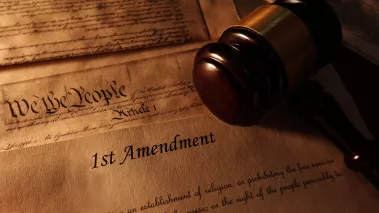
Check out Paul McMasters’ interesting article on the state of First Amendment rights in America.
Americans take a great deal of pride in their right to think, believe and speak as they wish. But that right is neither as broad nor as constant as we would like to think. Even in America, we have to be careful of what we say. You don't have to be a pornographer, a defamer or an extremist to be charged with a speech crime.
Even so-called "high-value " speech such as political discourse has its limits. For example, the campaign-finance reform law enacted in 2002 criminalizes political advertising. Incredibly, the Supreme Court upheld these provisions. Whether you are the ACLU or the NRA, if your ad mentions a federal candidate's name 60 days before the general election or 30 days before a party convention or primary, you will be subject to criminal sanctions.
A publisher who promotes a book written by a candidate or a producer who touts a documentary that praises or criticizes a candidate during those periods also invites prosecution.
Speech crimes don't stop there, of course. In the last year alone, television and radio broadcasters have paid out millions of dollars in fines for words and images that the First Amendment protects if they appear on cable or satellite or the printed page.
There is a wide range of words and thoughts, in fact, that can get you in trouble.
Take for instance the nation's college campuses, where robust speech and inquiry supposedly claim sanctuary. Nevertheless, students – and faculty – are frequently punished for mistakenly thinking the First Amendment means what it says. The penalties can be swift and harsh.
Recent Articles
Get the latest free speech news and analysis from FIRE.

Venezuela is a cautionary tale w/ Jim Epstein and Germania Rodriguez Poleo
Podcast
FIRE sues Los Angeles City Council over policy banning certain words during public comment

It was never just going to be about keeping kids off social media