Table of Contents
She was fired for teaching English literature in an English class. Now she’s suing.
Joelsangle Productions LLC
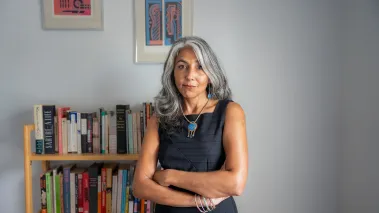
South Florida State College Professor Vinita Prabhakar.
SEBRING, Fla., July 29, 2026 — In a story stranger than fiction, a Florida college fired an English professor for nothing more than teaching literature in a literature class.
After professor Vinita Prabhakar assigned a commonly-taught short story for her freshman English course, South Florida State College President Fred Hawkins dragged Prabhakar into a meeting, complained the story was “political,” and ordered her to stop teaching it.
A day later, he unceremoniously fired her. No hearing. No due process.
“For 20 years, I’ve taught students how to engage with stories that excite them, challenge them, and broaden their experience of what it means to be human,” said Prabhakar. “I don’t plan on stopping now. If what happened to me becomes the norm, colleges across America will become less curious, less vibrant, and less free.”
Now, represented by FIRE Legal Network Member Gary Edinger of Benjamin, Aaronson, Edinger & Patanzo and the Foundation for Individual Rights and Expression, Prabhakar is filing a federal lawsuit against Hawkins and the South Florida State College board of trustees seeking to vindicate her First Amendment rights.
“President Hawkins firing a professor for teaching a work of literature isn’t just a betrayal of every principle that a university is supposed to embrace,” said Edinger. “As a state employee, he also trampled over our client’s constitutional rights. The First Amendment doesn’t let public officials suppress ideas by firing the people who teach them.”
Prabhakar has been an English professor for close to two decades. After stops at several upstate New York colleges, she relocated to Florida in 2023 to be closer to her elderly parents and took a position at SFSC’s Avon Park campus.
In spring 2026, Prabhakar assigned the students in her Freshman English II course the short story “Bettering Myself” by Ottessa Moshfegh. Prabhakar had assigned the story in her classes for nearly a decade. “Bettering Myself” tells the story of an alcoholic and directionless teacher at a Catholic school who engages in self-destructive behavior and makes inappropriate sex jokes to her teenage wards. The winner of the 2013 Plimpton Prize for Fiction, “Bettering Myself” is commonly taught in English courses across the country, including at the University of Florida, West Virginia University, and NYU.
COURTESY PHOTOS OF VINITA PRABHAKAR FOR MEDIA USE
One student in the course reached out to Prabhakar and said she was “uncomfortable” with the subject matter of the reading. Prabhakar spoke with the student, and the student said that they felt better about the reading after the classroom discussion.
Hawkins learned about the situation and dragged Prabhakar into a meeting. At the meeting, Prabhakar laid out why “Bettering Myself” was relevant to the course — it was part of an assignment on unsympathetic and unreliable narrators and was taught alongside works by Hemingway and Raymond Carver.
The chair of the English department, the dean of arts and sciences, and the college vice president backed her explanation, but Hawkins didn’t care. He expressed his personal dislike of the story and demanded she stop teaching it. Hawkins wouldn’t point to anything specific he disliked about “Bettering Myself,” saying only, “I don’t want to ever see this story again,” and calling it “political.”
The day after the meeting, Prabhakar was placed on administrative leave and informed that her contract would be terminated at the end of the semester. She never received a formal complaint, nor was told which policies she supposedly violated. The only explanation the head of human resources gave for her firing was that “the president has the final say.”
“At a public university, the Constitution has the final say,” FIRE Senior Attorney Greg Greubel said. “The First Amendment protects professors from being punished simply because administrators disagree with the ideas they teach. President Hawkins cannot dictate which viewpoints belong in the classroom.”
The circumstances and rationale behind Prabhakar’s firing were a clear violation of both her academic freedom and her First Amendment rights. Institutions of higher education can set the broad strokes of their faculty’s curriculum. For example, an economics professor who insists on assigning only books about scuba diving probably won’t keep his job for long. But Prabhakar’s assignment of a short story in an English literature class was plainly relevant to the course. When administrators at public colleges step in and ban stories or books simply because they disagree with the ideas being expressed, that violates the First Amendment.
Hawkins’ shocking actions are part of a pervasive pattern of disregard for the First Amendment in the Sunshine State. Since 2022, FIRE has been in federal court fighting to block provisions of Florida’s so-called “Stop WOKE Act,” which chilled or banned classroom instruction on a series of disfavored viewpoints on race, gender, and sexuality. (A former Republican legislator, Hawkins himself voted for the Stop WOKE Act and was a key supporter of Gov. Ron DeSantis’s efforts to retaliate against Disney for criticizing the law.)
Earlier this month, the U.S. Court of Appeals for the Eleventh Circuit ruled in FIRE’s favor and upheld an injunction blocking the state of Florida from enforcing the law against university students and faculty. The court flatly rejected the state’s arguments that the First Amendment allows it to dictate the speech of university professors in the classroom. “Florida’s restrictions are, as the State admits, an attempt to force uniformity of thought on students by curtailing the free exchange of ideas in universities — the very environments traditionally regarded as laboratories for expression and truth seeking,” the court held.
The lawsuit was filed in the United States District Court for the Southern District of Florida and seeks reinstatement, compensatory damages, punitive damages, and declaratory relief.
The Foundation for Individual Rights and Expression (FIRE) is a nonpartisan, nonprofit organization dedicated to defending and sustaining the individual rights of all Americans to free speech and free thought — the most essential qualities of liberty. FIRE educates Americans about the importance of these inalienable rights, promotes a culture of respect for these rights, and provides the means to preserve them.
CONTACT:
Alex Griswold, Communications Campaign Manager, FIRE: 215-717-3473; media@fire.org
Recent Articles
Get the latest free speech news and analysis from FIRE.
After a congressman challenged a student reporter’s right to record, here’s what journalists should know
Restoring Title IX kangaroo courts is no solution to the ‘Cornell 7’ sexual assault controversy
A UK teen mocked a local politician. Then the police showed up.