Table of Contents
Do K-12 students have the right to walk out in protest?
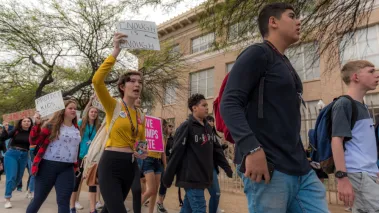
March 14, 2018: Students at Tucson High Magnet School conduct a student walkout as part of the national #ENOUGH! walkout day.
A wave of student walkouts has washed over the country in the last month, with secondary school students leaving campus to protest ICE activity in Oklahoma, Illinois, Virginia, Texas, Washington state, Ohio, Florida, and more. In Texas, the state is investigating whether school employees encouraged the walkouts; in Florida, the state teachers union has rejected similar accusations, saying their members don’t support walkouts.
As someone who has advocated for, taught, and written about the First Amendment in schools for more than two decades, I’m frequently asked about these protests. Walkouts are a recurring form of student protest; students have used them to oppose gun violence, protest against racial injustice, call attention to climate change, protest wars, and more. Is there a right to walk out? Are states censoring students by pushing back?
The short answer is that the First Amendment protects students’ rights to express views, but not the right to walk out of class to express them. But there’s a lot to unpack.
The 30,000-foot overview
Each of the 50 states has created a right to a public education and state-operated systems to support that right. Those systems can be pretty different at times, or have specific and unusual nuances that could change the outcomes.
A simple example relevant to our conversation here: A handful of states, like Texas, fund their schools based on average daily attendance, not enrollment. So when Texas warns that student walkouts could lead to a loss of funding for the school, it’s true in the sense that walkouts lower daily attendance and in time that could lower the averages. In the vast majority of states (44) and the District of Columbia, though, that’s not how funding works.
So except where I’m talking about federal court decisions, I necessarily have to talk in general principles. Talk to someone licensed in your jurisdiction to find out more about your local laws. That said, the general contours of how walkouts work are pretty similar across the jurisdictions I’ve studied.
A school can usually punish K-12 students for walking out without permission
The First Amendment protects the right to protest, but it doesn’t create a right to leave school to protest. That might feel counterintuitive at first, or even feel like the First Amendment is disingenuous — what good is a right to speech you can’t go outside to use, after all? But it makes sense in the context of how speech law works and the goals of public education.
As a general matter, the intent to engage in free speech doesn’t create exceptions to generally applicable, viewpoint neutral rules regulating conduct. For example, I have a right to paint a mural; I don’t have a right to paint it on a police car. That I want to create art doesn’t create an exception to the general rule that I can’t vandalize government property.
There’s similar tension with walkouts and rules about cutting class or truancy. In every state of which I’m aware, an underage student of the public schools can be punished for cutting class. That’s a viewpoint-neutral rule that exists to ensure the public investment in education returns the intended benefit, and to protect the safety of minors in general. K-12 schools act in loco parentis (literally, “in the place of the parents”) in maintaining supervision and custody of minor students. If a student cuts class, they can be punished; that remains true if they cut class to hang out with friends, smoke in the bathroom, write a letter to a relative, or protest outside.
Walkouts can be acts of principled civil disobedience, but civil disobedience has historically drawn its power from participants’ willingness to accept the consequences of violating a rule to draw attention to a perceived injustice.
I’m not aware of any caselaw suggesting that a walkout is insulated from discipline simply because it’s associated with an otherwise-protected message. In most cases, the exercise of First Amendment rights in a K-12 school is governed by the Supreme Court’s 1969 decision in Tinker v. Des Moines Independent School District. In Tinker, a group of students planned on wearing black armbands to school to protest the Vietnam war. The school district got wind of this and threatened to punish students who did.
About 50 students attended the meeting to plan the armbands. After the school’s threat, only seven followed through with wearing them. Of those seven, five were suspended. And of those five, three joined a lawsuit against the school: Mary Beth Tinker, her brother John, and her brother’s friend Christopher Eckhardt (who was also the student who had initially organized the meeting).
In a 7-2 vote, the Supreme Court ruled that the school violated the students’ First Amendment rights by punishing them for engaging in passive, silent expression. The Court held that students in public schools have the right to engage in expression that doesn’t “materially and substantially interfere with the requirements of appropriate discipline in the operation of the school” or infringe on the rights of other students. (This is sometimes called the “substantial disruption test,” for short.)

Free Speech in High School
Do students have free speech rights? In four landmark cases, the Supreme Court has provided a general outline of the First Amendment rights of high school students.
There are lots of things students can do to express their views without offending the substantial disruption test. Tinker’s armbands would be protected speech, for example, and in most cases, t-shirts and buttons would be treated the same way. Starting an independent student newspaper or contributing editorials to an existing student newspaper would likewise be protected. Circulating petitions or starting clubs would be protected. And engaging in demonstrations at the school or elsewhere outside of school hours would generally be protected, too.
But if K-12 students walk out of classes to join a protest, the First Amendment doesn’t shield them from being disciplined for cutting class.
There are a couple exceptions to that general rule. If a student is 18 years old, their relationship to the school isn’t custodial in the same way a minor’s relationship would be, which is a fancy way of saying adults are in charge of themselves and can often sign themselves out. (This is also why walkouts don’t result in discipline in colleges; the vast majority of college students are adults.)
With minors, parents are usually able to sign them out of school. Remember how I said that a school could punish a student who cuts class, regardless of the reason? Similarly, a school usually cannot punish a student who is signed out of school by a legal guardian, whether the reason for being signed out is a dentist appointment, a family vacation, or to stand on the sidewalk outside with a sign. Whatever authority a school has in retaining custody of a student, absent a court order to the contrary, parental rights come first.
If a school does choose to discipline a student for walking out to join a protest, it has to do it consistently with how it would punish any other student for cutting class. Punishing a student more harshly because they wanted to express their opinion would be viewpoint discrimination, which is never permissible under the First Amendment. (Going back to my hypothetical of making a mural on a police car, the First Amendment won’t protect me from being punished for defacing the car, but it does protect me from being punished harder because they didn’t like the message of the mural.)
In theory, a school doesn’t HAVE to punish students who walk out
A big asterisk: Public schools are organs of the state, and are not really capable of taking dramatically different positions on issues than the ones dictated by state authorities. If a state tells its employees not to cooperate with student walkouts, those employees typically have two choices, and it’s the same two choices most employees have: Follow directives or get fired.
But I’m sometimes asked the question: “Does a school have to punish students who walk out?” As a matter of pure philosophical theory, no. Schools have an obligation to be viewpoint-neutral in the discipline they hand out, so they can’t choose not to punish students who go to protest while still punishing those who go to McDonalds, for example. But they might rationally have different levels of punishment for students who cut class while staying on campus and those who leave campus.
In reality, though, most schools have worked to eliminate nuance and discretion from their disciplinary rules, not enhance it. And to the extent the state directs the operation of public schools and enforces truancy laws, the discretion exists at the state level, not necessarily the district.
States aren’t wrong to push back on truancy, but could be clearer
In states that are pushing back on student walkouts, there’s a missed educational opportunity. Yes, states likely should take steps to encourage students to attend class, but state officials should be as clear as possible about their opposition to the act of walking out, not the message being expressed. (On the other hand, if students walking out were threatened with penalties by the state because state officials don’t like the message of the walkout, that would be a First Amendment problem.)
A major reason states have laws to prohibit truancy is to ensure students are educated. In enforcing truancy law to discourage walkouts, the state should explain the problem and propose alternatives that still allow for free expression. Something along the lines of, “We hear you, we want you to know there are other channels for this, and please understand our rules against truancy are not meant to silence you.”
As heated as this political moment is, it will eventually pass. When it does, the students who lived through it will be left with whatever lessons we gave them. If the lesson we send boils down to “the First Amendment says it protects speech but it doesn’t really,” we will have taken people who are trying to use their speech rights and turned them into cynics who outright deny the truth of individual rights.
It’s important that students go to class, but it’s also important they understand and share American values. We must not sacrifice the latter on the altar of the former — particularly when we can have both if we speak a little more carefully and thoughtfully.
Students and families need to ultimately decide what to do
Some people are going to have the take-away message from this blog that you shouldn’t go participate in walkouts, so I need to be explicit and talk directly to those students: I’m not telling you not to protest. I’m telling you the First Amendment doesn’t protect you from the consequences of walking out imposed by your public school. (At private schools, your relationship to the school is contractual, so it will depend on the terms of that contract — but generally, they aren’t going to have less authority to punish you.)
What you decide to do needs to be your decision. Walkouts can be acts of principled civil disobedience, but civil disobedience has historically drawn its power from participants’ willingness to accept the consequences of violating a rule to draw attention to a perceived injustice.
If you’re a student, talk to your parents about it. (If you’re a parent, talk to your kids about it.) Talk through your goals and options and decide what’s right for you and your family.
What I can tell you is this: The First Amendment won’t stop you from being punished for walking out. There are alternatives to walking out, if you want to express yourself without risking punishment. And in the grand scheme of things, whether you got punished for cutting class one time in high school is going to matter a lot less than whether you understand what the First Amendment means and how to use your rights.
Recent Articles
Get the latest free speech news and analysis from FIRE.

FIRE sues Los Angeles City Council over policy banning certain words during public comment
It was never just going to be about keeping kids off social media