Table of Contents
A UK teen mocked a local politician. Then the police showed up.
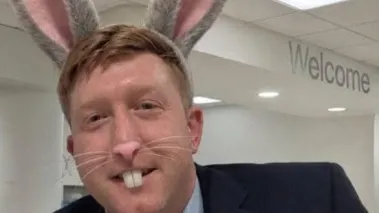
Now-deleted image of Wolverhampton Tory councillor Simon Bennett, sporting AI-generated bunny ears, whiskers, and teeth, as posted by UK 15-year-old Fraser on Facebook.
Free Speech Dispatch covers censorship trends and challenges around the world. If you want to know where free expression is under attack and why it matters, subscribe now to get each edition delivered to your inbox.
Today’s Dispatch covers a wide range of censorship efforts, from government takedown demands to social media platforms to a shocking death sentence in Saudi Arabia. But the lead-off story will look at what is, on its face, an absurd story of overpolicing in the United Kingdom. A politically active teen posted some comments mocking a local politician on Facebook — and then the police appeared at his home. It’s a story that has become all too common in the country. But behind it looms another threat to online speech. In a few months time, new rules will go into effect banning young people from using social media and requiring adults to verify their age with a passport or license.
The question now won’t just be whether police will come knocking at your door over what you said online, but under what conditions you can speak online in the first place.
‘Rent boy’ and bunny ears jokes bring police to teen’s door
Fraser, a 15 year old boy from the UK’s West Midlands, is a vocal teenager. He campaigns for Reform UK and posts about politics on social media. And that’s where the trouble started. Four officers showed up at Fraser’s door one morning this August and told him he was under arrest — but didn’t explain exactly why, other than that it was “to do with social media.” Fraser was then fingerprinted, photographed for a mugshot, and questioned for a short time about his social media use and his knowledge of Tory councillor Simon Bennett from the Wolverhampton city council. Fraser’s Facebook posts about Bennett, it turns out, are presumably the reason why he was arrested in the first place, in what police said could be a potential “hate crime offence.”
Fraser had posted some insults about Bennett on Facebook, including an edited photo of Bennett wearing bunny ears with the caption: “Nibble… nibble… crunch… crunch Can you hear it? That’s the sound of a rabbit devouring the last remaining shreds of Wolverhampton Conservatives’ credibility.” Fraser also complained about how Bennett dressed at meetings, and when he wore a suit instead of casual clothing Fraser posted that he was glad Bennett was “not looking like a rent boy.”
The “rent boy” dig is apparently what may have tipped the scales from wisecrack to crime. Bennett reported the posts to police, believing Fraser had potentially engaged in harassment and malicious communications against him.
“It was unpleasant and I was targeted by a child I had no way of dealing with,” Bennett said.
Fraser is now represented by the Free Speech Union but is still waiting to learn whether police intend to charge him with a crime.

It was never just going to be about keeping kids off social media
Age-gating teens online was never going to stop with kids. The UK is already promising a more "active interventionist state" for the internet.
The UK’s problems with free expression on the internet, particularly where young people are involved, is about to get even more complicated. The government remains intent on ensuring its upcoming under-16 social media ban — one that would keep teens like Fraser from engaging on social media entirely — isn’t flouted like Australia’s landmark legislation. So officials have now acknowledged that they may require “hard checks” in the form of passport or license verification to age-gate social media platforms. UK social media users concerned about a police knock at the door may soon have even more to worry about.
Speaking of long-running censorship issues: Police in the UK are still arresting peaceful protesters under anti-terror legislation for holding up signs in support of Palestine Action, a group currently fighting its government ban in court. Dozens were arrested late last month for holding signs expressing support for the group, including Massive Attack musician Robert Del Naja for his “I OPPOSE GENOCIDE, I SUPPORT PALESTINE ACTION” placard.
Once again, Turkey ramps up internet censorship
Social media censorship is a favorite tool of the Turkish government, and they are wielding it once again. In recent weeks, government officials have ordered X to block at least 1,270 accounts, primarily from LGBTQ advocates, journalists, and academics. Meta has also blocked a number of accounts. T24, one of the oldest independent media outlets in the country with 1.9 million followers on X, earned a block order because it was “aimed at disrupting and weakening the Turkish family structure” and “would adversely affect the developmental process of young and underage individuals concerning sexual orientation and gender identity.” Human Rights Watch reports “[n]either X nor Meta have provided public explanations about their responses to the September-October censorship waves,” and that users are not even receiving explanations about the legal basis under which their accounts are being targeted.
The repression extends offline, too. Ali Tarakçı, one of the journalists censored on X, was also arrested for publicly spreading misleading information after speculating that an unnamed government minister would resign.
More tech censorship in the news:
- The Philippine government temporarily banned Discord but lifted the restriction after the platform agreed to implement stricter measures on child safety and extremist content.
- Russian authorities recently enacted another crackdown on Virtual Private Networks (VPNs), which are used to evade internet censorship, through methods including distributed denial of service (DDoS) attacks, IP address blocks, phishing scams to employees at VPN service providers, and removal orders to app stores.
- Political cartoonist Satish Acharya’s Instagram account was temporarily blocked in India over years-old cartoons about the Bharatiya Janata Party and Prime Minister Narendra Modi.
- The Indian government demanded app stores take down Bitchat, the Bluetooth-based messaging app co-founded by Jack Dorsey, for allowing “illegal” content and because the app’s decentralized nature would make it harder for government officials to target material and users.
New charges loom after French ‘public insult’ conviction
French writer and activist Dora Moutot was convicted for “public insult” and fined €4,754 earlier this year after stating in a 2022 talk show debate that she believed Marie Cau, a former French mayor and trans woman, is male. Moutot also said that “as women, we have no choice but to be wary of people with penises.” Finding her guilty, the judge said her words were an “abuse of freedom of expression warranting the imposition of a criminal penalty commensurate with the harm thus caused to the values protected by our democratic society.”
The United Nations Special Rapporteur on violence against women and girls Reem Alsalem expressed concerns this month about Moutot’s prosecution and threats of violence against her, saying in statement, “Simply expressing views on sex, gender or the specific needs of women based on their sex should not constitute grounds for harassment, intimidation or sanction.”
Moutot is appealing, but says she is again facing allegations of “insult” charges, with another organization filing new complaints over Moutot and her colleague Marguerite Stern’s social media posts, blog, and YouTube channel.
Journalist’s views questioned at Israeli border
British journalist Secunder Kermani was temporarily denied entry and taken to an immigration detention facility after landing in Israel’s Ben-Gurion Airport to cover the country’s election season. Kermani was later granted entry after his employer, Channel 4, intervened, but he says that when he first landed border officials questioned him about his views, specifically asking if he believed Israel was “committing genocide.”
“Is this a new government policy to only allow certain journalists into the country? Even when they work for mainstream news organizations?,” Kermani said. He joins a group of reporters who have faced entry issues or had their travel credentials revoked.
Sedition, book bans, and…Tom Cruise?
If you’re seeking to understand how repressive Hong Kong has grown in recent years, this about sums it up: Outgoing national security police chief Andrew Kan said that just questioning the government’s lack of clarity on which books are banned is itself a “form of soft resistance.”
Even asking the government to spell out what you can’t say and read could itself be seditious.
And the sedition arrests have continued. Independent journalist Tang Ho-wing was arrested, and then released earlier this month, on sedition charges after sharing a video showing protesters marking the anniversary of a police crackdown on a 2019 protest. Then two people were arrested for “operating pages on various social media platforms and publishing seditious posts that incite hatred against the constitutional order of the Hong Kong Special Administrative Region.”
Meanwhile, Tom Cruise’s new film Digger was yanked from Hong Kong theaters ahead of its release, without an official reason given. Reports suggest that government censors pulled the film due to “sensitive dialogue” about a potential nuclear attack on China.
Migrant worker’s death sentence overturned
Blasphemy laws are still on the books in dozens of countries. A handful of those countries threaten the death penalty for blasphemers, and some do indeed sentence blasphemers to death. Thankfully, Sri Lankan migrant worker Sivarasa Anojan now will avoid that fate. Anojan made a Facebook comment critical of Islam in June after a video of a man kicking a dog set off a religious debate on social media. He soon apologized and deleted the comment, but the damage was done.
Anojan was initially sentenced to five years in prison and fined three million Saudi Riyals for blasphemy but prosecutors appealed the judgment, seeking a harsher punishment. They got their wish: A Saudi appeals court upgraded the sentence to death. Sri Lanka engaged in diplomatic appeals for mercy, and succeeded this week when Saudi Arabia’s Supreme Court overturned Anojan’s death sentence.
Whether he will remain imprisoned or receive a different sentence, however, remains unclear.
Recent Articles
Get the latest free speech news and analysis from FIRE.
VICTORY: New Jersey drops complaint against school board member targeted for asking constituents about taxes
FIRE sues Los Angeles City Council over policy banning certain words during public comment

It was never just going to be about keeping kids off social media