Table of Contents
Iran war triggers calls for censorship in UK as higher ed regulator seeks to monitor ‘extremism’
Shutterstock.com
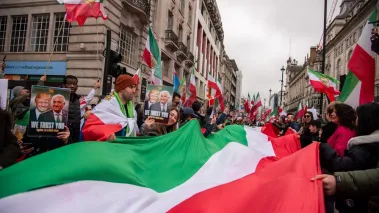
London protest in support of regime change in Iran, March 7, 2026.
“It’s like clockwork. War breaks out. Then come the calls for censorship,” my colleague Nico Perrino warned last week about calls for censorship in the U.S. amid the outbreak of war with Iran. The same goes for the rest of the world. Dubai is threatening to imprison social media users who depart from official government narratives amid Iranian drone attacks, for example. And the UK is getting into the game too.
UK Metropolitan Police said they will not allow the Al-Quds Day march in London, an annual pro-Palestinian event that has taken place for 40 years and was set up by Iran’s first Supreme Leader Ruhollah Khomeini after the Islamic revolution in 1979. Police Assistant Commissioner Ade Adelekan said the march was “uniquely contentious having originated in Iran and in London is organized by the Islamic Human Rights Commission.” The IHRC, which says the march supports “Palestinian liberation,” said it plans to challenge the ban.
Iran replaced my mother’s voice with silence
For 13 years, Faraz Harsini's mother never missed her Sunday call from Tehran. Then the regime cut the lines. Now he waits in silence.
The one-month ban on events was approved by Home Secretary Shabana Mahmood, who said, “doing so is necessary to prevent serious public disorder, due to the scale of the protest and multiple counter-protests, in the context of the ongoing conflict in the Middle East.” Mahmood added that she expects “the full force of the law applied to anyone spreading hatred and division instead of exercising their right to peaceful protest.”
It’s been over a decade since police exercised this power, which was last used in 2012 to stop marches by the right wing organization English Defence League. But in recent years, Metropolitan Police have said they are prepared to crack down on protests they consider controversial. In January, police announced a more assertive approach to protest chants police deem antisemitic, even if they don’t meet the threshold for prosecution.
Controversial speech about the war with Iran, particularly public expression of mourning for Ayatollah Ali Khamenei, is also sparking calls for censorship in UK higher education. “We condemn all extremist intimidation, harassment and incitement to hatred in our universities,” the Department for Education said in a statement. “Where public mourning involves this sort of unacceptable behaviour, it should not be tolerated. We are absolutely committed to protecting lawful free speech and academic freedom, but those freedoms do not extend to behaviour that intimidates others.”
It certainly looks like UK officials are suggesting that speech praising Khamenei, upsetting as it may be to many listeners, is intimidating conduct, rather than political speech that must be protected in a free society. That distinction between illegal conduct and controversial speech is key, but it’s one that’s failing in the UK, where social media users are regularly detained for posts that simply upset or offend others..
The Henry Jackson Society wrote last week to Mahmood and Secretary of State for Education Bridget Phillipson, calling for investigation into comments praising Khamenei and clarification on whether any action was needed under the government’s anti-extremism “Prevent” program, which in the past has already evoked concerns of academic freedom violations and allegations of chilled speech.
Indeed, the UK government announced days later forthcoming policies intended to amp up Prevent’s role in higher education. The new rules for campuses are part of a policy paper, “Protecting What Matters: Towards a more confident, cohesive, and resilient United Kingdom,” targeting factors “putting social cohesion in the UK under strain.”
The policy will apply to sectors across UK society, with a major focus on campuses. “Universities should not only be alert to violent extremism,” the government explains, “but also non-violent extremism, including certain divisive or intolerant narratives which can reasonably be linked to terrorism.”
Part of the campus policy changes will include the production of a Cohesion Charter, “which brings together a set of agreed principles that guide students’ conduct and engagement on issues that underpin — or undermine — campus cohesion,” that universities will be “strongly encouraged” to incorporate into their codes of conduct.
Iranian agents accused of attempted assassination on U.S. soil — again
Authoritarian regimes around the world are cracking down on critics while Europe, Australia promise more tech regulations.
But another will focus on universities’ duties to guide students away from terrorism under the Prevent program. Going forward, the Office for Students will publish new frameworks to monitor universities’ “efforts to prevent individuals from becoming involved in terrorism or supporting it.” For those concerned about impacts on free expression on UK campuses, it will especially be important to watch how the government does — or doesn’t — define “support.”
The Office for Students also plans to release “updated guidance” to “help universities manage external speakers and events responsibly.” If universities fail in their duties to vet speakers or events for what the government deems extremism, violent or not, they will risk sanction or derecognition.
We’ll know more details when the full guidance is released later this year and universities, of course, must be expected to act upon threats, harassment, and criminal activity.
But it’s not difficult to see how this could quickly devolve into a censorial mess, especially given that the UK government has recently suggested that peacefully holding signs is a terror offense and warned teens that sharing links they find funny may get them nabbed for terrorist content. And with the risk of sanctions on the line, universities may be inclined to censor a wide array of speech that falls under the mile-wide umbrella of “non-violent extremism, including certain divisive or intolerant narratives which can reasonably be linked to terrorism,” creating a chilling effect that extends across academia.
Recent Articles
Get the latest free speech news and analysis from FIRE.
Venezuela is a cautionary tale w/ Jim Epstein and Germania Rodriguez Poleo
Podcast
FIRE sues Los Angeles City Council over policy banning certain words during public comment

It was never just going to be about keeping kids off social media