Table of Contents
Hamit Coskun wins Quran-burning case, but threats to free expression linger in UK

Atheist and Kurdish-Armenian asylum seeker Hamit Coskun has emerged triumphant from a year-long legal battle after he burned a Quran in protest near the Turkish embassy in London last February. This is good news, especially given the rarity of positive free speech developments in the UK.
But the doggedness with which prosecutors pursued charges against Coskun, and the process he was subjected to, should alarm UK residents, whose right to blaspheme may be in as much danger as their freedom to publicly protest or their ability to post anonymously online.
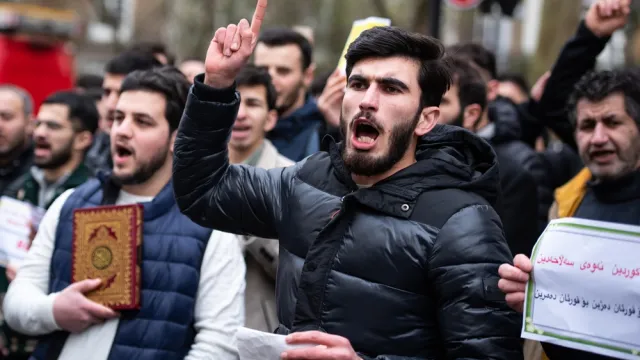
The controversy began on Feb. 13, 2025, when Coskun stood outside the Turkish Consulate in London, lit a Quran on fire, and yelled messages including “Fuck Islam” and “Islam is the religion of terrorism.” Coskun has consistently argued this was a protest against political Islam in Turkey and Turkish President Erdoğan, whose “rise to power,” Coskun says, “brought with it a new political theology.”
Coskun was soon attacked by two men including one carrying a knife, who told Coskun he was “going to kill him” and then beat and kicked him. That man later pleaded guilty and was sentenced to 20 weeks in prison and community service, but his prison sentence was suspended. Ultimately, he would serve no time for the assault.
UK citizens should remain deeply concerned about their ability to express their thoughts on important matters like religion or politics — even, or especially, in unpopular ways.
Coskun’s legal struggles, however, lasted much longer than his attacker’s did. Coskun was initially charged with “intent to cause against [the] religious institution of Islam, harassment, alarm or distress.” If you’re thinking that looks quite a bit like a blasphemy offense, you’d be right. The Crown Prosecution Service (CPS) then substituted the charge with a religiously aggravated public order offence after activists objected to the original offense.
In June, Coskun was found guilty in the Westminster Magistrates’ Court and fined £240 ($321). Incredibly, Judge John McGarva argued “That the conduct was disorderly is no better illustrated than by the fact that it led to serious public disorder involving him being assaulted by 2 different people.” In other words, being the victim of an attack was evidence of his disorderly conduct because the attack was disorderly.
In Quran burning conviction, UK judge uses violence against defendant as evidence of his guilt
UK judge cites violence against Quran-burning protester as proof of his guilt, Brazil sentences comedian to over eight years for telling jokes, and France targets porn.
Coskun successfully appealed at the Southwark Crown Court, which overturned his conviction in October. Justice Joel Bennathan refuted the previous ruling citing the attack on Coskun as evidence against him, writing that courts “should be wary of allowing the criminal reaction of one person to make a criminal of another for exercising their right to free speech.” He said further, “the right to freedom of expression, if it is a right worth having, must include the right to express views that offend, shock or disturb.” Rightfully so.
That should have been the end of the story. It wasn’t.
The Crown Prosecution Service, refusing to let the case go, challenged Coskun’s successful appeal weeks later. In a statement, CPS said: “There is no law to prosecute people for ‘blasphemy’ and burning a religious text on its own is not a criminal act. Our case remains that Hamit Coskun’s words, choice of location and burning of the Quran amounted to disorderly behaviour, and that at the time he demonstrated hostility towards a religious or racial group, which is a crime. We have appealed the decision, and the judge has agreed to state a case for the High Court to consider.”
Last week, prosecutors’ efforts to punish Coskun finally met an end. The High Court rejected that attempt, writing that the justices were “not persuaded” that the Southwark Crown Court “left any material factor out of account or relied on any immaterial factor” when overturning Coskun’s conviction. A spokesperson said CPS “will review its decision carefully.”
This is a notable win for free expression in a country where arrests for subjectively offensive speech have become alarmingly common. But UK citizens should remain deeply concerned about their ability to express their thoughts on important matters like religion or politics — even, or especially, in unpopular ways.
This chain of events, from the original charge referencing the “religious institution of Islam” to the guilty finding citing the attack against Coskun to prosecutors’ refusal to let this case drop, represent an alarming effort to enforce what certainly look like blasphemy restrictions.
This isn’t an anomaly, though. Laws and prosecutions protecting religious institutions from offence and insult should be a relic of the past but are instead still present in dozens of countries, and are experiencing a resurgence of sorts in European countries like Sweden and Denmark, with the encouragement of the United Nations Human Rights Council.
The UK appears to be heading down this path, too, giving another means of censorship to a country increasingly fond of them.
Recent Articles
Get the latest free speech news and analysis from FIRE.
Campus hecklers are silencing pro-Israel speakers. Speech codes are not the fix.

Tuskegee tells students to suit up and leave the durag at home

Student punished for ‘blasted’ comment wins court battle