Table of Contents
The crusade to ban teens from social media is advancing across Europe

Shutterstock
Free Speech Dispatch covers censorship trends and challenges around the world. If you want to know where free expression is under attack and why it matters, subscribe now to get each edition delivered to your inbox.
Free speech is in a curious place today. We’re facing challenges that, in many ways, feel fresh and new while at the same time fighting battles that feel ancient. Take two of the issues we discuss in this week’s Free Speech Dispatch: age-gating and blasphemy. While restrictions on young people’s speech is nothing new, what is new — and remarkable — is that governments in different countries now seem to be pursuing the same aggressive approach to tech regulation. On the other hand, even today the right to commit “blasphemy” is far from settled. People can still be put to death for it. Restrictions on insults to the gods may be as old as humanity itself.
EU bans loom as Australia hardens its own
You don’t need a weatherman to know which way the wind is blowing on teen social media bans. The bans are everywhere, and more are coming. European Commission President Ursula von der Leyen announced this week that the EU will seek some form of a youth social media ban across Europe.
“It is clear we need age-appropriate restrictions to platforms,” von der Leyen said. Though she did not offer exact details on what restrictions would apply to which ages, she advocated “a phased and gradual access for different age ranges.” An expert panel convened by von der Leyen pushed for policies across the EU that restrict “social media plus” — including platforms with video games and chatbots — for children under 13, but added that member states could consider applying the rules to older ages too. Irish officials, for example, have signaled their intent to move forward with an under-16 ban.
Check back for more details this autumn, when the European Commission plans to roll out its draft policy.
Over in Australia, the landmark under-16 ban has been missing the mark. It simply has not worked to keep kids off of social media. So officials are doubling down. Parliament will now consider legislation that would double the maximum fine for platforms that don’t take enough steps to keep kids offline, bringing the fine up to nearly 70 million USD.
We’ve also discussed at length the problems with the UK’s incoming under-16 ban — we know too little about how it will operate, but we do know that officials have threatened it will be more expansive and extreme than Australia’s rules. With Keir Starmer’s exit as British prime minister, Labour Member of Parliament Andy Burnham is on track to fill the role. And Burnham has confirmed that the change in leadership will not signal a change in policy.
“He knows this ban is a critical first step to keeping kids safe online and preventing further tragedies for families,” a spokesperson said. “The task now is to build on the consensus across political parties to make sure it’s enforced in full, and delivered with the urgency this issue demands.”
New ‘trusted’ media policy and more from the UK
There, as always, is more free speech news out of the UK. Last month, government officials unveiled a new “trusted” media strategy to combat disinformation. Measures under discussion include requirements that social media and video sharing platforms “make sure that news content from public service media…and other trustworthy providers, is prominent and easy to find on their platforms.” Platforms may be required to augment their algorithms to ensure government-approved sources are “more likely to be at the top of people’s social media feeds when they search for news.”
Meanwhile, Reform UK Deputy Leader Richard Tice is pushing an amendment to the Representation of the People Bill, introduced into Parliament earlier this year. The amendment would require that all election materials be in either English or Welsh — with a penalty of fines or up to six months in prison for violations.
And the UK’s track record with censorial defamation threats continues: JK Rowling, author and founder of sexual violence support center Beira’s Place, is offering to fund legal action over an Amnesty International UK report — “A Growing Threat: The Anti-Rights Movement in the UK” — that accused Beira’s Place, For Women Scotland, the LGB Alliance, and similar groups of being “anti-rights.”
Soapbox 2026
Soapbox is FIRE’s bold new conference, taking place in Philadelphia to celebrate America’s 250th anniversary with high-impact keynotes, timely panels, and unforgettable entertainment.
Amnesty quickly took down the report, saying its “use of language does not reflect the position of Amnesty International UK which is why it was promptly removed.” Rowling has not dropped the matter — her organization Beria’s place is still threatening legal action, and Rowling is encouraging others listed in the report to apply to her fund to target Amnesty UK with lawsuits over its criticism.
Hong Kong police put targets on booksellers’ backs
If Hong Kong authorities are to be believed, the city is in the midst of a dangerous crime wave — from bookshops. Independent bookshops and their employees have been the target of police raids, tax investigations, and arrests. This week, police raided two more shops, Have a Nice Stay and Greenfield Bookstore, and arrested five employees on sedition charges. The Hong Kong Free Press reports that police “found that the five had displayed and sold items carrying seditious intent” that “could stir hatred for the Hong Kong government, the Judiciary and law enforcement bodies.”
After the raid, Secretary for Security Chris Tang said he would not create a “banned books” list, as that would “let criminals off the hook.” He added that booksellers have a “responsibility” to ensure their material “won’t endanger national security,” just as restaurants have a duty not to sell poison.
Author CJ Hopkins faces prosecution, again
Readers may remember FIRE covering the case of CJ Hopkins, an American writer living in Germany, who faced prosecution for violating Germany’s law against disseminating propaganda. The charges centered on two tweets Hopkins posted that showed a swastika and medical mask on the cover art for his book, The Rise of the New Normal Reich: Consent Factory Essays, Vol. III (2020-2021). Hopkins was initially acquitted, but the prosecutor appealed the verdict and he’ll be sentenced later this year. Last November, Hopkins received yet another visit from police, who interrogated him and seized his devices. But Hopkins says that, while he waits to be sentenced in the case over the cover art for his book, he is now facing separate charges for the “authoring, publishing, and advertising” of the very same book. Hopkins says he had even cancelled the distribution of his book after his previous prosecution, but is nevertheless facing new charges.
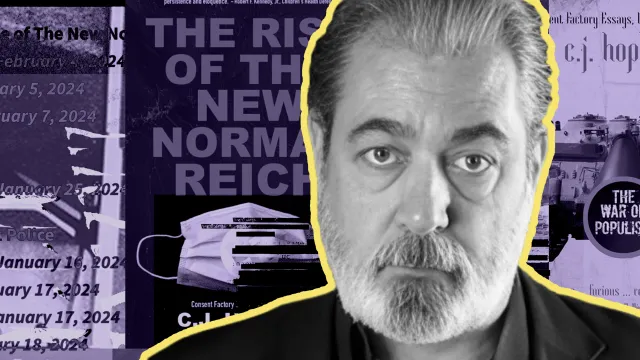
So to Speak Podcast Transcript: CJ Hopkins compared modern Germany to Nazi Germany. Now he's standing trial.
J Hopkins is an American playwright, novelist, and political satirist. He moved to Germany in 2004.
A blasphemy accusation can be a death sentence
Seven nations still keep the death penalty for blasphemy on the books, though outside of Iran actual government-run executions are rare. Mob executions, however, are a different story and simply being accused of blasphemy in Nigeria or Pakistan can result in vigilante violence. This month, an armed mob of men and even children surrounded a courthouse where a blasphemy suspect was being held and demanded they be allowed to execute the accused.
And in Pakistan, Amir Peter, a 61-year-old man awaiting trial for blasphemy, died after suffering deteriorating health in custody. A shopkeeper accused him of insulting the prophet Muhammad and Peter was held until his death, even though he suffered from advanced dementia. An investigation this month found that in Punjab, the province in which Peter was arrested, most of the blasphemy cases registered over the past five years were found to be totally fabricated by accusers who use the law to settle personal fights and disputes.
In less lethal, but still disturbing, news, Turkish authorities detained comedian Deniz Goktas upon landing in Istanbul and questioned him for “publicly insulting religious values.” Goktas’ recent set in Istanbul earned millions of views on YouTube — and apparently dozens of complaints from viewers for his jokes about religion.
Supreme EU court affirms Russian propaganda sanctions
The Court of Justice of the European Union ruled this month that EU sanctions against broadcasting or transmitting Russian state propaganda from RT or Sputnik extend to websites that are free to access and operate without a profit motive. The case centered on a German state’s 2023 prosecution and seizure of the Traugott Ickeroth blog. That year, the blog reposted three videos from RT. Reason reports that it’s a site run by reader donations where one of the bloggers “uses the ‘Traugott Ickeroth’ pseudonym to publish tracts about interdimensional aliens and the Illuminati.” The Court confirmed that German prosecutors should pursue action even against non-commercial entities that broadcast sanctioned content.
Even SpongeBob cannot evade Russia’s LGBT censorship
A highly memed clip of SpongeBob SquarePants casting a rainbow over his head looks a little different to Russian viewers. Instead, there’s just a yellow arc over his head. A likely reason? The station may very well be trying to avoid Russia’s oppressive LGBT propaganda laws, which dole out harsh penalties for symbols and material — rainbows included — deemed to be advancing sexual themes or identities banned by the state.
Recent Articles
Get the latest free speech news and analysis from FIRE.
Venezuela is a cautionary tale w/ Jim Epstein and Germania Rodriguez Poleo
Podcast
FIRE sues Los Angeles City Council over policy banning certain words during public comment

It was never just going to be about keeping kids off social media