Table of Contents
K-12 expression and the First Amendment
Research & Learn
Six Supreme Court cases have defined public school students’ First Amendment rights.

Public school students “do not shed their constitutional rights to freedom of speech or expression at the schoolhouse gate.” So said the Supreme Court in Tinker v. Des Moines (1969). Such rights must, however, be considered in the context of “the special characteristics of the school environment.” This means that while public school students possess First Amendment rights at school, school officials have greater authority to regulate student speech than the government ordinarily has with respect to the general public.
Students did not always enjoy meaningful free speech rights at school. In the early 20th century, for example, courts upheld the punishments of a student who criticized school officials over unsafe building conditions and of students who helped publish a poem poking fun at school rules. The consistent theme behind these cases was that schoolmasters possessed virtually unchecked authority over their pupils.
A Remarkable Reversal
Then, in the mid-1940s, the Supreme Court ruled in West Virginia State Board of Education v. Barnette (1943) that the First Amendment prohibited public school officials in West Virginia from punishing two elementary school girls for refusing to salute the flag and recite the Pledge of Allegiance for religious reasons. The girls were sisters and Jehovah’s Witnesses who believed that saluting the flag was akin to worshipping a graven image.
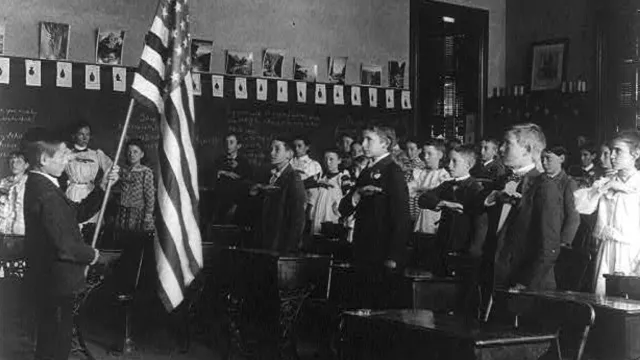
The Jehovah’s Witnesses and the First Amendment
Between 1938 and 1943, the Jehovah’s Witnesses had an astonishing 30 cases before the Supreme Court that mostly expanded First Amendment liberties. The result was a much stronger and richer jurisprudence.
In oft-celebrated language, Justice Robert Jackson wrote: “If there is any fixed star in our constitutional constellation, it is that no official, high or petty, can prescribe what shall be orthodox in politics, nationalism, religion, or other matters of opinion or force citizens to confess by word or act their faith therein.”
The Court’s decision was important in that it made clear the First Amendment protects not only the right to speak, but the right to refrain from speaking. But the decision was significant for another reason as well: It recognized that the First Amendment provides some level of protection to public school students’ First Amendment rights. The Court did not, however, develop a test to determine when students’ speech is protected and when schools may lawfully restrict it.
The Tinker Decision
The Court established that test twenty-six years later, in Tinker v. Des Moines (1969). Mary Beth Tinker, her brother John Tinker, their friend Christopher Eckhardt, and several other students wore black armbands to school to protest the Vietnam War. School officials learned of the impending protest and quickly passed a rule prohibiting armbands. The students wore the armbands anyway and faced suspensions.
After losing in the lower federal courts, the students took their case to the Supreme Court. In a 7-2 opinion authored by Justice Abe Fortas, the Court emphasized the passive, political nature of the student’s symbolic expression, describing it as “akin to pure speech.” The Court also noted that there was little to no evidence that the armbands disrupted school activities.
The Court held that school officials may censor student speech only when it substantially disrupts school activities, or officials may reasonably forecast that it will, or it invades the rights of others. And officials must support that conclusion with actual evidence. That didn’t happen in Tinker. The prohibition on the armbands violated the First Amendment because it rested on nothing more than “undifferentiated fear or apprehension of disturbance.”
School officials may regulate school-sponsored student speech, such as a school mascot or plays produced as part of the curriculum, “so long as their actions are reasonably related to legitimate pedagogical concerns.”
The most common application of the Tinker standard involves the substantial-disruption inquiry. Courts rarely invoke the “invasion of the rights of others” standard, and the Supreme Court hasn’t precisely defined its contours. But Tinker’s discussion of this standard was informed by two decisions of the U.S. Court of Appeals for the Fifth Circuit that reached opposite conclusions on significantly different facts. In one case, the Fifth Circuit held the First Amendment protected students wearing “One Man One Vote” buttons that neither disrupted class nor caused disorder. In another, the court upheld discipline of students who not only wore political buttons but accosted classmates by pinning buttons on them without their consent and disrupted class instruction. The Tinker Court drew on this distinction, demonstrating that “invasion of the rights of others” concerns behavior interfering with another student’s right to be free from targeted and extreme harassing conduct or coercion, not speech that merely causes offense or controversy.
Other Tests
In the 1980s, the Supreme Court recognized two other permissible reasons for restricting student speech. In Bethel School District v. Fraser (1986), the Court ruled 7-2 that public school officials could discipline a student for delivering a speech filled with sexual innuendo at a school assembly. Under Fraser, “school authorities acting in loco parentis” (in the place of a parent) may “protect children — especially in a captive audience — from exposure to sexually explicit, indecent, or lewd speech.”
Two years later, the Court ruled 5-3 in Hazelwood School District v. Kuhlmeier (1988) that a high school principal did not violate the First Amendment when he ordered the removal of two articles about teen pregnancy and divorce from a school newspaper produced as part of a journalism class. Three student editors challenged the principal’s actions. The Court created a new, more deferential standard that allows educators to exercise a degree of “editorial control over the style and content of student speech in school-sponsored expressive activities.” Under that standard, school officials may regulate school-sponsored student speech, such as a school mascot or plays produced as part of the curriculum, “so long as their actions are reasonably related to legitimate pedagogical concerns.”
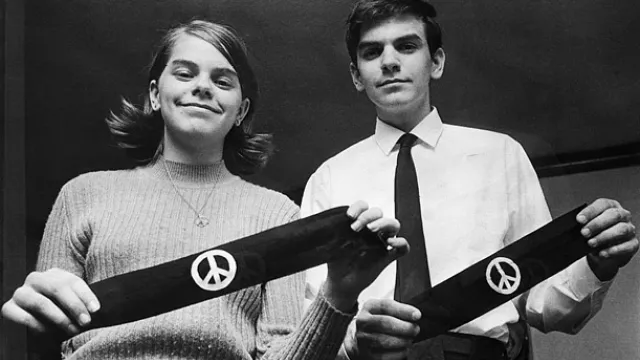
Key lessons from landmark Tinker ruling still resonate today
Even though the Court decided Tinker nearly 55 years ago, it remains the leading student K-12 decision and lower courts apply the standards from Tinker with regularity.
The Supreme Court would not hear another K–12 student speech case for about 20 years. Morse v. Frederick (2007) involved Alaska student Joseph Frederick, who, along with several friends, unfurled a large banner reading “BONG HiTS 4 JESUS” while the Olympic torch relay passed along a public street in front of his high school.
Principal Deborah Morse, who allowed students to leave class to watch the relay as part of a school-approved event, was less than pleased and ordered the students to take down the banner. All complied except Frederick, who received a 10-day suspension.
Frederick fought his suspension all the way up to the Supreme Court, which ruled 5-4 that the principal did not violate the First Amendment because schools may restrict “speech that can reasonably be regarded as encouraging illegal drug use.” Morse thus carved out another narrow exception to Tinker’s general rule that non-disruptive student speech is protected.
One thing Barnette, Tinker, Fraser, Hazelwood, and Morse have in common is they all concerned speech on school grounds or during school-supervised activities. As students increasingly communicated through social media and other online platforms outside of school, an important question remained unresolved by the Supreme Court: How far does a public school’s authority extend over off-campus speech? The Court finally gave an answer in 2021.
School discipline for off-campus K–12 student speech
When Mahanoy Area High School student Brandi Levy failed to make the school’s varsity cheerleading squad, she vented her frustration on Snapchat while at a local convenience store that weekend. Levy posted two images, including one that bore the caption, “Fuck school fuck softball fuck cheer fuck everything.” After school officials learned of the posts, they suspended Levy from the junior varsity cheerleading squad for the upcoming year.
Levy and her parents sued the school district and won, but the district appealed all the way up to the Supreme Court. In an 8-1 decision, the Court held in Mahanoy Area School District v. B.L (2021) that off-campus speech is not categorically beyond a school’s reach, but schools’ authority to regulate it is “diminished.”
Writing for the majority, Justice Breyer identified three important features of off-campus speech that distinguish it from on-campus speech and justify its heightened protection. First, a school will rarely stand “in loco parentis" when a student speaks off school grounds. Second, regulations of off-campus speech, combined with regulations of on-campus speech, “include all the speech a student utters during the full 24-hour day.” Efforts to regulate off-campus speech therefore warrant heavy skepticism “for doing so may mean the student cannot engage in that kind of speech at all.” Third, public schools have “an interest in protecting a student’s unpopular expression, especially when the expression takes place off campus,” because “America’s public schools are the nurseries of democracy.”
Applying these principles, the Court held that the school violated Levy's First Amendment rights. The Court emphasized that her posts were made on a personal device outside school hours and off school grounds, consisted of criticism that fell within the First Amendment’s ordinary protection, did not target any member of the school community, and did not cause substantial disruption within the school environment.
While Mahanoy did not fully resolve under what circumstances a “speaker’s off-campus location will make the critical difference,” it made clear that schools’ authority over student speech is at its weakest when students speak off campus.
In need of First Amendment resources for your classroom? The Foundation for Individual Rights and Expression has you covered. Our "First Things First" First Amendment textbook for college undergraduates explores the fundamentals of modern American free speech law.
Keep Reading

Free Speech in High School
Issue Pages
FIRE statement on age-based restrictions on social media access
Issue Pages

What are my rights on campus?
Issue Pages
Is hate speech legal?
Issue Pages
Related pages
- TINKER v. DES MOINES INDEPENDENT COMMUNITY SCHOOL DISTRICT
- BETHEL SCHOOL DISTRICT v. FRASER
- HAZELWOOD SCHOOL DISTRICT v. KUHLMEIER
- MORSE v. FREDERICK
- WEST VIRGINIA STATE BOARD OF EDUCATION v. BARNETTE
- MINERSVILLE SCHOOL DISTRICT, BOARD OF EDUCATION OF MINERSVILLE SCHOOL DISTRICT, et al. v. GOBITIS et al.