Table of Contents
Washington professor who parodied university 'land acknowledgment' wins $600K settlement
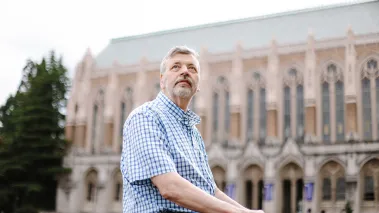
University of Washington Professor Stuart Reges
- Payment comes after federal appeals court held university violated Prof. Stuart Reges’s academic freedom rights
- Settlement includes guarantee of no further university action against Reges
SEATTLE, Sept. 3, 2026 — The University of Washington paid $600,000 after punishing Professor Stuart Reges for parodying a university-approved “land acknowledgment” in his syllabus.
The payout comes after the U.S. Court of Appeals for the Ninth Circuit held administrators liable under the First Amendment for retaliation and viewpoint discrimination.
Today’s settlement concludes the legal battle that began with a 2022 lawsuit by the Foundation for Individual Rights and Expression on Reges’s behalf. Besides the monetary settlement, the agreement stipulates that the university cannot take any further action against Reges. While Reges’s appeal was pending, UW also rescinded and replaced the vague antiharassment policy used to punish the professor for his speech.
“I am deeply grateful to FIRE for this legal victory which will remind public universities that they are obligated to respect the First Amendment rights of their students, faculty, and staff,” said Reges. “More importantly, I hope that my protest can help reverse a decade-long trend towards ideological conformity in academia and help to convince them that instead of ‘protecting’ students from controversial ideas, they should be helping them to learn how to cope with disagreement. Only then can we heal the deep divisions that confront us today.”
It has become increasingly common in academia to encourage statements that formally recognize indigenous ties to the land. In December 2021, Reges criticized land acknowledgment statements in an email to faculty, and the next month he parodied UW’s model statement in his syllabus: “I acknowledge that by the labor theory of property the Coast Salish people can claim historical ownership of almost none of the land currently occupied by the University of Washington.” Reges’s statement was a nod to John Locke’s philosophical theory that property rights are established by labor, and a response to the Computer Science department’s recommendation that professors include the UW’s model statement in their syllabi. Reges objected to the political nature of the UW’s model statement and sought to demonstrate that there are competing views on the value of land acknowledgments.
UW was not amused. University officials censored Reges’s parody statement from his syllabus and created a competing class, so students could choose not to take a computer science class from Reges. The university also initiated a nearly year-long investigation of Reges under an “antiharassment” policy.
Just before Christmas last year, the Ninth Circuit delivered a decisive victory for Reges, holding that UW officials violated the First Amendment and directing the U.S. District Court for the Western District of Washington to enter summary judgment for Reges on his retaliation and viewpoint discrimination claims, and reversing the district court’s dismissal of Reges’s challenges to the antiharassment policy.
“Reasonable people can disagree about the value of land acknowledgments,” said FIRE attorney Gabe Walters. “What’s not up for debate is academic freedom. Today’s settlement vindicates Reges’s right to express his own opinion rather than toeing the university’s line. UW learned the hard way: Ignoring the First Amendment can be costly. The livelihoods of professors shouldn’t be at the mercy of student or administrator outrage, and this ruling will help protect other professors across the country.”
Carl Marquardt of the Law Office of Carl J. Marquardt PLLC acted as local counsel for the lawsuit.
______________________________________________________________________
The Foundation for Individual Rights and Expression (FIRE) is a nonpartisan, nonprofit organization dedicated to defending and sustaining the individual rights of all Americans to free speech and free thought — the most essential qualities of liberty. FIRE recognizes that colleges and universities play a vital role in preserving free thought within a free society. To this end, we place a special emphasis on defending the individual rights of students and faculty members on our nation’s campuses, including freedom of speech, freedom of association, due process, legal equality, religious liberty, and sanctity of conscience.
CONTACT:
Katie Stalcup, Communications Campaign Manager, FIRE: 215-717-3473; media@thefire.org
Recent Articles
Get the latest free speech news and analysis from FIRE.
VICTORY: New Jersey drops complaint against school board member targeted for asking constituents about taxes

FIRE sues Los Angeles City Council over policy banning certain words during public comment

It was never just going to be about keeping kids off social media