Table of Contents
Flag on the play: First Amendment problems with NIL regulation
Shutterstock
Amuda Balu is a rising senior at the University of Texas at Austin where she studies government.
Correction: An earlier version of this essay incorrectly described the College Sports Commission as part of the NCAA. The CSC is an independent organization.
“The first thing to understand about NIL is that nobody fully understands NIL.”
That’s how college sports reporter Ross Dellenger summed up the National Collegiate Athletic Association’s decision in 2021 to let athletes benefit from their names, images, and likenesses. Since then, the NIL policy has given way to an unpredictable marketplace where athletes sign endorsement deals worth millions, the transfer portal is the most chaotic since its 2018 debut, and nearly every state plays by a rulebook of its own.
Legislatures have therefore stepped onto the field with various bills, including most recently, the Protect College Sports Act. But before Congress rewrites the playbook, any new rules must survive First Amendment review.
The NCAA’s model wasn’t always so messy. But that all changed when the Supreme Court held in NCAA v. Alston (2021) that limiting education-related compensation violated the Sherman Antitrust Act. This resulted in the patchwork landscape of compliance we see today, with the NCAA yielding to state authorities on the matter, producing uncertainty for athletes, schools, and conferences. But can these laws pass muster of the First Amendment?
NIL agreements are about more than money. They are also about expression. Student athletes earn compensation by appearing in advertisements, promoting products on social media, and publicly associating themselves with brands. These activities therefore qualify as speech, which receives First Amendment protection. Yet many of our current state and university NIL laws do not seem to withstand constitutional scrutiny. Two types of common restrictions in particular are concerning: restrictions for contracts in vice industries and those relating to institutional values.

Students in sports keep off-campus speech rights, Third Circuit rules
Students don’t lose their off-campus First Amendment rights by signing up to participate in extracurricular athletics, according to a ruling issued yesterday.
Many universities and states do not allow athletes to engage in contracts that are in vice industries such as alcohol, tobacco, or gambling. These types of restrictions are mandatory for all institutions in the state of Texas. But by restricting the brand deals they can enter, the government is directly limiting the associations that athletes are making.
The other type of restriction involves broad bans on industries that conflict with a university’s general values. But this opens the door for institutions to restrict essentially any expression they deem controversial or inappropriate. This provides universities too much judgment and does not afford enough protection under the First Amendment.
All this growing confusion has led to one point of agreement in the NIL debate: the current system has become too difficult to manage. Coaches complain that differing state laws create recruiting advantages. Universities struggle to comply with constantly changing regulations. Meanwhile, the NCAA has found itself unable to enforce its own policies. A federal framework would establish clear rules for everyone involved and deter practices that have blurred the line between legitimate endorsements, which are constitutionally protected, and pay-for-play recruiting, where athletes are compensated to attend or remain at a specific school.
While previous congressional attempts at regulating NIL have failed, the Protect College Sports Act (co-authored by Sens. Ted Cruz and Maria Cantwell) is headed to the Senate floor for a vote.
The Act includes various provisions including an antitrust exemption so that the NCAA can enforce caps on athletes’ payments and other rules relating to transfers and eligibility. The concerning aspects, however, are the limits it places on NIL.
One of these allows institutions to declare a student-athlete ineligible if they enter into an NIL agreement that violates the institution’s code of student conduct, so long as that code applies to all students. At first glance, this appears to be a sensible limitation. Rather than imposing athlete-specific speech restrictions as other state legislation, Congress attempts to place student-athletes on equal footing with the rest of the student body.
However, this merely shifts the constitutional inquiry. At public universities, student conduct codes themselves are constrained by the First Amendment. If an institution adopts vague standards prohibiting conduct that conflicts with its values, those policies may be used to deny athletic eligibility based on protected expressive activity.
The act also requires certain NIL deals to serve a “valid business purpose,” defined as a purpose genuinely related to promoting goods or services offered to the public for profit. The independent College Sports Commission, which enforces NCAA rules adopted in connection with the House settlement, has declined to clear nearly $90 million in proposed NIL deals under that and related standards.
The confusion surrounding “valid business purposes” presents a key issue: the vagueness of these standards allows governing boards to capriciously decide what is and is not a valid business purpose. While this rule was created to prevent pay-for-play practices, it undermines the First Amendment by allowing those in power to dictate what kinds of expression are “valid.”
A fragmented system of state laws has produced confusion, competitive imbalance, and First Amendment concerns across collegiate athletics. But replacing fifty different rulebooks with one federal rulebook is not enough.
Despite common assumptions, the commercial nature of these NIL agreements does not place them outside of First Amendment protection. While these deals seem solely like restrictions on conduct, they necessarily involve expression. As the Court has recognized in its campaign finance jurisprudence, spending money facilitates speech. The mere fact that athletes are compensated — and compete in collegiate rather than professional athletics — does not eliminate the First Amendment interests of their NIL activity.
Moreover, some argue that no one has a constitutional right to engage in sports. But debating whether participating in collegiate athletics is a right or a privilege misses the point. The government cannot require student athletes to forfeit their First Amendment rights simply because they choose to compete. The constitution does not stop at kickoff. Congress has an obligation to ensure that athletes’ rights are respected both on and off the field.
The broader lesson remains the same: NIL exists at the intersection of commerce and expression. Every sponsored Instagram post, commercial appearance, or brand partnership communicates a message as well as generates income. Regulations that burden those expressive activities must therefore satisfy the constitutional protections afforded by the First Amendment.
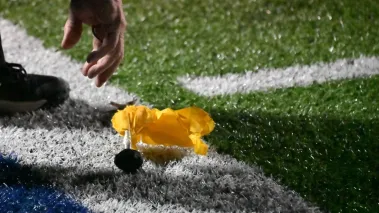
The current NIL landscape undoubtedly calls for reform. A fragmented system of state laws has produced confusion, competitive imbalance, and First Amendment concerns across collegiate athletics. But replacing fifty different rulebooks with one federal rulebook is not enough. If Congress wants to restore order to college sports, it must do so in a way that avoids committing a constitutional foul. Otherwise, the next flag may not come from the NCAA, but from the First Amendment.
Recent Articles
Get the latest free speech news and analysis from FIRE.

Venezuela is a cautionary tale w/ Jim Epstein and Germania Rodriguez Poleo
Podcast

FIRE sues Los Angeles City Council over policy banning certain words during public comment

It was never just going to be about keeping kids off social media