Table of Contents
FIRE SURVEY: Law professors report widespread self-censorship and fear of speaking freely
Shutterstock.com
PHILADELPHIA, June 9, 2026 — A new survey of law school faculty paints a bleak picture of free speech and inquiry in the legal academy, with respondents reporting self-censorship, political litmus tests, and attacks on speech from the left and right alike.
Over the course of a month and a half, the Foundation for Individual Rights and Expression surveyed thousands of faculty members at 192 of the 197 ABA-accredited law schools, seeking their perspectives on the state of free speech and discourse within their programs. Among the notable findings:
- 58% of law faculty say American legal education is heading in the wrong direction.
- 56% of law faculty reported at least occasionally feeling unable to express their opinions because of how students, colleagues, or the administration would respond. That number climbs to 72% for conservative faculty, but 50% of liberal faculty also feel the same.
- Law faculty overwhelmingly support adopting written policies protecting academic freedom (92%) and encouraging free expression (91%).
“Law schools are supposed to train the future lawyers, judges, and policymakers of America to grapple with all sides of an argument and make the strongest possible case for their position,” said FIRE Manager of Polling and Analytics Nathan Honeycutt. “When faculty report feeling unable to speak freely, it becomes harder to teach and model those critical skills for the next generation of legal professionals.”
In addition to set survey questions, FIRE also collected anonymous open-ended responses from law school faculty about the climate surrounding political hot topics. A common refrain was that threats to faculty speech come from both inside and outside the university community, and from the left and right alike. One professor from Philadelphia summed it up by lamenting both “the speech police of both the Trump administration and liberal progressive curtail[ment] of open dialogue.”
“I’m afraid both of students somehow getting offended and causing a stink, and I’m afraid of this administration seeking ‘vengeance’ if they don’t like my remarks or views,” said another professor at Georgetown Law (a school previously targeted by the Trump administration). “Seriously. I might stop teaching out of fear.”
While staring down speech threats from all directions, the responses from law faculty also suggest they believe conservatives are viewed as less welcome within their own schools. Eighty-one percent of law faculty say a liberal individual would be a positive fit in their law school, compared to only 44% who say the same for a conservative.
![How well would a [liberal / conservative] individual fit in your law school? (Bar Chart)](https://datawrapper.dwcdn.net/V0KN8/full.png)
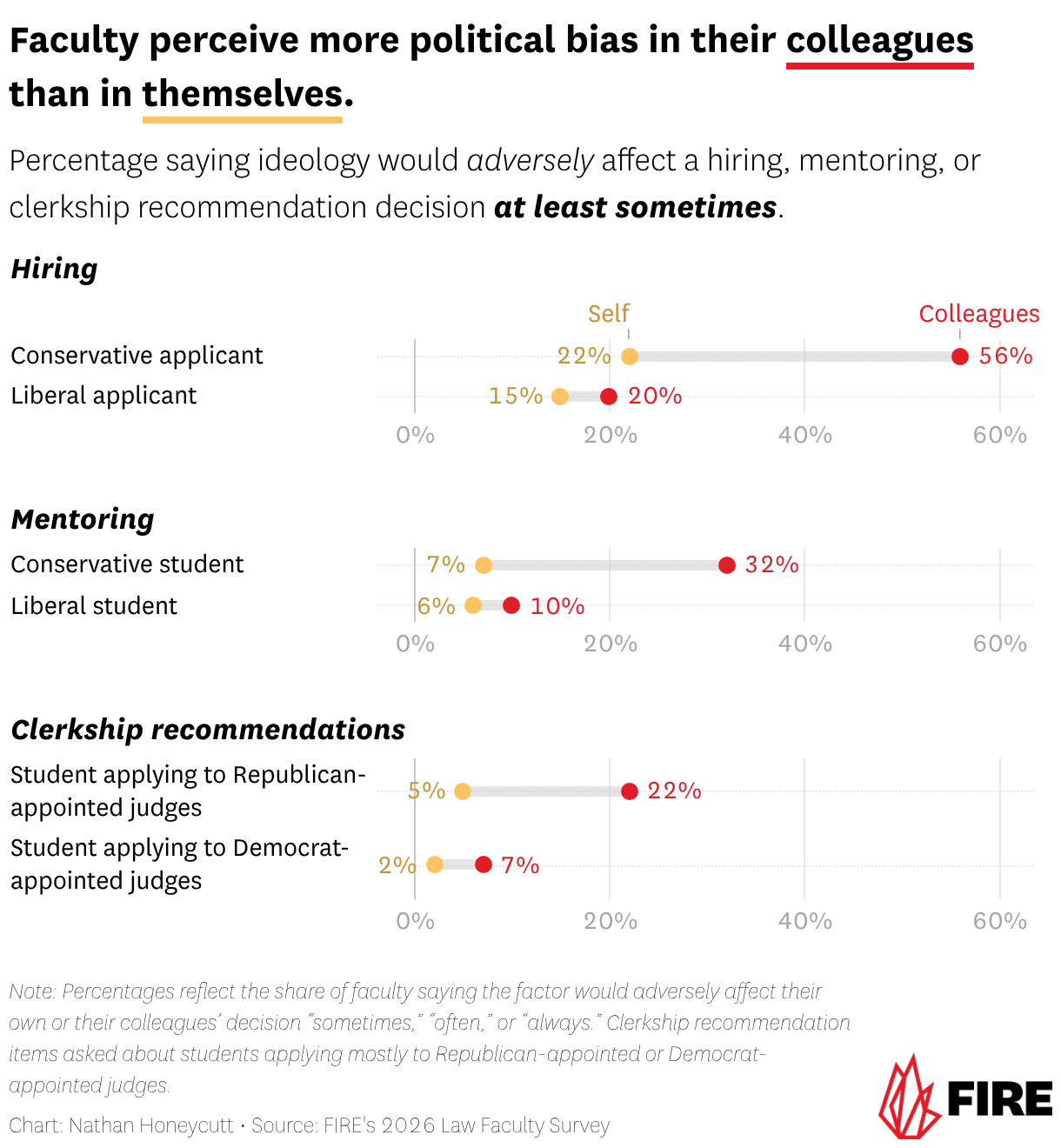
When asked whether they personally would be less likely to hire someone who was notably conservative or liberal, only 22% said they would at least “sometimes” be affected by a conservative applicant’s views and only 15% said the same of a liberal applicant. But when asked how their colleagues would act, their belief that a conservative could be negatively affected rocketed to 56%, while their belief that a liberal would be affected remained lower at 20%. A similar trend emerged when asking about mentoring students or recommending them for clerkships. Professors were confident they would not act with bias, but far less certain others would if the student was conservative.
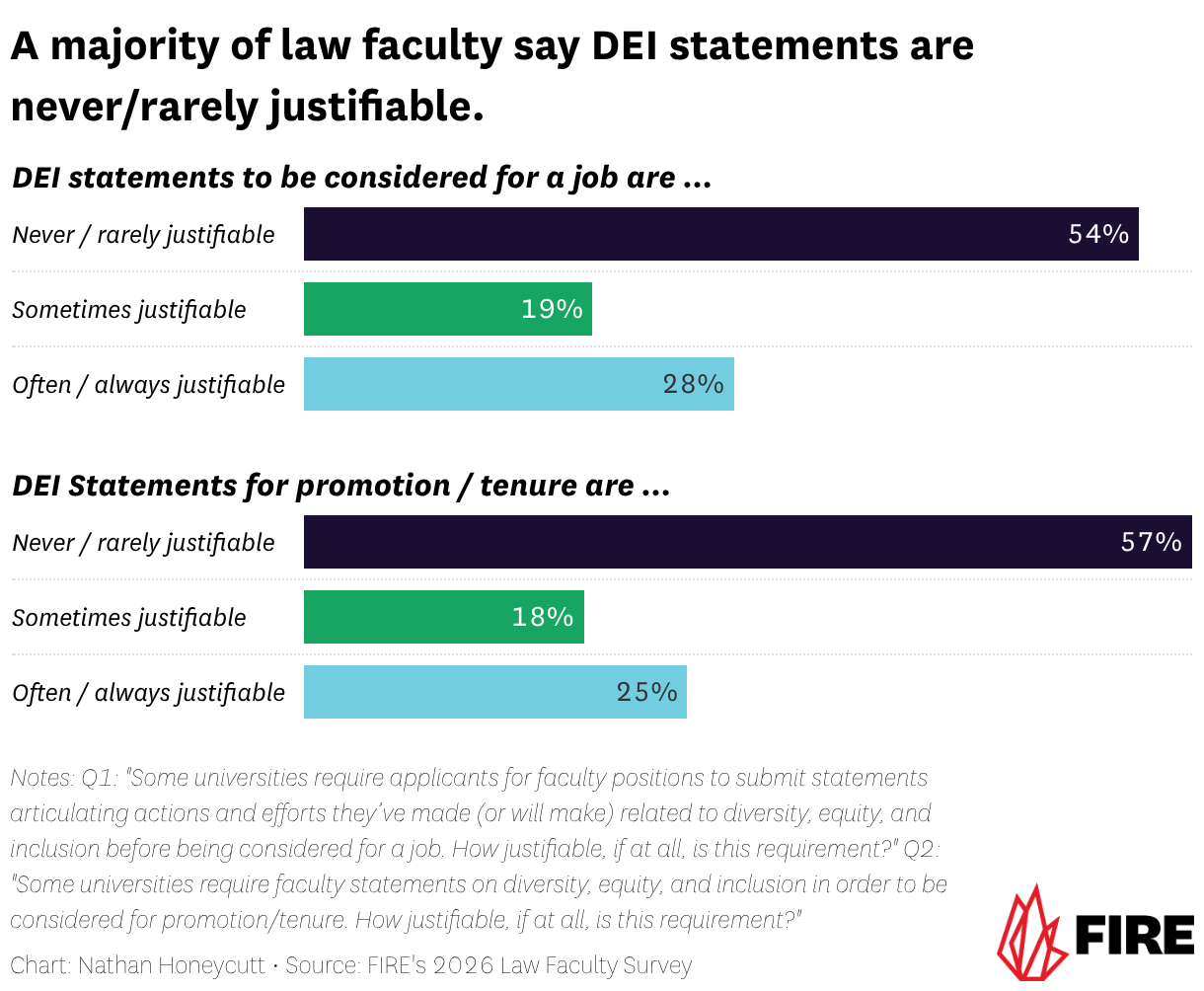
Despite the sample of liberals outnumbering conservatives 3:1, most law faculty surveyed rejected common speech restrictions implemented in the name of progressive causes. Majorities of law faculty, for example, said that the use of “diversity, equity, and inclusion” (DEI) statements are never or only rarely justified in hiring (54%) and promotion or tenure decisions (57%).
Law faculty also largely rejected the definition of harassment in the 2011 “Dear Colleague” letter issued by the Obama-era Department of Education, which substituted the Supreme Court’s definition with one that incentivized institutions to censor more speech. A clear majority of faculty said that definition of harassment was “too broad” (62%), while a majority (54%) said the Supreme Court definition “strikes an appropriate balance.”
The Foundation for Individual Rights and Expression (FIRE) is a nonpartisan, nonprofit organization dedicated to defending and sustaining the individual rights of all Americans to free speech and free thought—the most essential qualities of liberty. FIRE recognizes that colleges and universities play a vital role in preserving free thought within a free society. To this end, we place a special emphasis on defending the individual rights of students and faculty members on our nation’s campuses, including freedom of speech, freedom of association, due process, legal equality, religious liberty, and sanctity of conscience.
CONTACT:
Alex Griswold, Communications Campaign Manager, FIRE: 215-717-3473; media@fire.org
Recent Articles
Get the latest free speech news and analysis from FIRE.

Venezuela is a cautionary tale w/ Jim Epstein and Germania Rodriguez Poleo
Podcast

FIRE sues Los Angeles City Council over policy banning certain words during public comment

It was never just going to be about keeping kids off social media