Table of Contents
Free Expression in a Climate of Self-Censorship
Research & Learn
A National Survey of American Law Faculty
Executive Summary
This report presents findings from a national survey of 1,959 law school faculty at 192 American Bar Association (ABA) approved law schools in the United States, conducted by the Foundation for Individual Rights and Expression (FIRE). As one of the largest surveys of law faculty on free expression and professional norms, the data reveal a profession that strongly endorses free speech principles while struggling to live them out in practice.
Key findings include:
- A majority of law faculty say American legal education is heading in the wrong direction.
- Law faculty strongly endorse free speech in principle, but often struggle to practice it. Nearly nine in ten say offensive speech used for a pedagogical purpose deserves complete protection, yet a majority report feeling unable to express their opinions at their law school.
- Law faculty broadly reject the Obama-era Department of Education’s expansive approach to hostile-environment harassment: 62% say the guidance on what expression could be punished was too broad. By contrast, a majority (54%) say the Supreme Court’s narrower standard strikes the right balance.
- More than nine in ten law faculty surveyed support adopting written policies encouraging free expression.
- Most law faculty find required DEI statements unjustifiable as a condition of hiring or promotion.
- Most (54%) law faculty say a liberal individual would be a very positive fit in their law school, compared to 16% who say the same for a conservative.
- Law faculty are far more willing to attribute anti-conservative bias to their colleagues than to acknowledge it in themselves: 56% say colleagues would penalize a notably conservative job candidate versus 22% who admit they themselves would. The same pattern also holds for mentoring a notably conservative student: 32% versus 7%.
- Conservative law faculty experience a sharply different climate than their liberal colleagues: 61% of conservative faculty say their law school is hostile toward people with their political beliefs, compared to 11% of liberal faculty, and three times as many hide their political beliefs to keep their job (52% versus 17%).
Citation
Honeycutt, N. (2026). Free expression in a climate of self-censorship: A national survey of American law faculty. The Foundation for Individual Rights and Expression. https://www.fire.org/research-learn/free-expression-climate-self-censorship-national-survey-american-law-faculty
About FIRE
The Foundation for Individual Rights and Expression (FIRE) is a nonpartisan, nonprofit organization dedicated to defending and sustaining the individual rights of all Americans to free speech and free thought. These rights include freedom of speech, freedom of association, due process, legal equality, religious liberty, and sanctity of conscience — the most essential qualities of liberty. FIRE also recognizes that colleges and universities play a vital role in preserving free thought within a free society. To this end, we place a special emphasis on defending these rights of students and faculty members on our nation’s campuses, including the right to academic freedom for faculty.
For more information, visit fire.org or @thefireorg on X.
Acknowledgements
Thank you to Harrison Rosenthal for his substantial contributions to the creation of the questionnaire and the conceptual development of the project. Thank you as well to Nadine Strossen, Jacob Gaba, and Sheridan Macy for their thoughtful review of the questionnaire; Sean Stevens for his support of the study and editorial assistance; Adam Goldstein for his support during the early stages of conceptualizing the project; Logan Dougherty, Angela C. Erickson, Robert Shibley, Will Creeley, David Volodzko, and Alex Griswold for helpful editorial feedback; Jackson Fleagle for designing the report; Jordan Howell for designing the online version of the report; Chapin Lenthall-Cleary for data checking; Emily Nayer for reviewing short-answer responses; and the many FIRE research assistants who helped build the participant pool.
Introduction
For nearly a decade, Ken Lawson — a criminal law instructor at the University of Hawai’i — used a classroom hypothetical to teach first-year law students the concept of “transferred intent,” which is the doctrine invoked when a defendant intends to harm one person, but ends up harming another instead. To help teach the concept, Lawson included in his lecture slides photos of real colleagues — including two deans at the law school — in a hypothetical scenario in which one shoots at the other, but accidentally hits Lawson instead.
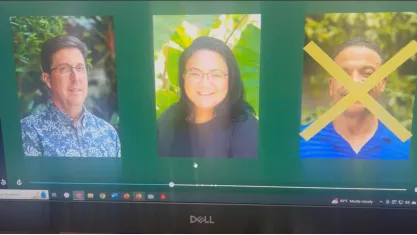
Over the years, Lawson rotated different deans and administrators into these roles, creating a kind of vivid, if slightly irreverent, scenario. This is exactly the kind of technique that law professors have long used to bring dry and abstract legal principles to life. It’s the kind of example that makes students sit up and lean forward, and what makes the topic memorable. Simply put, it’s good teaching.
But in September 2024, an anonymous student filed a complaint against Lawson,[1] calling the hypothetical example “extremely disturbing,” in part because actual shootings that had recently taken place in the U.S. and near the campus. In subsequent meetings, school administrators told Lawson his slides and hypothetical example had not violated any law or university policy, but that he had to change them anyway. When Lawson refused, the school administrators went into the school’s online curriculum system and made the changes themselves, replacing the photos of the deans with generic silhouettes. They left the photo of Lawson himself as the hypothetical shooting victim, however, untouched.
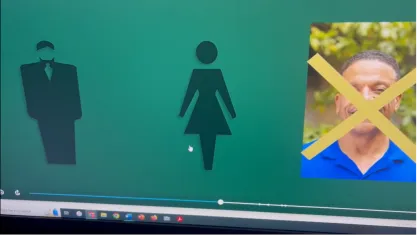
So what happened? A law instructor at a public university, well within his academic freedom rights, had some of his teaching materials rewritten by administrators because someone found them uncomfortable.
Lawson’s experience is striking, but not isolated. It reflects a pattern that some legal scholars have observed for years: a gradual narrowing in how law faculty teach, or in what some feel free to teach, with some limiting or avoiding topics they consider “too hot to handle.”[2] In a law review essay on the Socratic method,[3] which pre-dates Lawson’s experience by seven years, Harvard Law School professor Jeannie Suk Gersen pointed to something similar: colleagues quietly altering how they teach laws about rape, treating some difficult questions as requiring exceptional handling, considering trigger warnings, and avoiding or limiting course materials involving sex, violence, or race. These actions were not generally in response to formal mandates or content restrictions, but instead reflected what Suk Gersen described as a self-protective desire to avoid running afoul of hard-to-predict law student sensibilities.
This retreat is significant because legal education’s paradigmatic teaching method depends on the very discomfort some faculty are now working to avoid. The Socratic tradition, a prominent characteristic of American legal education since the 1870s, rests on the premise that productive discomfort — being called on without warning, made to defend a position one does not hold, forced to reason aloud about cases not yet mastered — is central, not incidental, to legal training.
Lawyers, judges, and citizens in a pluralistic democracy must be capable of engaging with discomfort and with difficult material. Law classrooms that cannot model that engagement, Suk Gersen argues, are poorly equipped to produce graduates (or citizens) capable of sustaining it. Yet when discomfort is treated as evidence of harm and labeled as trauma, and faculty avoid or limit difficult material, an essential element of legal training begins to erode.
Lawson’s experience demonstrates what that erosion looks like in a single classroom, occurring even where no official rule was broken. But new data suggest that the underlying conditions have taken hold across the legal academy. What Lawson encountered as a single incident, and what Suk Gersen identified as a pattern in some classes, the present survey provides evidence for at scale, pointing toward a profession whose stated commitments and actual experiences have diverged.
Free Expression and Academic Freedom in Law Schools: The Data
What law faculty believe
To better understand the climate within American law schools, and how law faculty are experiencing it, in Spring 2026 FIRE conducted a national survey, receiving responses from nearly 2,000 law faculty across 192 of the 198 ABA-approved law schools.[4] Among respondents, 57% identified as liberal leaning, 18% as conservative leaning, 16% moderate, and 10% something else (see Methods and Table 2 in the appendix for other sample demographics).
Law faculty endorsed free expression principles in striking numbers, with large proportions indicating that various types of speech should be afforded complete protection. Notably, 85% said that speech many find offensive but is used for teaching deserves complete First Amendment protection, and 89% said students should be able to express views on course material that other students find controversial.
When asked about speech that provokes anger, protest, or unrest but does not call for violence, the percentage of law faculty saying this deserves complete First Amendment protection was still a majority but dropped to 61%.
Law faculty also appear to draw a clear line between offensive expression generally, and targeted personal insults, as 25% indicated that complete protection is warranted for speech directed at a specific individual in a personally insulting or demeaning manner.

Participants were also asked whether they think it’s acceptable for law professors to use offensive language in class when it’s relevant to teaching, or to quote from judicial opinions, historical cases, or other legal materials that contain offensive language. In recent years, both practices have led to serious conflicts and professional consequences for some professors and students.
Take, for example, Rutgers University Law School. In 2021, professor Vera Bergelson and an unnamed student came under fire because the student used a racial epithet when quoting a line from a 1993 legal opinion in a New Jersey criminal case.[5] The incident led to a student-driven petition that demanded policy reform and official apologies.
The Rutgers incident was not isolated. Just months before the Rutgers incident, the University of Illinois, Chicago Law School suspended and investigated tenured professor Jason Kilborn for including redacted references to two slurs in a hypothetical scenario on an exam.[6] Ironically, after the incident he was forced to complete sensitivity training which included materials using the exact same slurs he had redacted.[7]
Notwithstanding these incidents, the survey responses indicate that the practices for which some have been punished are actually considered acceptable by majorities of law faculty. Specifically, 85% indicated they believe it is acceptable for law faculty to quote from judicial opinions, historical cases, or other legal materials that contain offensive language, and 55% indicated that they believe it is acceptable for law faculty to use offensive language in pedagogically relevant hypotheticals.
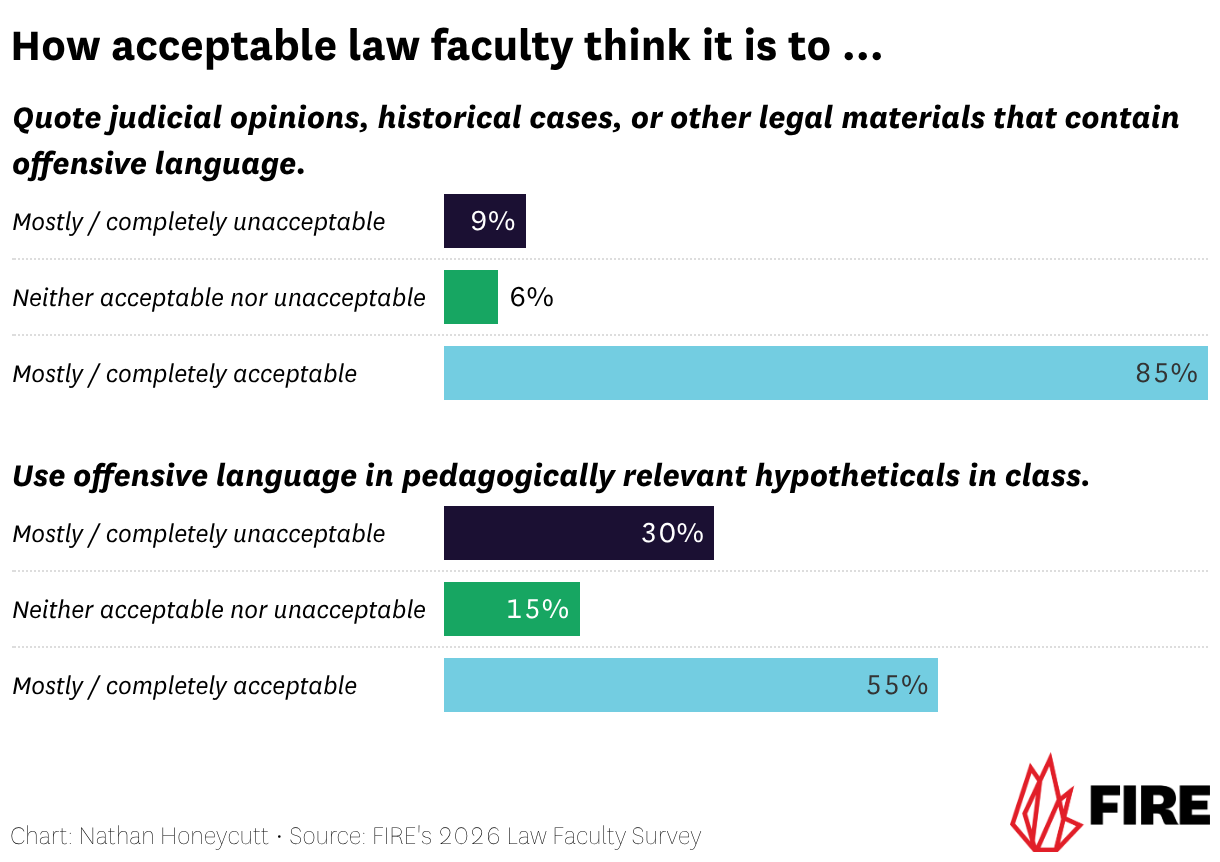
In broad strokes, these data points suggest that most law faculty accept the kind of methods Lawson used to teach transferred intent, and that Suk Gersen defended in her reflection essay. (Suk Gersen’s concern was not that any particular topic had been banned, but that professors might increasingly avoid difficult or controversial material altogether.)
These results suggest that many law professors still believe difficult or potentially even offensive material has a place in the classroom. At least in theory, there is still support for teaching sensitive topics, including using direct quotations from legal opinions. But whether professors actually feel comfortable doing so is another matter. A faculty member may believe this kind of teaching is legitimate and still hesitate to quote offensive language from a judicial opinion or raise controversial subjects in class because of possible backlash.
What law faculty experience
If law faculty strongly endorse free expression in principle, the question then becomes whether they can act on those commitments in practice. A majority say they can’t. Namely, 56% of law faculty reported that they at least occasionally feel unable to express their opinions because of how others (students, colleagues, or the administration) would respond. Similarly, one in three reported that they are at least somewhat uncomfortable discussing topics students might find offensive or controversial.

As one professor at Georgetown Law told us:
It’s very scary to be a Professor right now. I’m afraid both of students somehow getting offended and causing a stink, and I’m afraid of this Administration seeking “vengeance” if they don’t like my remarks or views. Seriously. I might stop teaching out of fear. That would be a genuine shame.
This professor isn’t alone: The fear of both giving offense and facing official retaliation are widely shared by many others in the legal academy. Across the field, 40% of law faculty say they worry about damaging their reputation because someone misunderstands something they said or did, and 20% worry about losing their job on the same grounds.

Other faculty in the survey explicitly pointed this out. One professor at a southern law school shared that:
For 28 of the 29 years I’ve taught at a law school, I’ve not been worried that my job was in jeopardy due to something I say in class in teaching my area of expertise. I can no longer say that.
Another, at the University of Oklahoma, stated that while debating sensitive topics is important, he/she would now formally decline to do so:
I have no interest in losing my job. I’m aiming to keep my head down and ride out this current administration (both nationally and university) until we get back to a place where no-one particularly cares what professors say or do.
It’s unclear what role law school administrators may be playing in either mitigating or contributing to these fears. Law faculty express general confidence in their administration’s commitment to free speech in the abstract — 76% say it is at least somewhat clear that their law school’s administration protects free speech. But this confidence narrows sharply when the question turns concrete.
Nearly half (47%) of law faculty say that if a controversy over offensive speech actually arose at their law school, it is at least somewhat likely their administration would sanction or take action against the speaker. In a striking fashion, the gap between principle and practice that characterizes law faculty responses throughout this survey extends to their reading of those running their law schools.[8]
Put bluntly by a law professor at Louisiana State University:
I walk on eggshells for fear of offending politically active students who will call the governor and demand my firing if they don’t like what I said, as happened to a tenured colleague who was suspended and will soon be fired for a joking opinion relevant to his teaching … If I could retire, I would.
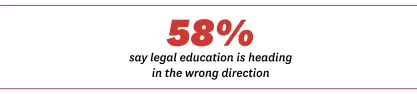
These findings sit alongside a broader judgment of the legal academy: 58% of law faculty say American legal education is heading in the wrong direction.
Among the reasons faculty offered, one recurring concern was a perceived disconnect between legal education and the realities of legal practice.
As a professor at the University of Utah summarized:
We are failing our students by treating them as if they couldn’t (or should I have to [sic]) deal with conflict. All of the special accommodations and fear of offending someone results in graduates unprepared to practice law. And it’s the fault of law schools and the education system. We need to do a better job actually preparing our students for real life.
Similarly, a law professor in Philadelphia suggested that legal education is heading in the wrong direction because of “the speech police of both the Trump Administration and liberal progressive curtail[ment] of open dialogue, funding cuts, and the corporatizing of higher education turning students into consumers of a service rather than an intellectual endeavour.”
The pressures faculty describe, in other words, do not all run in the same direction. Some come from students and internal institutional culture, while others come from political actors. What unites them is the common downstream effect: a faculty member calculating whether a comment in class, a hypothetical example when teaching, or a research question to study is worth the risk.
When considered alongside what law faculty say they believe, the combined picture is of a profession that endorses free expression in principle, but reports meaningful constraints on speech in practice. This is similar to the dynamic Suk Gersen pointed out nearly a decade ago: not necessarily formal censorship, but a subtler chill around difficult material, shaped more by anticipated social and professional costs than by explicit prohibition.
These experiential findings are one part of the story told by the survey data. The other is what law faculty, as legal experts, think about key doctrines. Specifically, how they think about the doctrines and policies that shape speech on campus.
Title IX, harassment, and where faculty draw the line
In 1999’s Davis v. Monroe County Board of Education, the Supreme Court of the United States set the bar for actionable discriminatory harassment at educational institutions receiving federal funding. Writing for a 5-4 majority, and cognizant of expressive rights, Justice Sandra Day O’Connor drew a deliberately narrow line, defining hostile environment harassment in educational settings as unwelcome conduct (which may include expression) “that is so severe, pervasive, and objectively offensive, and that so undermines and detracts from the victims’ educational experience, that the victim-students are effectively denied equal access to an institution’s resources and opportunities.”
Twelve years later, in 2011, the Obama-era Department of Education moved the line. In a “Dear Colleague” letter, ED’s Office for Civil Rights directed federally funded schools to address any “unwelcome conduct of a sexual nature,” including expression, as hostile environment sexual harassment, setting a substantially broader standard than Davis. As FIRE noted at the time,[9] this standard effectively swept vast swaths of protected expression into the category of punishable conduct.
When asked to evaluate the Supreme Court’s definition of hostile environment harassment, a majority of law faculty (54%) said they believe the court strikes an appropriate balance and is neither too narrow nor too broad. On the other hand, when asked about the Obama-era ED guidance, a majority (62%) believe this standard was too broad. These responses are striking in their convergence, particularly given the 3:1 liberal-to-conservative ratio of the respondents.

Across these two questions, evaluating first the narrower judicial standard and then the broader administrative one, the pattern is consistent: From two directions, a majority of law faculty believe that the line Davis drew is closer to where it belongs. This matters not only for the courtroom but also for the campus, and for the classroom as well, as the expansive Obama-era standards implicated the kind of pedagogically relevant offensive speech that 85% of law faculty say deserves complete First Amendment protection.
While the hostile environment harassment question asked law faculty to evaluate a specific legal line, a separate question asked them about the values that line is implicitly meant to reconcile. When asked “which (if either) is a greater priority? Promoting equality and inclusion, or protecting free expression?” almost a third (32%) said protecting free expression is a greater priority, while just 5% said promoting equality and inclusion. A clear majority (61%) said the two should not be in conflict and are both a priority. In other words, a majority of law faculty appear to reject the premise that the choice must be made.

In a similar vein, 86% of law faculty indicated that they support the position that “freedom of speech helps marginalized groups in society be heard.” This position directly cuts against the all-too-common framing of the issue that pits expression rights against the interests of marginalized communities. That is, responses to this question suggest that law faculty believe expression actively helps marginalized voices.
These findings sharpen the tension running through this report. Law faculty are not just expressing personal preferences for broader expression. Rather, as scholars of the doctrine itself, they endorse (at least in this case) a narrower legal standard for harassment and reject the framing that pits expression against equality and inclusion. Simultaneously, though, majorities report self-censoring, worrying about reputational damage, and feeling unable to speak.
DEI statements in hiring and promotion
One factor shaping the academic climate for faculty operates closer to home: the hiring and promotion processes faculty themselves administer. Among the most controversial initiatives affecting faculty hiring and promotion in recent years has been the incorporation of optional or mandatory diversity, equity, and inclusion (DEI) statements into the hiring process, and in some cases into the promotion or tenure process.
As FIRE and others have argued,[10] DEI statement requirements too easily function as ideological litmus tests that threaten employment and advancement opportunities for those who dissent from prevailing views, or are simply unorthodox. Recent experimental research bears this out: Faculty (from a national cross-disciplines sample) rated DEI statements that did not discuss race and gender lower than statements that did, and were less likely to recommend advancing the applicants that submitted them.[11]
Since 2024 the prevalence of DEI statement requirements has declined sharply,[12] and law faculty themselves appear skeptical of such statements. A majority (54%) said it is never or rarely justifiable to require applicants for faculty positions to submit a DEI statement before being considered for a job, and a larger majority (57%) say the same when the context is promotion or tenure. These numbers are consistent with those from FIRE’s 2024 faculty survey, where majorities of faculty also rejected DEI statements in hiring and promotion contexts (50% and 52% respectively).[13]
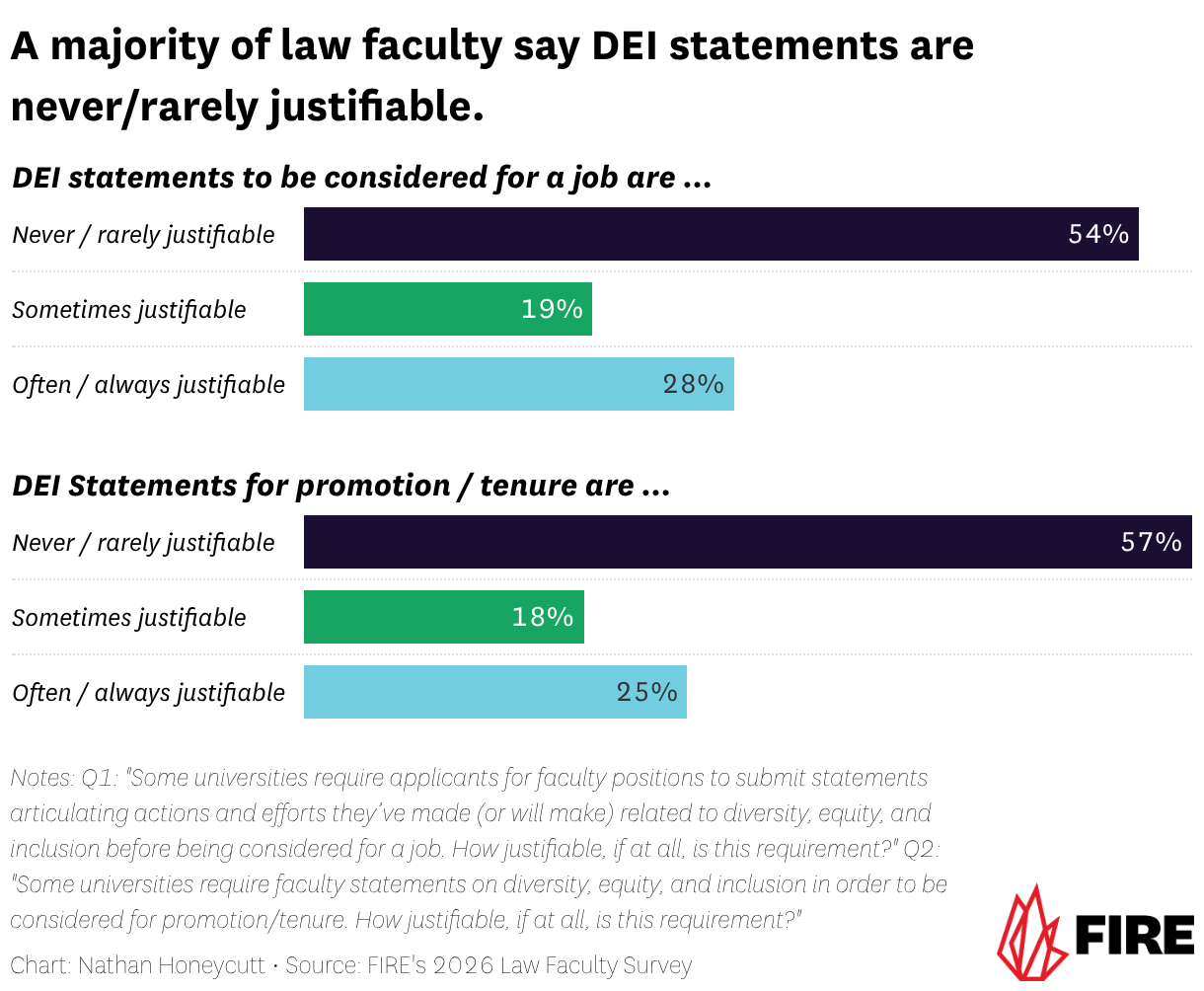
That said, sharp ideological differences emerged: A far larger percentage of conservative and moderate law faculty, compared to liberal law faculty, reported that DEI statements are rarely or never justifiable to be considered for a job. This pattern also mirrors what was found in 2024 among faculty across the academy: near unanimous conservative opposition, moderate skepticism, and a liberal cohort genuinely split on the question.[14]

Two different law schools: The political climate
The ideological gap on DEI statements stands as one visible symptom of a larger divide within law schools. Conservative-leaning law faculty (18% of respondents) are not only outnumbered by liberal-leaning law faculty (57%), but also describe a meaningfully different professional environment across nearly every measure of climate, fit, and professional treatment. In effect, conservative and liberal law faculty metaphorically inhabit two different law schools.
From the perspective of one professor at a California law school, who has taught at three different schools over the years, there appears to be a common thread:
… the trend away from political diversity is stark. When I began teaching, there were conservatives, moderates, and liberals on the faculties I worked with. Then the conservatives got harder and harder to find… And you can’t find a conservative on my faculty today.
The survey data trace the contours of what this professor describes. When asked how well a liberal individual would fit in their law school, 54% said a liberal would be a “very positive” fit. Only 4% said a liberal would be a poor fit.
For conservatives, the picture is very different: 16% of law faculty said a conservative would be a “very positive” fit. Adding in the “somewhat positive fit” responses brings the total to 44%, which is meaningful but still well below the liberal figure. Over a quarter (27%) said a conservative would be a poor fit.
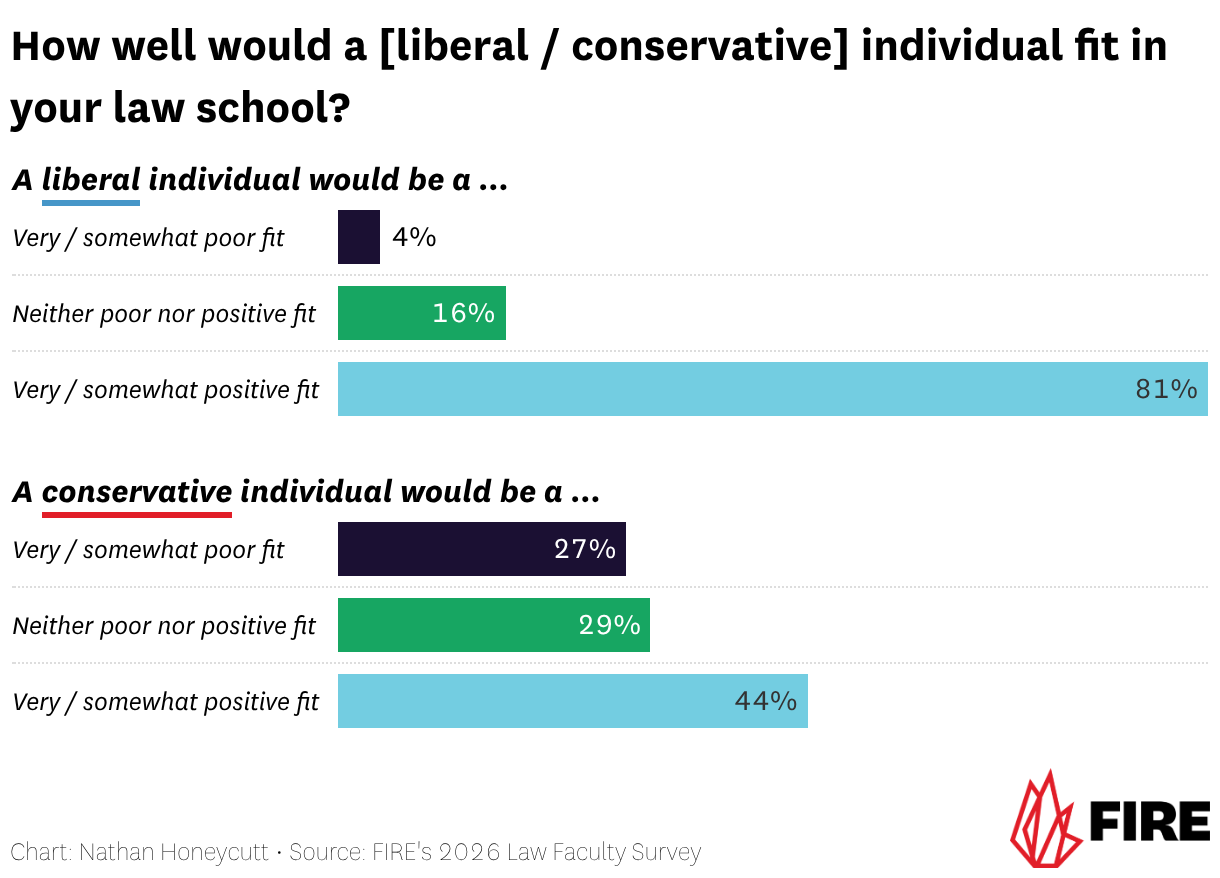
These law school numbers are better for conservatives than what was found in 2024 among faculty across the academy at large, where 20% said a conservative would be a positive fit in their department and 39% said a conservative would be a poor fit.[15] That is, law faculty appear meaningfully more open to conservative colleagues than their counterparts in other disciplines. But the gap between liberal and conservative fit remains striking. And it is important to note that in higher education, “poor fit” may often mean “not hired” or “not promoted.”
This gap also appears across faculty ideology. Among liberal, moderate, and conservative law faculty alike, a larger share say a liberal individual would be a somewhat or very positive fit in their law school than say the same of a conservative individual. Notably, even conservative faculty are more likely to say a liberal individual would be a positive fit than to say the same of a conservative individual.

Faculty were also asked directly about their willingness to discriminate against liberals or conservatives in hiring decisions, in the context of mentoring/advising students, and in the context of writing clerkship recommendations. These questions were also mirrored to ask faculty what they thought their colleagues would do in these specific situations.
The answers to these parallel questions diverge sharply, and diverge in only one direction.
For a notably conservative applicant, 22% of faculty said their own decision to hire would be adversely affected at least sometimes. When asked the same question about their colleagues, 56% said they think their colleagues’ decision to hire a notably conservative applicant would be adversely affected at least sometimes. For a notably liberal applicant, the corresponding numbers are 15% (self) and 20% (colleagues).
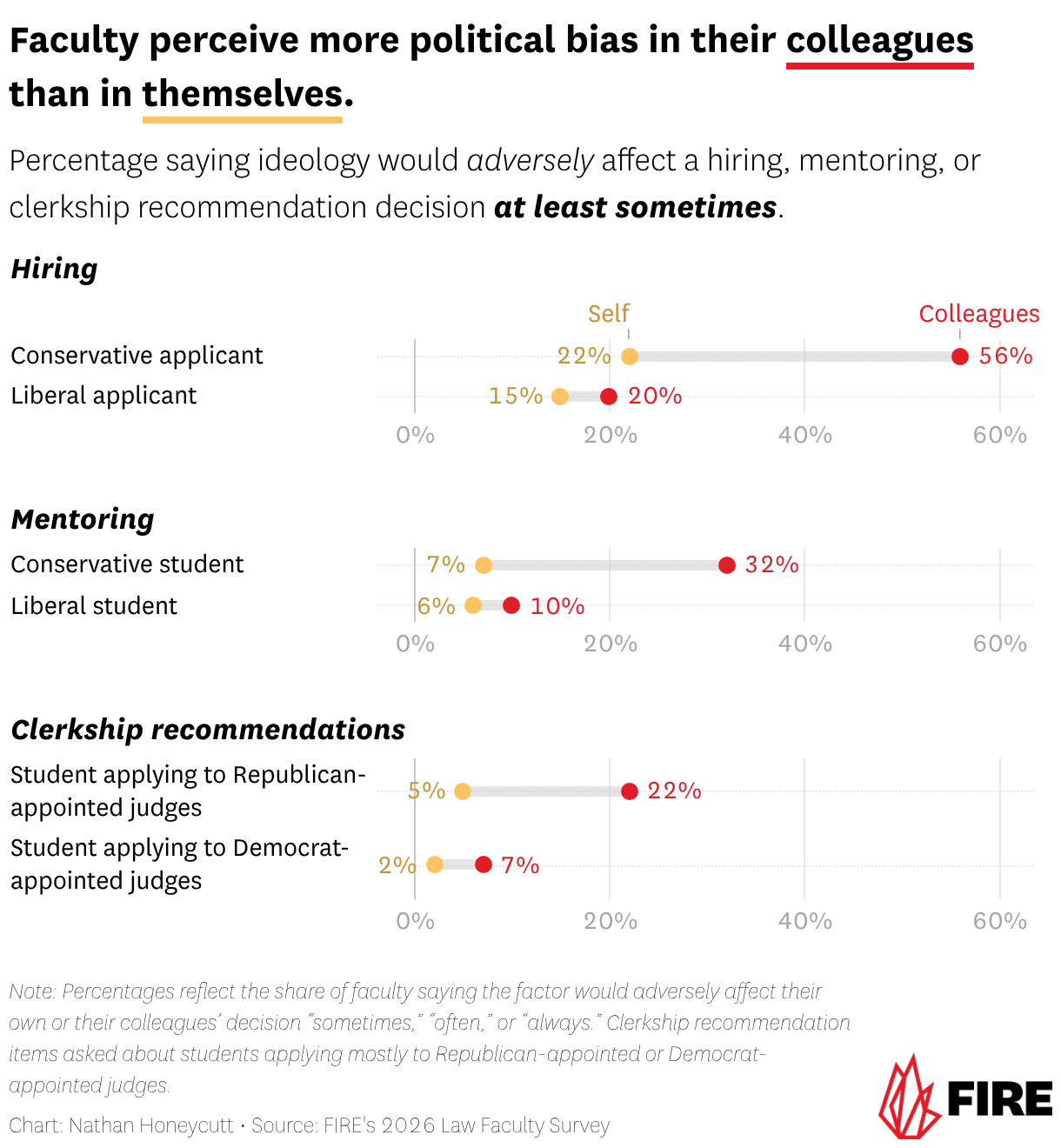
From these questions, dual asymmetries emerged. First, a greater percentage of law faculty explicitly report a willingness to discriminate in hiring decisions against conservatives than liberals, and report that it would be the same with their colleagues. They are also more willing to attribute substantial anti-conservative bias to their colleagues than they are to acknowledge it in themselves.
At least three interpretations of this gap are possible. One is that faculty may be accurately perceiving bias in their colleagues that they genuinely do not share. (This could also be an example of the “bias blind spot:” believing that other people are biased, but you’re fair and objective.)[16] A second possibility is that faculty are projecting onto colleagues what they believe about themselves but prefer not to admit. A third is more technical: The two questions are not precisely parallel. The “self” question has a denominator of one, while the “colleagues” question has a denominator of many, and a respondent may only need a few biased colleagues in mind to rate the group-level frequency as “sometimes” or “often.” And a hiring committee with one reliably biased member likely produces biased outcomes at a higher rate than any individual member’s behavior would suggest.
The data can’t distinguish between these possibilities, but the practical consequence is the same regardless. By the collective account of law faculty who participated in this survey, a notably conservative job candidate would likely have their political identity counted against them, at least some of the time.
The same pattern observed for hiring also occurs in the mentoring context for students, albeit with smaller absolute numbers. Asked whether a student being notably conservative would adversely affect a decision to mentor or advise the student, 7% of law faculty said yes, at least sometimes. Asked about their colleagues, the figure rises to 32%. For a notably liberal student, the figures are 6% (self) and 10% (colleagues).
Mentoring is, in some ways, a more revealing test than hiring. A hiring decision is collective, formal, and reviewable. A decision to take on a student as a mentee is private, informal, and largely invisible. It is also more personal. An overwhelming majority (72%) say a student being notably conservative would never adversely affect their decision to mentor or advise the student, which is noteworthy and encouraging. But the fact that nearly a third believe their colleagues would let a student’s conservatism affect a decision to mentor helps illuminate the environment conservative law students are expected to navigate. It also demonstrates that law faculty perceive a hostile climate toward certain viewpoints.
Faculty open-ended responses sketched some of what that navigation looks like in practice. As one law professor in Northern California put it:
Conservative and libertarian students do exist but are struggling. Student governments try to de-platform them by declining to recognize their clubs as registered student organizations. Left-wing peers interrupt events, destroy posters and handouts, and harass them on campus. Administrators seldom do anything to help.
The pattern seen for hiring and mentoring attenuates, but persists, in clerkship recommendations as well. Five percent of law faculty said their decision to write a clerkship recommendation would be adversely affected at least sometimes if a student were applying to mostly Republican-appointed judges, and 22% said the same of their colleagues. For students applying to mostly Democratic-appointed judges, the corresponding figures are 2% and 7%.
Clerkship letters are a downstream professional task with strong norms, such that law faculty are largely expected to write letters for qualified students. At the same time, though, a slightly higher aversion to writing letters for Republican than Democratic judges could also reflect a majority liberal law faculty simply having fewer contacts or connections with Republican-appointed judges, at least for high prestige clerkships. Either way, the directional asymmetry is the same as in hiring and mentoring: At every stage of a student’s professional progression, faculty believe their colleagues are more likely to penalize conservatives than liberals.
The cumulative effect of these dynamics starts to show up in how faculty describe the climate they work in and how they manage their own visibility. Specifically, 26% of law faculty describe the climate toward people with their political beliefs as somewhat or very hostile. But this overall number conceals a central finding on this question: among conservative law faculty, 61% describe their law school’s climate as hostile to their political beliefs, compared to 11% of liberal faculty and 32% of moderate faculty.

In a similar manner, 27% of law faculty say they hide their political beliefs from other faculty at least occasionally in an attempt to keep their job. Among conservatives, this rises to 52%, compared to 17% among liberals and 33% among moderates.

The conservative concealment figure is nearly identical to what was found in 2024 with faculty across higher education generally (55%),[17] even though previously discussed data points suggest that law faculty are meaningfully more open than the broader professoriate on questions of conservative fit.
Such patterns create an unfortunate professional environment. As a professor at the University of Florida Law School shared:
I miss being part of a faculty that had vastly different ideological beliefs but were all based upon a common understanding of the rule of law. It allowed lively, spirited discussions. We didn’t agree, but that was part of the fun. Now it feels like there is little room for ideological disagreement.
Judging from these responses, the legal academy appears to be a profession rife with internal tension. Liberal and conservative law faculty are in the same field, the same classrooms, and the same faculty meetings, but their experiences are very different depending on where they sit politically. That has consequences for what legal education can actually deliver. The Socratic tradition presupposes faculty willing to model adversarial engagement across viewpoints. When half of the conservative minority hides their political beliefs to keep their jobs, the pool of faculty available to do that modeling shrinks, and what students see narrows accordingly.
Legal education and the judiciary
The patterns documented thus far are not confined to internal law school dynamics. They also shape the relationship between law schools and the judiciary, and how faculty may teach about those on the bench. These are two distinct dimensions of legal education, and the survey speaks to both.
Law schools and the judiciary have always operated in close relationship. Law schools supply the pipeline of clerks, attorneys, and eventually judges. Judges, in turn, help shape what law schools teach, who they hire, and which graduates rise. When that relationship becomes strained, the consequences affect hiring, mentoring, and ultimately the composition of the bench.
Over the last four years, this relationship has come under visible strain, at least for some law schools with some judges. Most notably, in 2022 Judge James Ho of the U.S. Court of Appeals for the Fifth Circuit announced that he would no longer hire clerks from Yale Law School, in large part because of a number of speaker cancellations and disruptions that had occurred at the school.[18]
In subsequent years, Judge Ho, joined by Judge Elizabeth Branch of the Eleventh Circuit, expanded the boycott to include Stanford Law School after the infamous shoutdown of Judge Kyle Duncan,[19] and in 2024 eleven more judges joined with Judges Ho and Branch in a boycott of Columbia University.[20]
In the letter sent to Columbia University, the thirteen signing judges stated that “considering recent events, and absent extraordinary change, we will not hire anyone who joins the Columbia University community — whether as undergraduates or law students — beginning with the entering class of 2024.” Front and center were campus events post-October 7, which led the judges to lose confidence in Columbia, arguing that it had become an “incubator of bigotry” and thus “disqualified itself from educating the future leaders of our country.”
Judge Ho has also been vocal about his reasoning beyond formal boycott letters. Speaking at an April 2026 event, which was prompted by a recent protest and speaker disruption at the UCLA Law School, Ho argued that the problem runs deeper than any single disruption.[21] In his words, many law schools have become “incubators of intolerance,” where students are “learning all the wrong lessons” about how to engage with those with whom they disagree. He was also candid about his frustration with the unwillingness of most of his colleagues in the judiciary to join him in doing anything about it. On that point, law faculty have a clear view of their own.
In the survey, law faculty were asked whether they think it is justified for judges to not hire law clerks from schools the judge perceives to be ideologically biased.[22] A clear majority (67%; 79% among faculty at the three boycotted law schools) indicated they think it is unjustified for judges to do this, compared to 20% who believe it is justified, and 13% who think it is neither justified nor unjustified. The opposition here is revealing: those largely responsible for shaping law school culture are, by large margins, opposed to Judge Ho’s remedy.

By ideology, though, a larger share of conservative than liberal or moderate law faculty say that it is justified for judges to do this. Though even conservative law faculty are divided with nearly as many saying the practice is unjustified (42%), while clear majorities of liberal (76%) and moderate law faculty (67%) say it is unjustified.

Similarly, when asked if they think it is justified or unjustified for judges not to hire clerks from Ivy League or T14 law schools,[23] a majority (71%) indicated they think this practice is unjustified.
The boycotts are one dimension of the relationship between law schools and the judiciary. How law faculty themselves think and teach about the judiciary is another.
One of the enduring questions about the American judiciary is how much confidence we should place in judges as neutral arbiters of the law. Do judges generally apply legal principles neutrally, or are their decisions shaped by preferred substantive outcomes? Often framed as formalism versus realism, this question has shaped American jurisprudence for over a century.[24] Law faculty are in a unique position to assess what judges do in practice, as many have studied judicial decisionmaking, clerked for judges, argued before them, or know them personally.
The survey asked law faculty how they personally view judges’ decisionmaking — a question related to, but narrower than longstanding debates over formalism and realism. Their answers suggest a profession that is skeptical, but not cynical. Nearly three-quarters (71%) of law faculty indicated they personally think judges are a mix of politically motivated and politically neutral. Far fewer took either endpoint: 11% reported they think judges are politically motivated, and 17% that judges are politically neutral.

Put differently: Most law faculty do not appear to view judges as mostly neutral actors. Consistent with other recent data,[25] most law faculty indicate that they believe — at least in some circumstances — that judges don’t engage in the neutral application of legal principles to facts. That said, they also don’t fully embrace a view of judging as simply politics by another name. The dominant view is more ambivalent. These findings do not resolve where law faculty stand in debates about how judges should decide cases. But they do suggest that confidence in judges as neutral actors is limited.
In the teaching context, faculty soften this view, as the share who indicate that judges are a “mix of politically motivated and politically neutral” drops from 71% to 56% — still a majority, but a much smaller one. However, this may be because 23% indicate that in the classroom they “don’t characterize judges’ decisionmaking as either politically motivated or politically neutral.”
Either way, this too reflects another gap, mirroring the patterns documented earlier in the report. Many law faculty hold one view in private, and present what could be classified as a more cautious, moderated version to others, including students. The same dynamic that constrains speech on contested topics also may be shaping how the debate over realism and formalism is being transmitted to the next generation of lawyers.
In a number of situations this might be intentional, and for a defensible purpose. As one professor at Stanford Law shared:
Even though I can see as well as anyone else how political judicial behavior is, I worry my students will become cynical and not bother to learn legal reasoning and doctrine if they think everything is just political, so I withhold my honest assessment to encourage them to build vital skills. I also worry if I critique judicial behavior they will think I’m biased and not respect me.
This in effect extends the pattern Suk Gersen described, but with a twist. Elsewhere in this report, the gap between private views and public expression appears to be driven by concern or fear: of student complaints, administrative reprisal, or reputational damage. Here, at least for some faculty, the mechanism is different and arguably more benign. Some faculty may not be pruning discussions of the judiciary to avoid provoking students, but rather withholding an honest assessment out of a concern that students may become cynical or disillusioned. But the cumulative effect on what students hear is similar.
These dynamics sit alongside a broader finding about legal pedagogy itself. Asked whether legal education is most effective in an adversarial context (e.g., Socratic dialogue), a non-adversarial context, or “neither/don’t know,” 39% of law faculty endorsed the adversarial approach (19% said non-adversarial, and 43% said “neither/don’t know”). The pedagogy that has defined American legal education since the 1870s appears to no longer command a majority of the profession that practices it. Whether that reflects a considered turn toward blended methods or a quieter retreat from a tradition some faculty no longer feel fully free or comfortable practicing is a question this survey cannot answer. But this is consistent with the pattern documented throughout: a profession whose stated commitments and actual practices have begun to drift apart.
The ABA mandate, and a path forward
What can be done to help improve the climate for expression within American law schools? In February 2024, the American Bar Association (ABA) answered part of the question.
On Feb. 5, 2024, the ABA House of Delegates adopted Resolution 300,[26] creating Standard 208,[27] which requires all ABA-approved law schools to adopt, publish, and adhere to written policies protecting academic freedom and encouraging the free expression of ideas. This was the first ABA accreditation standard to address free speech for the entire law school community, and schools were expected to implement the standard by Summer 2025.
Standard 208 did not emerge in a vacuum. The years leading up to its adoption saw a series of widely publicized incidents, along with a related congressional inquiry,[28] that called into question whether law schools were capable of hosting the kinds of contested arguments their graduates would be expected to address in court.
In March 2022, a panel discussion at Yale Law School featuring Kristen Waggoner of the Alliance Defending Freedom was disrupted by student protestors.[29] A year later, in March 2023, students at Stanford Law School disrupted the aforementioned Federalist Society event featuring U.S. Court of Appeals Judge Kyle Duncan, and the school’s then-associate dean for DEI intervened in a manner that drew national attention and substantial criticism.[30] While Standard 208 wasn’t adopted solely because of these incidents, it sought to respond to the climate within American law schools that gave rise to such incidents occurring.
When asked about core commitments enumerated by Standard 208, law faculty were nearly unanimous in their support. Roughly 92% said they support adopting written policies protecting academic freedom, and 91% support written policies encouraging the free expression of ideas. On the substantive policy commitments Standard 208 requires, faculty have already arrived at agreement.
This near-consensus, though, has limits, as support for institutional self-commitment via policies does not translate into similar, nearly unanimous, levels of support for debates or mandated student programming. Specifically, 78% of law faculty support law school sponsored events to debate controversial ideas, and 56% support a mandatory session for law students on the importance of free speech, with 27% neutral and 18% in opposition. While faculty support Standard 208 and binding their institutions via policy, some are a bit cautious about debates and what should be required of students.
One faculty respondent, who was recently terminated after two decades as a lecturer, put the diagnosis plainly:
The big issue isn’t academic freedom, [it’s] free expression. ABA Standard 208 is a step in the right direction. There is too much self-censorship and, in my case, seriously adverse impacts for one with the courage to express their views (civilly, politely yet clearly) with colleagues in the workplace.
Thus, the endorsement from this professor comes with a warning: A written policy is only as good as the institutional culture that enforces it.
The faculty data and the ABA’s mandate point in the same direction. Standard 208 enjoys near-universal support among the faculty who have to live under it, which is exactly the form of institutional commitment that is most likely to take root. But adopting policies is relatively easy compared to sitting with discomfort in the classroom, defending a colleague whose hypothetical offended a student, and publicly debating contested issues. These, and situations like them, are the actual tests of whether the culture has changed, and they are not tests a written policy can pass on its own.
As one professor at New York University put it:
We have started to veer away from vibrant, difficult conversations toward “protecting” students from offense and in doing so we are depriving them of one of the great and distinctive benefits of legal education--the ability to engage in robust, effective analytic debate regardless of the subject matter.
That is the work Standard 208 starts, not the work it finishes.
Conclusion
Law schools occupy a unique position within American higher education, serving as the training ground for lawyers, judges, and policymakers who will interpret and defend the very constitutional rights that protect free expression. As such, if the culture within law schools discourages open debate, fails to model robust engagement with opposing viewpoints, or penalizes divergent or dissenting thought, the consequences will extend far beyond the legal academy, reaching into courtrooms, legislatures, and the broader legal profession.
The data in this report describe a profession that endorses free speech in principle, but often struggles to practice it. Law faculty endorse free expression in striking numbers, and on the substantive commitments required by Standard 208 the legal academy appears to be in broad agreement. At the same time, a majority of law faculty report at least occasionally feeling unable to express their opinion, many worry about reputational damage from being misunderstood, and a majority say American legal education is heading in the wrong direction. And when ideology is factored in, the conservative and liberal experience within law schools diverges sharply.
Return, then, to Ken Lawson: a criminal law instructor who had some of his teaching slides rewritten by administrators because a single anonymous student found a long-running hypothetical uncomfortable. He broke no law. He violated no university policy. And yet the school administrators changed the slides — without Lawson’s consent — anyway. Standard 208 was passed seven months before Lawson’s incident, and faculty support it overwhelmingly.[31] Yet he was still censored.
That is the gap this report documents, and it is the gap that policy alone can’t close. Adopting written commitments is an important and essential step that signals to members of a school or community about the values, priorities, and principles being pursued. But the essential, and more difficult, second step requires going deeper: mentoring across viewpoints, defending colleagues under fire for their views, and teaching contested issues without retreating from the discomfort that contestation produces. These are the daily practices the Socratic tradition presupposes, and they are the practices a written policy cannot perform on a faculty member’s behalf. They are also some of the practices Suk Gersen worried were quietly being abandoned. The data in this report suggest her concern was warranted.
These practices also depend on faculty who can model what they ask of students, such as taking a position, hearing it zealously advocated, and defending or revising it professionally without retreat. Such modeling is harder to perform when conservative faculty are outnumbered, and when half of them indicate they hide their political beliefs to keep their jobs, particularly in the face of a perceived hostile climate. Adversarial pedagogy across viewpoints requires courageous faculty willing to be adversaries in front of their students. But the data suggest that for a meaningful share of the law faculty, the safer choice may be to avoid this altogether. Students, then, who are watching, explicitly or implicitly learn that certain views or positions may not be acceptable.
What sustaining these practices requires, in the end, is a culture that treats disagreement as the substance of legal education rather than a threat to it. As one professor at Southern Methodist University put it: “Everyone should learn how to speak up for and defend their ideas, challenge ideas they think are wrong or misguided, and understand the civic value of debate.”
This is the culture a robust commitment to free expression calls for. Building it falls to the faculty who teach in these classrooms and mentor and advise students, the administrators who set the tone in their schools, and the students who will carry whatever they see and learn into their professional lives. The data in this report suggest that many law faculty are ready. What remains is the work of building the institutional culture that allows them to act on it.
Methodology
The FIRE Law Faculty Survey was fielded from Jan. 21 to March 10, 2026. No donors took part in any part of the project. All methods received IRB approval from the University of Arkansas Institutional Review Board prior to data collection, and the instrument was hosted on a secure Qualtrics site.
Sample
Faculty at all 197 ABA-approved law schools (as of 2025) were contacted with an invitation to participate in the survey. A national sample of 1,959 law faculty participants from 192 ABA-approved law schools participated in the survey (see Map, and Table 1). For each law school, publicly available web pages and online rosters were used to create a list of eligible faculty participants. Participants had to be clearly identified as faculty within the department. As such, graduate students and staff were not included. Those with invalid email addresses, and those who had no email address listed, were not included.

In total, 32,595 law faculty were contacted with an invitation to participate in the survey. The final sample reflects a 6.01% response rate, which is on par with other recent surveys of faculty.[32] See Table 1 for a listing of the schools represented in the survey responses.

Procedure
The author emailed participants with an invitation to participate in the study. The email was followed by a reminder email to participants who had not yet started or completed the survey. Upon opening the survey online, participants were presented with the informed consent. Upon agreeing to the informed consent, participants completed the survey.
Sample demographics
Demographic frequencies can be found in Table 2. A comparison of demographics from this report to numbers reported in 2025 as a part of the ABA Standard 509 disclosure can be found in Table 3.


Survey Items and Topline Results
Survey questions, and associated topline results, can be found in the PDF version of this report.
Notes
[1] https://www.fire.org/cases/university-hawaii-manoa-university-changes-law-professors-hypothetical-example-after-student
[2] Suk Gersen, J. (2017). The Socratic Method in the Age of Trauma. Harvard Law Review, 130(9).
[3] Ibid.
[4] Faculty at all 197 ABA-approved law schools (as of 2025) were contacted. As of 2026, there are 198 ABA-approved law schools.
[5] https://www.nytimes.com/2021/05/03/nyregion/Rutgers-law-school-n-word.html
[6] https://www.courthousenews.com/chicago-law-professor-accused-of-racism-asks-seventh-circuit-for-another-chance-to-sue-school
[7] https://www.fire.org/news/lawsuit-professor-suspended-redacted-slurs-law-school-exam-sues-university-illinois-chicago
[8] This hesitance is not unique to law schools. FIRE’s 2024 faculty survey found similar patterns across the broader professoriate, and faculty aren’t oblivious to the climate. In FIRE’s Sanctioned Scholars Survey, scholars who have been sanctioned or targeted for sanction because of their speech — including many law faculty — described the personal and professional toll of such episodes, and the near absence of public support from colleagues.
[9] https://www.fire.org/sites/default/files/pdfs/2ed5a2e9ece4ba6386cbfd3cd59a0ced.pdf
[10] https://www.fire.org/research-learn/diversity-equity-and-inclusion-criteria-faculty-hiring-and-evaluation
https://academicfreedom.org/afa-calls-for-an-end-to-required-diversity-statements/
[11] Honeycutt, N. (2026). Faculty Evaluations of DEI Statements for Academic Hiring. Retrieved from osf.io/preprints/psyarxiv/mwt5r_v2
[12] Rozado, D., Spitz Siddiqi, S., Shaw, E., & Selterman, D. (2026). Changing DEI requirements in faculty hiring: A comparative analysis between 2024 and 2025 hiring cycles. Heterodox Academy.
[13] Honeycutt, N. (2024). Silence in the Classroom: The 2024 FIRE Faculty Survey Report. The Foundation for Individual Rights and Expression. https://www.thefire.org/research-learn/silence-classroom-2024-fire-faculty-survey-report
[14] Ibid.
[15] Ibid.
[16] Pronin, E., Lin, D. Y., & Ross, L. (2002). The bias blind spot: Perceptions of bias in self versus others. Personality and Social Psychology Bulletin, 28(3), 369–381.
[17] Honeycutt, N. (2024). Silence in the Classroom: The 2024 FIRE Faculty Survey Report. The Foundation for Individual Rights and Expression. https://www.thefire.org/research-learn/silence-classroom-2024-fire-faculty-survey-report
[18] https://www.nationalreview.com/2022/09/exclusive-federal-judge-vows-to-stop-hiring-law-clerks-from-yale-law-school/
[19] https://www.fire.org/news/stanford-law-students-shout-down-5th-circuit-judge-post-mortem
[20] https://fingfx.thomsonreuters.com/gfx/legaldocs/byprkzomyve/FILE_9699%20(1).pdf
[21] https://reason.com/volokh/2026/05/08/what-can-be-done-to-stop-campus-disruptions/
[22] To note: the critique of Judge Ho and others certainly extends beyond schools being “ideologically biased,” but this was the framing used in the corresponding survey question.
[23] T14 law schools are the fourteen schools historically ranked at the top of the U.S. News law school rankings.
[24] Posner, R. A. (1998). Legal Formalism, Legal Realism, and the Interpretation of Statutes and the Constitution. In Precedents, Statutes, and Analysis of Legal Concepts. Routledge.
[25] Martínez, E., & Tobia, K. (2023). What Do Law Professors Believe about Law and the Legal Academy? (SSRN Scholarly Paper No. 4182521). https://doi.org/10.2139/ssrn.4182521
[26] https://fingfx.thomsonreuters.com/gfx/legaldocs/byprkzomyve/FILE_9699%20(1).pdf
[27] https://www.americanbar.org/content/dam/aba/administrative/legal_education_and_admissions_to_the_bar/guidance-memos/2025/25-april-standard-208-guidance-memo.pdf
[28] https://edworkforce.house.gov/uploadedfiles/ltr_to_aba_vf_new.pdf
[29] https://www.fire.org/cases/yale-law-school-protestors-substantially-disrupt-federalist-society-panel-civil-liberties
[30] https://www.fire.org/news/stanford-law-students-shout-down-5th-circuit-judge-post-mortem
[31] Standard 208 was adopted in February 2024. Implementation was not required till Summer 2025.
[32] See, e.g.:
Honeycutt, N. (2024). Silence in the Classroom: The 2024 FIRE Faculty Survey Report. The Foundation for Individual Rights and Expression. https://www.thefire.org/research-learn/silence-classroom-2024-fire-faculty-survey-report
Kaufmann, E. (2021). Academic Freedom in Crisis: Punishment, Political Discrimination, and Self-Censorship. CSPI. https://www.cspicenter.com/p/academic-freedom-in-crisis-punishment