Table of Contents
Democracy has a participation problem. AI may help solve it.
Shutterstock
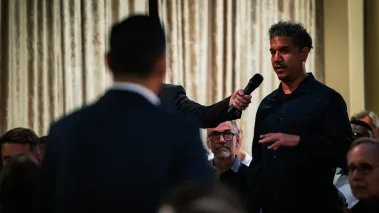
Congressman Robert Garcia answers a question from a resident during a town hall meetings in Long Beach, California, on Aug. 23, 2023.
Chloe Ratner is a political science major at Yale University. Last summer, she worked at the Department of Justice Human Rights and Special Prosecutions Section.
Most citizens don’t have the time to spend their evenings at town hall meetings, testifying before city councils, or poring over policy proposals. As a result, our democracy is often shaped by the most active voices rather than the broadest cross-section of the public. What this system lacks is not greater persuasion by people already participating, but greater civic participation by people who aren’t yet.
In the spring of 2025, Bowling Green launched “What Could BG Be?” where over 8,000 residents gathered, physically and digitally, to create a shared vision of the future for their community powered by AI tools from Jigsaw — Google’s technology incubator — paired with technology from Pol.is, a survey software tailored towards collecting group opinions. On the other side of the world, Taiwan spent nearly a decade quietly reinventing digital governance through vTaiwan, a platform that brings citizens, experts, and government ministries together to deliberate on national issues and translate ideas into tangible policies.
What has FIRE been doing in the AI space?
How did FIRE become a leading voice on AI? By defending free speech in legislatures, courts, research, and emerging technology.
But these platforms represent something larger than the mere policies they make. They ask their participants to reimagine how they engage with existing civic institutions, challenging the long-held belief that generative AI is a threat to democracy by using it as an instrument to elevate voices. While discussions about AI often focus on misinformation and transparency, these concerns miss the bigger picture. The question is no longer whether AI should shape democratic processes — it already does — but how it can be channeled to promote free speech and democracy with imperfect tools.
Generative AI has become a hot debate topic in the world of First Amendment rights and free speech. Questions about how to classify AI-generated content, what protections it does or does not deserve, and who bears liability for its outputs represent genuine legal and ethical frontiers. But amid these legal and ethical debates, a fundamental capability of AI gets lost in the noise: its ability to sort, organize, and amplify human speech rather than replace it.
AI already performs this kind of work throughout daily life, helping Spotify recommend songs, ranking Google search results, and filtering spam. Those same capabilities can organize thousands of town hall comments into coherent themes, making it possible for governments to hear from far more people than a traditional town hall ever could.
These platforms don’t replace public debate — they make much larger, and therefore more democratic, public deliberation manageable.
Some platforms, like Polis, which powers vTaiwan’s infrastructure, take it one step further and present participants with comments, such as showing previous threads of debated topics, before asking the community whether they agree with a proposal. This produces a broader sense of public sentiment that organizers can use to inform policy and prioritize resources.
But reshaping the town hall system isn’t perfect. The AI platforms powering these civic exercises do not arrive as neutral arbiters. Like all large language models, they are trained on data and shaped by the choices of the engineers who built them. In practice, these "biases" can manifest as systems that reflect the views and values embedded by their designers, such as a pronounced tendency toward politically progressive guardrails and softening of contentious language. These AI platforms also raise the question of whether participants can meaningfully challenge the model’s classifications of aggregated data. In most cases today, the answer is functionally “no.”
Consensus-building tools are, by design, optimized for agreement and AI is exceptionally good at seeking it out. And, aggregation of information is never neutral. When an AI decides which comments belong in the same cluster and which fall outside the recognized categories, it is exercising a form of editorial power. But while we may have normative critiques about these decisions, it presents a greater opportunity for expression that shapes, and should not be curbed by, government influence.
While system biases and optimization are real risks and deserve serious attention, they are also the growing pains of a technology still in its civic adolescence. Bowling Green’s town hall, for all its imperfections, produced actionable priorities that city planners are now using to launch the city’s policy planning process. The vTaiwan platform helped broker a national consensus on ride-sharing regulation that had previously been deadlocked for years and forced participants to become familiarized with viewpoints and perspectives that they may have never been exposed to before.
Artificial intelligence and freedom of speech
How should we think about speech rights in the age of artificial intelligence and advanced robotics?
At their best, these AI town halls can revive civic forums by lowering barriers to participation, making it easier for more people to engage in democratic decision-making and facilitating consensus in an increasingly polarized society. Public meetings have long suffered from low participation, and AI presents an opportunity to increase civic engagement without displacing existing avenues for public participation. The technology is deeply consonant with First Amendment values: it expands the universe of speech that reaches the negotiation table, rather than contracting it.
The experiments underway in Bowling Green and Taiwan are separated by thousands of miles and vastly different political contexts and yet they arrive at the same conclusion: the AI tools people feared would hollow out democratic life might, with intention and accountability, be the ones that restore it. But civic technology has long proved to be only as democratic as the people willing to show up for it.
Democracy will always be a work in progress. AI town halls won’t change that. But they will help more people take part in the work that remains.
Recent Articles
Get the latest free speech news and analysis from FIRE.
After a congressman challenged a student reporter’s right to record, here’s what journalists should know
Restoring Title IX kangaroo courts is no solution to the ‘Cornell 7’ sexual assault controversy

A UK teen mocked a local politician. Then the police showed up.