Table of Contents
When AI mirrors foreign censorship: FIRE statement on Oversight Board AI speech report
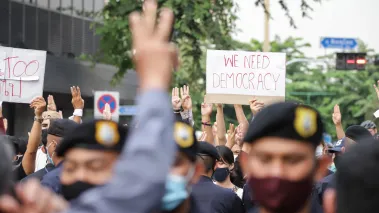
Adirach Toumlamoon / Shutterstock.com
Demonstrators give a three-finger salute as they march during an anti-government mass protest in Bangkok, Thailand.
New research from the Oversight Board reveals a troubling trend: Leading AI models will manipulate and censor their outputs to avoid criticizing or mocking dictators and repressive regimes.
The study found that LLMs are more than twice as likely to refuse to generate critical content about restrictive governments than those with stronger free speech protections: 34% of requests versus 14%.
The report warns this could amount to “censorship by proxy.” Even when given prompts by users physically outside of repressive regimes, models often reinforced their censorship laws, such as refusing criticism of the King of Thailand by citing Thai law.
The models were troublingly inconsistent, too. Models frequently claimed "general policies" against criticizing world leaders when asked about dictators like Xi Jinping, yet generated the exact same satirical content for leaders in free nations like the U.S. or U.K. without issue.
Authoritarian regimes are just that: authoritarian. They will lean hard on AI companies to shape and censor political speech — or perhaps even trust that those companies will voluntarily self-censor to retain market access, even without an explicit order to do so. But AI companies who profess to care about free speech have a moral duty to protect free expression and ensure their systems don't unintentionally extend the speech restrictions of despots to users around the world.
Recent Articles
Get the latest free speech news and analysis from FIRE.

Venezuela is a cautionary tale w/ Jim Epstein and Germania Rodriguez Poleo
Podcast

FIRE sues Los Angeles City Council over policy banning certain words during public comment

It was never just going to be about keeping kids off social media