Table of Contents
Why is the Chinese government dictating who speaks at a religious event in Texas?
Public domain
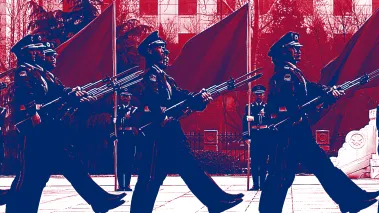
Members of a Chinese military honor guard march during a welcome ceremony for Chairman of the Joint Chiefs of Staff Marine Gen. Peter Pace at the Ministry of Defense in Beijing, China, in March 2007.
In the United States, campus speakers, online expression, blockbuster movies, and printed books are all, of course, protected by the First Amendment. But that doesn’t necessarily mean they’re protected against influence and censorship by foreign powers, particularly the Chinese government. This censorship may go under the radar for many Americans, but make no mistake: It can influence not just what you encounter in the secular world, but maybe the spiritual one, too.
A report this week from the National Catholic Register paints a disturbing picture: A U.S.-based Catholic organization chose to disinvite a speaker from its conference at the University of St. Thomas in Houston after facing direct pressure from Chinese officials. Apparently even the speaker lists at religious events in the U.S. cannot escape pressure from foreign officials who vest in themselves the authority to censor the world.
How a small Texas conference became a target
This time last year, the U.S.-China Catholic Association (USCCA) invited Purdue University professor and director of the Center on Religion and the Global East Fenggang Yang to speak at USCCA’s summer 2026 conference in Houston. Yang agreed to deliver what he called a “very non-political” speech, “Transforming Guanxi: Chinese Christian Transnational Ties and the Making of Social and Spiritual Capital.”
Yang, who was born in China, says his academic work on state regulation of religion — a long-brewing issue between the Vatican and the Chinese government — at one point was well received by Chinese officials. But, with the rise of Xi Jinping and growing repression within the country, state authorities have increasingly censored Yang’s work in the past decade. Enough so, it seems, that they sought to limit his ability to speak not just in China, but in the United States.
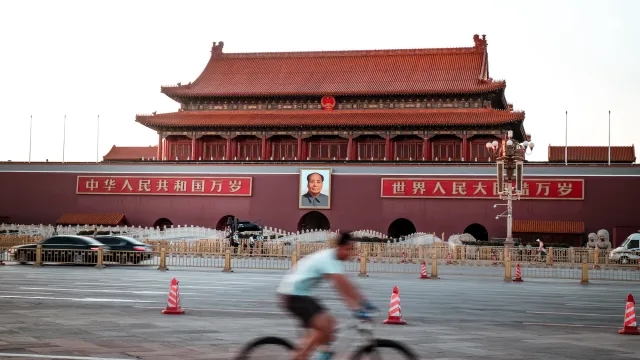
Chinese officials force censorship of Thai gallery’s art exhibit about authoritarianism (proving the exhibit’s point)
China censors Thai art show on authoritarianism, Hong Kong cites U.S. crackdowns to justify jailing Jimmy Lai, and T-shirts get people in trouble in Venezuela and Morocco
That brings us to May of this year, when chair of the USCCA board Peter Tan contacted Yang out of the blue to tell him that the two needed to talk, as Tan “just returned from China,” where he “was confronted by two government officials regarding your participation in our conference.” The two spoke over Zoom, where Tan asked Yang to step down but gave little detail.
Yang declined to self-censor, so Tan made the decision for him: To “protect the future of the USCCA,” Yang was no longer welcome to speak.
Why did a Catholic group in America assent to censorship?
Tan offered a number of reasons.
The University of St. Thomas and the Archdiocese of Galveston-Houston would “most likely ask us to cancel the conference,” Tan said, because he had to ensure that “we will not be in conflict with the Vatican’s position on the PRC or jeopardize the Vatican.” (The Register reports that, in a comment, the university said it did not make any requests regarding the conference and the archdiocese did not respond in time for publication.) Tan also worried that board members feared retaliation from Yang’s participation. “The bottom line is no one can predict what the government can and will do. There is too much risk,” Tan wrote.
In a June 29 letter, chair of the 2026 USCCA conference Father Rob Carbonneau and Tan wrote to Yang offering further explanation: Two officials from the State Administration for Religious Affairs called for Yang’s removal due to his “past public criticism of the Chinese government.”
Americans must ask themselves uncomfortable questions about what else foreign powers quietly censor on our shores without our notice.
The board deemed it necessary to “preserve the USCCA’s fragile, long-term presence and mission in China.” One board member, University of California, San Diego professor Richard Madsen, did not agree and resigned, objecting to this “violation of the freedom of speech that is essential to academic integrity.”
Yang, too, objected, including to the USCCA’s request that he keep this matter quiet. “I cannot promise to be silent about this whole thing,” Yang wrote. “The egregious violation of religious freedom and academic freedom, and your organization’s willing cooperation in it, need to be exposed.” He also called the group’s “willingness” to assist in transnational repression “disappointing and hurtful.”
In a comment to The Register, Tan said critics need to understand that his group is not a “human rights organization.”
Sometimes, it takes two to censor
“I think it really represents an escalation,” Yang told The Register about his cancellation by USCCA. “They are trying to censor me on American soil.” He’s right — and he’s not alone. As I chronicled in my book Authoritarians in the Academy, critics of the Chinese government face censorship, threats, and fear in U.S. higher education and beyond.
But that’s only half the story. The other half is those who are willing to assist with that censorship and comply with orders from officials seeking to exert power beyond their own jurisdiction. People who find themselves in that situation, where they are pressured to consent to censorship abroad on behalf of an authoritarian power, no doubt often face a difficult choice. But it is, nevertheless, a choice.
Americans must ask themselves uncomfortable questions about what else foreign powers quietly censor on our shores without our notice, and why it’s so difficult for tech companies, civil society institutions, universities, and even religious groups to clearly and resolutely say “no” to those efforts.
How can we fight for a more just and free world if we aren’t even willing to embrace, defend, and employ our own freedoms in the process?
Recent Articles
Get the latest free speech news and analysis from FIRE.
Venezuela is a cautionary tale w/ Jim Epstein and Germania Rodriguez Poleo
Podcast
FIRE sues Los Angeles City Council over policy banning certain words during public comment
It was never just going to be about keeping kids off social media