Table of Contents
In China and Hong Kong, remembrance is a crime
Free Speech Dispatch covers censorship trends and challenges around the world. If you want to know where free expression is under attack and why it matters, subscribe now to get each edition delivered to your inbox.
What’s past is prologue — and talking about it might be a crime. Many of the stories I discuss in the Free Speech Dispatch address fresh cases of censorship of speech about things that are happening now: dissenters opposing a new government policy, reporters investigating uncovered corruption, protest movements suddenly flourishing, etc. But governments are sometimes just as sensitive about the past as they are the present. Today’s edition leads off with a look at Hong Kong and China, where activists and an artist were recently prosecuted for their retrospection and discussion of China’s past — warts and all. And be warned: this repression leaks outside the borders of China and Hong Kong and into freer nations.
Tiananmen memorial activists and Mao artist convicted
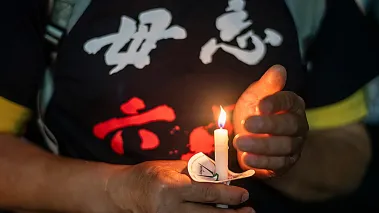
Lee Cheuk-yan and Chow Hang-tung, who led the Hong Kong Alliance in Support of Patriotic Democratic Movements of China and organized annual Tiananmen massacre memorials in Hong Kong, could now face a decade in prison. They were found guilty in court late last month and convicted under Hong Kong’s national security law. The alliance’s call to “end one-party dictatorship,” the panel of three judges asserted, constituted an attempt to unlawfully overthrow the Chinese Communist Party.
Politicians and civil society groups around the world condemned the decision, and Hong Kong authorities are now objecting to what they deem “baseless slander and smearing” from anti-China critics. “Members of the public should not be misled by the external forces’ attempts to smear, but must be able to distinguish between right and wrong, and clearly understand the difference between this case and the normal situation regarding the exercise of freedoms of association, assembly and speech,” a spokesman for the government said.
In mainland China, the situation is also grim. Gao Zhen, a Chinese artist and U.S. permanent resident, will spend three years in prison for “infringing upon the reputation of heroes.” The criminal conduct? Satirical works of art, including “Mao’s Guilt,” a sculpture of Mao Zedong kneeling in repentance. The law against insulting heroes was passed after Gao created these works. Gao’s wife had prepared his clothes, hoping and expecting that he would be released. But now she must return to the United States, and their family, alone. Comedian Guo Degang joins Gao in similar trouble. The popular comedian is facing show cancellations — and police investigation — after revising the lyrics to revolutionary song “Playing My Beloved Pipa” in a performance.
And there are, yet again, accusations that Chinese officials are attempting to chill speech outside the country, too. This summer, protesters held a vigil for Lobga Rangzen, the Tibetan activist who self immolated by the UN’s New York headquarters, outside the Chinese embassy in London. Footage from the vigil shows guards inside the embassy brandishing stun weapons — which are illegal in the UK — at protesters yelling outside the gates. Four years ago, staff at Manchester’s Chinese consulate dragged and beat a protester who held a sign mocking Xi Jinping.
It’s even in the United States. As I wrote about earlier this week, Chinese officials pressured a U.S.-based Catholic group to disinvite a speaker who studies state regulation of religion from a conference in Texas this summer. And they agreed to do so.
Will Palestine Action’s terrorist designation import UK censorship?
Last week, the Trump administration designated the UK-based Palestine Action as a terror organization, meaning it will face financial and other sanctions from the U.S. government. Reporting from The Telegraph and The Times suggests that pro-Palestine Action demonstrators who were arrested in the UK in recent months under Section 12 of the UK’s Terrorism Act 2000 — which bars expressing “opinion or belief that is supportive of a proscribed organisation” — may be denied entry to the United States. Unlike British law, the First Amendment draws a distinction between materially supporting groups proscribed by the government and simply expressing words and ideas about those groups.
If the designation of Palestine Action as a terrorist organization results in the United States denying entry to British grandmothers who were arrested for peacefully holding signs in a public park, America will be bringing the UK’s censorship onto our shores. At a time when the United States rightfully criticizes the UK for its immense failures on freedom of expression, we must reject that censorship — not import it.
New Zealand joins the social media ban campaign
Another domino threatens to fall. This time it’s in New Zealand, where Parliament is set to consider a bill forcing social media platforms to take steps to keep kids offline. The proposed ban would require platforms including Facebook and TikTok to enact measures to ensure teens under 16 are walled out or face major fines, potentially “substantially higher” than in Australia. As FIRE has explained before, Australia’s landmark ban has effectively been a failure. Not only are kids still using social media, but the tools governments have used to try to keep them out have created massive new privacy and censorship risks — including for adults.
Mexico weighs new demands on TV and radio broadcasts
A new proposal put forth by President Claudia Sheinbaum’s administration is raising fresh concerns about media censorship in Mexico. Under the proposed guidelines from the Telecommunications Regulatory Commission, TV and radio broadcasters would be required to make a number of changes to respect “audience rights.” Among those changes, which would be enforced by the commission, are that broadcasters would need to put up tags clarifying what content is news and what is opinion, the installation of ombudsmen to address audience complaints, and a guaranteed right of reply to audiences in response to coverage they deem false.
Sydney library returns ‘How to Sell a Genocide’ to shelves
A library in the same council area as Bondi Beach in Sydney took Adam Johnson’s 2026 book How to Sell a Genocide: The Media’s Complicity in the Destruction of Gaza from shelves after a survivor of last year’s Bondi Beach terror attack said the book’s presence was upsetting to victims and the bereaved. But the book is now back after the State Library of New South Wales wrote to remind Waverly Library that it can retain controversial material on its shelves. “The library acknowledges that some books and materials may not align with everyone’s personal views, experiences or beliefs, but supports the right of individuals to make their own choices about what they read, view and access,” the State Library said in a statement.
The danger of online expression in Pakistan
TikTok creator Shamso Bibi was murdered last month, shot dead by two men as she traveled in a car with her family. Bibi had 1.3 million followers on TikTok. Her family suspects she was killed by men with whom she had a financial dispute and who wanted “to silence her and take her money.” She apparently joins at least nine other women content creators killed in the past year or so in Pakistan, often by men offended at content they posted online. One man reportedly murdered four relatives for posting “indecent” on TikTok. Activists warn that the killings expose the heightened risks women in Pakistan face when using the internet to express themselves to broader audiences.
There’s another risk to online speech, too: “cyber-blasphemy.” Families of the accused are pushing the government to look into their allegations that a network is intentionally entrapping people into blasphemy cases online to extort them, given the risk of long prison sentences and even mob violence against accused blasphemers. The existence of “cyber-blasphemy” is a disturbing, if fascinating, insight into how much things change but how much they stay the same when it comes to free speech. Modern technology meets perhaps the most ancient of speech restrictions.
Tourist jailed for insulting sacred holiday in Bali
It’s an ugly reality tourists occasionally learn from time to time: Being on vacation in another country does not mean you are also on vacation from that country’s laws. Such was the case for Luzian Andrin Zgraggen, a Swiss tourist sentenced to prison late last month in Bali. Zgraggen was arrested in March after posting an Instagram video of himself using expletives to complain about Nyepi, the Day of Silence, a sacred Balinese Hindu observance during which businesses and events shut down on the island and residents usually stay at home.
Zgraggen apologized at his trial, expressing that he did not intend to insult the Balinese people, but was nevertheless sentenced to one year in prison. The presiding judge said he “offended the Balinese people, hurt their faith and provoked public outrage.”
‘Discredit’ the military, spend over a decade in prison
Russia continues to enact harsh punishments on critics of the war in Ukraine, particularly under laws banning “discrediting” or spreading misinformation about the armed forces. Last month, a Pskov court sentenced war critic and politician Lev Shlosberg to 11 years and one month in prison for comments about the war in a YouTube debate and a Telegram repost. In a separate case, his party, Yabloko, was also banned from participating in upcoming elections. “A single person is imprisoned, yet fear seeps into the hearts of millions,” Shlosberg said in closing remarks at his trial.
Europe’s top human rights court calls for political prisoner’s release
In a 15-2 ruling, the Grand Chamber of the European Court of Human Rights issued a clear statement: Activist, businessman, and philanthropist Mehmet Osman Kavala must be freed. Part of President Recep Tayyip Erdoğan’s crackdown on dissent in the aftermath of the 2016 failed coup, Kavala was first arrested by Turkish authorities in 2017, acquitted in 2020, but then prosecuted again and sentenced to life in prison. The Grand Chamber found that the Turkish government’s actions against Kavala were “predominantly motivated” by a desire to punish him “for expressing his opinions as a human-rights defender, and to silence him,” and constituted violations of the European Convention on Human Rights.
Recent Articles
Get the latest free speech news and analysis from FIRE.
Venezuela is a cautionary tale w/ Jim Epstein and Germania Rodriguez Poleo
Podcast
FIRE sues Los Angeles City Council over policy banning certain words during public comment

It was never just going to be about keeping kids off social media