Table of Contents
Is Britain bringing blasphemy laws back under another name?
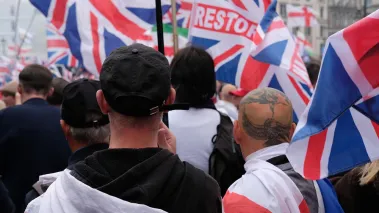
Shutterstock
Protestors hold Restore Britain and Union Jack flags in Trafalgar square at the Unite the Kingdom rally in London on May 16, 2026.
How many times can you prosecute blasphemous speech under other laws until you effectively have a blasphemy law?
This isn’t just a hypothetical. It’s a question the United Kingdom is posing again and again as police and the judiciary crack down on offensive speech about faith. In the aftermath of the Hamit Coskun saga — in which Coskun was violently attacked after burning a Quran and initially convicted by a judge who cited the attack as evidence for Coskun’s misconduct — more cases now suggest Britain has resurrected the concept of blasphemy under other names.
One such case involves retired police officer Stephen Gray, who is in the process of appealing after being found guilty of offensive communications under Section 127(1)(a) of the Communications Act 2003. Gray went on trial at Newton Aycliffe magistrates’ court earlier this year after facing charges for reposting two images on Facebook.
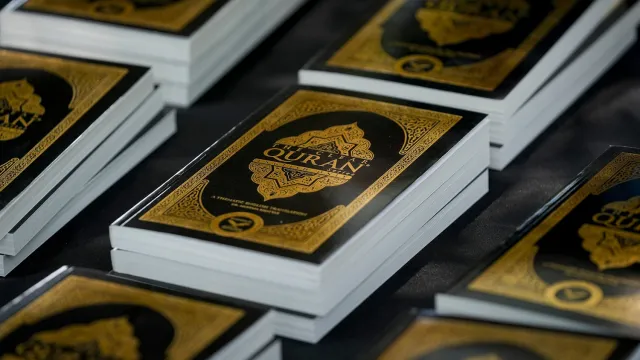
Quran burner assassinated in Sweden — and another arrested in the UK
Iraqi refugee Salwan Momika, known for his well-publicized and controversial public Quran burnings, was assassinated in Sweden.
The first showed “an image of a Middle Eastern man, who was in his late 20s or 30s, and the words ‘Children in Need,’” as well as the words “time for mass deportation” and a caption calling for donations “to help him move from a three-star to a five-star hotel.” The second meme showed bacon, a man in a turban, and the message: “Fun facts about Bacon! People who eat bacon have a lower chance of marrying a 9-year-old!”
The Telegraph reports that the complainant was Gray’s non-Muslim neighbor, with whom he had previously had an unrelated dispute.
The judge found the first image was not grossly offensive, reasoning that it dealt with a matter of public concern being debated in Parliament. But he reached the opposite conclusion about the bacon meme, saying that it concerned religion rather than politics and was grossly offensive. Gray was ordered to pay more than £1,000 in fines and costs. His appeal is scheduled for November. He fears a conviction could affect his family’s ability to foster children.
“I was initially quite worried because obviously we have to have enhanced DBS checks to foster children,” Gray told The Telegraph. “These kids have enough to put up with without the fear they may be moving again hanging over their heads.”
A second case raises similar concerns, but under a different statute. Two protesters were arrested after holding signs reading “fuck Islam” at the May 16 Unite the Kingdom rally in London, organized by activist Tommy Robinson, and are being investigated for possible offenses under the Public Order Act 1986. The Free Speech Union and Big Brother Watch have asked police and prosecutors to drop the matter.
British law doesn’t protect speech as broadly as the First Amendment does in the United States and permits investigation and prosecution based on the perceived offensiveness of speech.
That brings us back to Hamit Coskun.
As FIRE readers may remember, Coskun, a Turkish-born Kurdish-Armenian asylum seeker, burned a Quran and yelled “Fuck Islam” outside London’s Turkish consulate in 2025. A man named Moussa Kadri chased Coskun with a knife, attacked him, then kicked and spat on him. A passing delivery cyclist also stopped and kicked and spat on him. Coskun was charged with, and soon convicted, of a religiously aggravated public-order offense and fined. (Kadri was handed a suspended sentence for assault, and did not serve any time in prison.)
The trial judge’s reasoning produced one especially disturbing passage. In finding Coskun’s conduct disorderly, District Judge John McGarva cited the fact that Coskun was attacked as evidence of Coskun’s guilt, writing that his disorderly conduct was “no better illustrated” than by the fact that it led to two people assaulting him — even though the judge admitted neither attacker was justified.
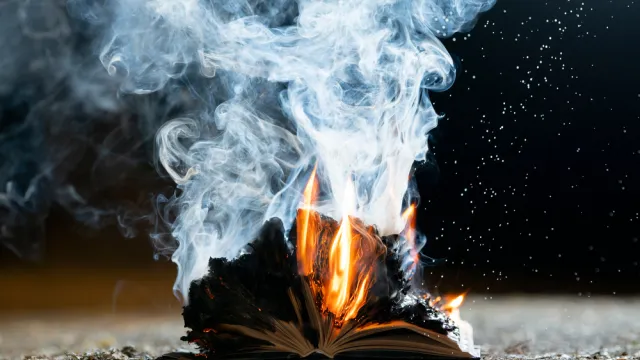
Hamit Coskun wins Quran-burning case, but threats to free expression linger in UK
Hamit Coskun beat UK prosecutors after burning a Quran in protest — but the case exposes troubling threats to free speech and blasphemy bans in Britain.
Coskun appealed. In October, Southwark Crown Court acquitted him, saying that burning a Quran may offend others, but “the right to freedom of expression, if it is a right worth having, must include the right to express views that offend, shock or disturb.” The Director of Public Prosecutions then challenged that appeal, and Coskun was forced once again to defend his case at the High Court. The court chose not to reverse the lower court’s ruling.
But the damage was done: his victory only came after arrest, prosecution, conviction, appeal, and another appeal by the state. Prosecutors, though they objected to critics’ claims of a return to blasphemy law, made clear they would vigorously pursue Coskun and similar cases of subjectively offensive speech about religion.
A destroyed Quran, “Fuck Islam,” and a meme mocking religious tenets may indeed offend some. The same would be true if you swapped out Islam, and swapped in Christianity, Judaism, or Hinduism. But free people should be able to speak critically of the religions that sometimes influence or even directly determine political policy and social power today.
Offense is simply the price we sometimes pay to live in a free society, and free societies must not allow government officials the dangerous authority of deciding when the state can limit speech about the sacred. That will not magically do away with discord and hate — but it just might create another avenue to silence dissent.
Recent Articles
Get the latest free speech news and analysis from FIRE.
Venezuela is a cautionary tale w/ Jim Epstein and Germania Rodriguez Poleo
Podcast
FIRE sues Los Angeles City Council over policy banning certain words during public comment

It was never just going to be about keeping kids off social media