Table of Contents
NY attorney general threatens to remove school board members over trans comments
Shutterstock.com
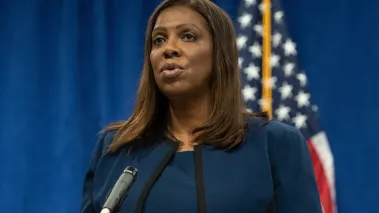
May 9, 2022 — Attorney General Letitia James makes announcement about protecting access to abortion at her office in New York City.
Jacob Roth is a third-year law student at Villanova University and a FIRE legal intern.
Last May, New York Attorney General Letitia James warned school boards across the state that when debating bathroom access or sports participation, board members can be removed if they make or even allow comments that “demean” trans students.
This is a problem. School board meetings are where the future of our children’s education is shaped. They offer a venue where the public can openly debate matters of public education, parents can stay informed and advocate for their children, and the community can offer needed feedback. Muzzling speech at these board meetings doesn’t just silence opinions; it undermines the community’s role in shaping their children’s future.
In her letter, James tells boards to shut down any such comments because “purely ideological statements opposing students’ rights under New York law are an unproductive diversion from boards’ important work,” adding that boards should “not entertain baseless allegations that transgender students’ identities and experiences are illegitimate, or that their mere presence in school spaces and participation in school activities is harmful to other students.” She also warns boards not to let speakers intentionally misgender students.
Incredibly, James not only threatens to remove board members who make such comments but also those who refuse to censor members of the public for doing likewise.
But when a school board opens the floor for public comment, the First Amendment limits its power to regulate what speakers say. A board can set reasonable ground rules, including time limits on comments and prohibitions on genuinely disruptive conduct, such as speaking out when it’s not your turn. But the government cannot restrict speech simply based on its viewpoint. If a school board member believes there’s no such thing as a “trans child,” they have every right to express that view in a meeting. If a parent thinks letting trans students play on the sports teams of their choice is harmful to other students, they can say that too.
But what isn’t allowed is viewpoint discrimination by the state. The attorney general wants to punish people for making statements she considers transphobic, but she makes no mention of trans-affirming statements. Those are apparently just fine. In other words, whether the state censors your opinion under her direction depends on what that opinion is. The First Amendment simply doesn’t work that way.
Worse still, the attorney general is placing school board members in an untenable position: either carry out her censorship demands and violate the First Amendment, or risk losing their positions.
The references to “harassment” in her letter do not fix the problem. The government cannot evade the First Amendment’s prohibition on viewpoint discrimination by simply affixing the label “harassment” to opinions it dislikes. As a legal matter, harassment generally refers to a pattern of targeted, unwelcome conduct directed at a particular individual, not the public expression of views on matters of public concern.
Even in the educational setting — which does not include a government-run public meeting — the Supreme Court has made clear that “harassment” is actionable only when it is “so severe, pervasive, and objectively offensive that it effectively bars the victim’s access to an educational opportunity or benefit.” A school board official or member of the public expressing an opinion relevant to an ongoing public debate, even in sharp or uncomfortable terms, is not harassment under any recognized legal standard. It is protected speech.
This isn’t the first time New York’s attorney general has attempted to stifle speech she doesn’t like. FIRE sued James in 2022 and secured a court order blocking enforcement of a New York law regulating online speech the state deems hateful — an order she later violated. Last month, Glenna Goldis — an attorney in the attorney general’s consumer fraud bureau — was fired after she raised concerns, in her personal capacity, about pediatric gender medicine. Nor is this the first time government officials have tried to control the terms of discussion during public comment periods. In fact, FIRE has frequently warned other government entities against imposing viewpoint-based speech restrictions at their meetings — and, when necessary, sued to vindicate censored speakers’ rights.
FIRE also has been a fierce advocate for local elected officials who face state-directed violations of their First Amendment rights. In Nazarene v. Laux, FIRE represents a New Jersey school board member facing a state ethics investigation for asking residents, via social media, their thoughts on a proposed school tax increase. The state’s School Ethics Commission has interpreted state law as preventing board members from discussing matters of public concern on social media and in op-eds. As in that case, board members in New York now face the threat of the state controlling how they communicate with constituents. That’s why parents and school board members are fighting back. The Southeastern Legal Foundation recently filed a federal lawsuit on behalf of two parent advocates and two school board members seeking to challenge James’s guidance letter, claiming a violation of their right to free speech.
The First Amendment protects the rights of parents and school board members to speak freely on educational matters at public meetings. There’s no exception for speech a state official finds offensive. The attorney general may disagree with others’ views, but as Justice Louis Brandeis famously put it, “the remedy to be applied is more speech, not enforced silence.”
Recent Articles
Get the latest free speech news and analysis from FIRE.
The new war on political satire

Hawaii is a forgotten First Amendment failure

Does MLB's Pride Night policy violate the First Amendment?