Table of Contents
New York wants warning labels on AI in the news
nwz / Shutterstock.com
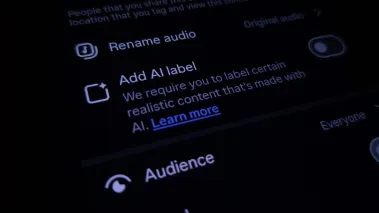
A bill pending with the New York governor would require media and digital content providers to provide warning labels on AI-assisted news content. That’s bad news for constitutionally protected speech.
Known as the the FAIR News Act, this legislation, introduced as S. 8451 and A. 8962, would require a disclaimer to share artificially generated content through a broad range of “news media” and communication channels — including newspapers, magazines, journals, periodicals, websites, newsletters, television or cable, radio or podcasts, and internet or satellite — if the content was “substantially composed, authored, or otherwise created through the use of generative artificial intelligence.”
This bill would set a terrible precedent by placing extraordinary power in the hands of the New York attorney general, who would be given the authority to enforce it. Imagine an emerging podcaster uses AI to host conversations with AI guests or a journalist covering a viral deepfake. The definition of “news media” is so broad that it could also cover newsy content on YouTube. Unless those sharing include either a verbal or written disclosure at the beginning of their work, they could be dragged into court.
What sours this proposal further is that news organizations and citizen reporters routinely investigate and criticize public officials — including attorneys general — yet this proposal would allow the same government to bring the full weight of its investigatory power against them, including the power under this bill to seek court orders restricting the distribution of news content that lacks a state-approved disclaimer. The First Amendment was precisely designed to prevent this sort of governmental control over the press.
Just as the state cannot force newspapers to publish state-approved bylines for its articles, it cannot claim greater authority over speech merely because AI was used to create content.
The bill contains an exception for the disclosure requirement if content is “eligible for copyright registration.” But the legal standard for copyrightability is not a bright line — let alone for AI-generated content. Those just seeking information about whether their content will be subject to the bill’s disclaimer requirement will be faced with an opaque, complex legal standard. Unless you have a copyright lawyer on hand, which most small news organizations and independent journalists likely don’t, many will be left guessing. Even for outlets that do have attorneys, the applicability of the bill's exception may not be resolved until a state judge decides whether the work is copyrightable.
Uncertainty carries real consequences. New York can seek to block distribution of content that they view as a violation of the bill, and speakers face penalties up to $1,000 for the first violation and up to $5,000 for any subsequent violations. What a hefty price to pay for exercising First Amendment rights.
Laws targeting the news media have long faced steep constitutional hurdles. As the Supreme Court pronounced in New York Times Co. v. Sullivan, we have “a profound national commitment to the principle that debate on public issues should be uninhibited, robust, and wide-open.” In that spirit, the Supreme Court has repeatedly recognized that the government generally may not prevent publication of information, punish the publication of lawfully obtained truthful information, or impose liability for disseminating newsworthy information of public concern.
In Miami Herald v. Tornillo, the Court held that the government may not compel a newspaper to publish content it would not otherwise print, a principle that casts doubt on laws requiring the news media to attach government-mandated disclaimers, warnings, or rebuttals to their reporting.
The quiet push to control AI speech
New federal plans to review AI models before release could blur the line between oversight and censorship.
These protections are not diminished when the media uses emerging technologies like AI. That’s because AI is an expressive tool, like the other communications technologies that have come before it, and the people who use it retain their First Amendment rights.
Newspapers — and their editorial guidelines — already tell readers who wrote a story, where information came from, and when corrections are warranted. The First Amendment leaves those editorial decisions to publishers, not to state officials. Just as the state cannot force newspapers to publish state-approved bylines for its articles, it cannot claim greater authority over speech merely because AI was used to create content.
New York's proposal would replace that judgment with a warning label regime, inviting courts and the attorney general to police how news organizations and other speakers use emerging technology. That’s not the power the First Amendment allows the government to wield.
Recent Articles
Get the latest free speech news and analysis from FIRE.
After a congressman challenged a student reporter’s right to record, here’s what journalists should know
Restoring Title IX kangaroo courts is no solution to the ‘Cornell 7’ sexual assault controversy

A UK teen mocked a local politician. Then the police showed up.