Table of Contents


LAWSUIT: Michigan State trustee challenges speech code restricting criticism of university leadership
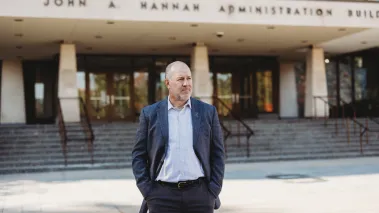
Marcie Kay Photography
Michael Balow sits on the board of trustees at Michigan State University.
EAST LANSING, Mich., Oct. 28, 2026 — A public university can’t silence the board members elected to run it.
But that’s exactly what a majority of Michigan State University’s board of trustees has done by requiring its members to promise not to publicly criticize university governance. When trustee Michael Balow refused to give up his First Amendment rights, the board imposed severe punishments that are preventing him from effectively carrying out his duties.
Today, Balow and the Foundation for Individual Rights and Expression filed a federal lawsuit challenging the unconstitutional restrictions the board’s revised ethics code imposed on Balow. The suit asks a judge to rule that the revised code violates the First Amendment and to stop its enforcement, and, in so doing, to recognize the First Amendment rights of elected trustees everywhere to share their opinions.
“Asking hard questions and demanding honest answers is the only path to solid governance,” Balow said. “Healthy friction leads to accountability and transparency that boards often talk about, but don’t always deliver. It’s not easy, but it’s necessary.”
During his candidacy, Balow vowed to increase transparency and accountability, declaring there should be “no more boardroom secrets at MSU.” His message resonated with voters. Two years into an eight-year term, Balow has publicly criticized MSU for its failure to investigate the circumstances that allowed the Larry Nassar sexual abuse scandal to occur and for withholding important documents regarding a $100 million private-equity investment in MSU’s athletics program.
COURTESY PHOTOS OF MICHAEL BALOW
But Balow’s forthrightness didn’t sit well with many of his fellow board members or MSU’s president. This spring, MSU Board Chair Brianna Scott accused him and other trustees of “undermining the president, the administration and decisions made by this board.” The board then revised its Code of Ethics and Conduct to silence dissenting trustees by forcing them to “uphold the university’s reputation” and refrain from sharing what the board majority considers “inaccurate, misleading, or false information concerning the university.” It commands that “when the board speaks through majority action, we will not undermine and will support the majority decision of the board” and requires “loyal opposition” to be raised in “appropriate settings,” generally before board action.
Under the new code, publicly praising MSU governance is fine — but criticism results in immediate censure and the loss of official privileges. That’s textbook viewpoint discrimination. And it gives the board chair the power to retaliate against virtually any speech she dislikes — all she has to do is accuse the trustee of “undermining” or being “inaccurate” or “misleading.”
“The people of Michigan elected Michael to be a watchdog, not a lapdog,” said FIRE Senior Attorney Greg Greubel. “The freedom to voice opposition strengthens the university by encouraging ideas to be challenged and solutions to be worked out.”
Balow refused to sign the new code, and the punishment was swift and severe. The board excluded him from events and pulled his credentials to a state policy conference. These sanctions have seriously hampered Balow’s ability to conduct trustee business, such as meeting with donors and school leaders.
FIRE warned MSU that the revised code was unconstitutional earlier this year, but the board declined to engage with our concerns. Today’s lawsuit filed in the US District Court for the Western District of Michigan followed. Brandon M. Grysko of Fausone & Grysko, PLC is serving as local counsel.
“I’m doing this to ensure that proper oversight of a major university can survive not only at MSU, but anywhere else free speech and independent oversight is questioned,” Balow said. “Our young men and women on campus are best served by a board that believes in free speech and puts it into action. That is the highest form of loyalty to the Michiganders who put us here to watch over this university.”
The Foundation for Individual Rights and Expression (FIRE) is a nonpartisan, nonprofit organization dedicated to defending and sustaining the individual rights of all Americans to free speech and free thought — the most essential qualities of liberty. FIRE educates Americans about the importance of these inalienable rights, promotes a culture of respect for these rights, and provides the means to preserve them.
CONTACT:
Jack Whitten, Communications Campaign Strategist, FIRE: 215-717-3473; media@fire.org
Recent Articles
Get the latest free speech news and analysis from FIRE.
Your speech, their rules: How foreign governments censor Americans

New Mexico's $25 billion verdict against Meta is fundamentally about speech

Silencing social media won't stop the unrest in France